Introduction
Welcome to the next lesson in our module on revision and diagnostics. In the last lesson, we developed a precise method for diagnosing character inconsistency by treating a character's values, fears, and misbeliefs as a "specification sheet" against which their actions could be tested. We've established how to audit for both plot logic and character logic.
Today, we address a different kind of structural weakness. A story can be perfectly logical, with every event caused by a previous one and every character acting consistently, yet still fail if it is bloated with scenes that serve no real function. Your learning outcome for this lesson is to diagnose scenes without purpose by confirming each one either advances plot or develops character.
From a computer science perspective, this is analogous to identifying and removing "dead code"—functions or modules that are syntactically correct and might even run, but whose results are never used and which have no effect on the program's final output. These purposeless scenes consume narrative space and reader attention, diluting the story's impact. Our goal is to develop a systematic process to detect and eliminate them.
1. The Two Core Functions of a Scene
Before we can diagnose a scene as "purposeless," we must have a technical definition of "purpose." In storytelling, a scene is a fundamental unit of narrative construction. For a scene to justify its existence, it must perform at least one of two core functions, and ideally both:
- Advance the Plot: The scene must cause a meaningful change in the story's overall state. Information is revealed, a plan succeeds or fails, a physical chase occurs, an advantage is gained or lost. The causal chain of the story moves forward because this scene happened.
- Develop Character: The scene must cause a meaningful change in the reader's understanding of a character, or in the character themselves. Their worldview is challenged, their values are tested, a new motivation is revealed, or they make a decision that reflects internal growth or decline.
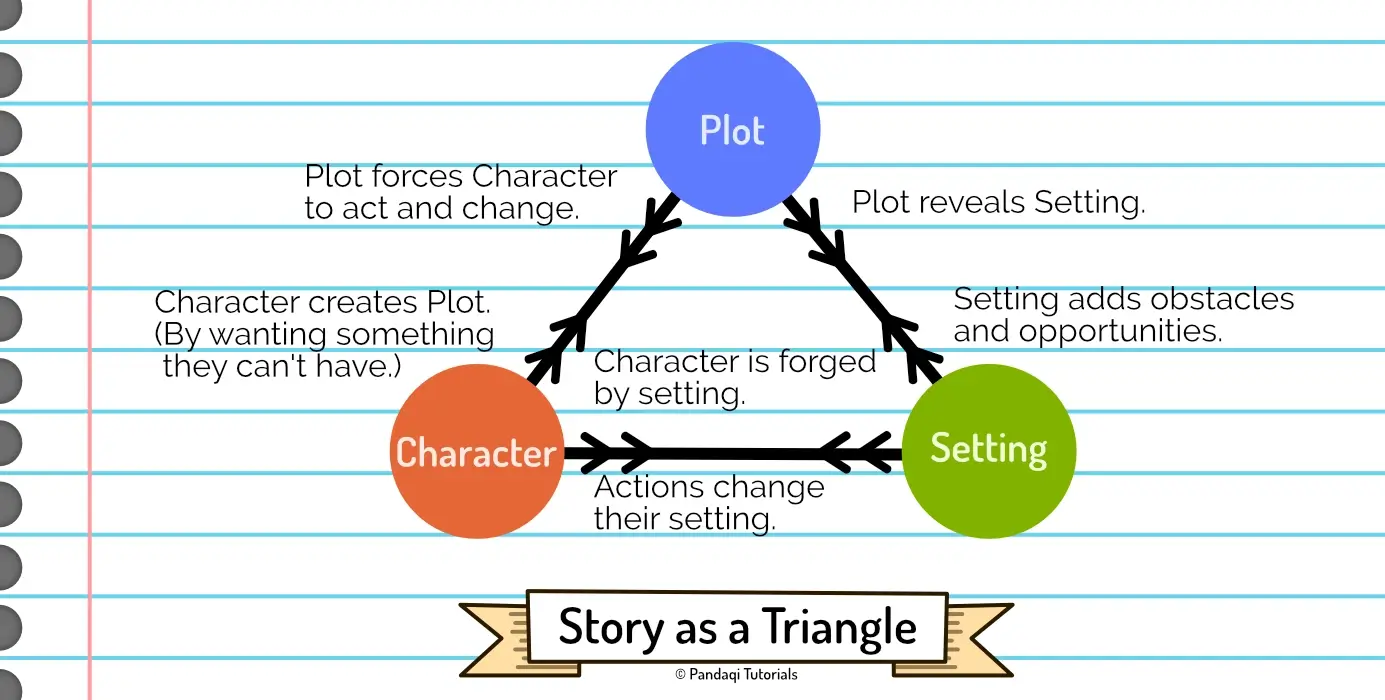
The most effective scenes are "multitasking," performing several functions at once. To learn how to spot these powerful scenes versus "lazy" ones, watch the following segment.
Stop Writing Boring Scenes -- Use this Secret 9-Step Formula
The video 'Stop Writing Boring Scenes' by the Bookfox channel makes a crucial point about scenes needing to do more than one thing. This concept is central to identifying scenes that aren't pulling their weight.
Watch from 03:20 to 04:35. Pay close attention to the idea of a scene 'pulling its weight' and the exercise of listing everything a scene from a favorite book accomplishes. This highlights the functional density of a well-crafted scene.
2. A Structural Test for Scene Purpose
Your preference for systematic approaches gives us a powerful diagnostic tool. We can analyze a scene's internal structure to determine if it's engineered for purpose. The following article presents a robust binary model for functional scenes.
The article 'Writing The Perfect Scene' by Randy Ingermanson presents a highly structured, mechanical view of scenes. This will provide our primary diagnostic framework.
Read the section titled 'Large-Scale Structure of a Scene.' Focus on the definitions of the two types of structures: the Scene (Goal, Conflict, Disaster) and the Sequel (Reaction, Dilemma, Decision). Understand how they form a chain.
Based on this reading, we can establish a clear structural test. Every functional scene should conform to one of two patterns:
-
The Action-Oriented Scene: This unit is built on Goal -> Conflict -> Disaster.
- Its primary function is to advance the plot. A character actively pursues an objective, encounters opposition, and the situation changes for the worse, creating a new problem that must be solved. The plot has moved from A to B (or, more accurately, from A to not-A).
-
The Reaction-Oriented Sequel: This unit is built on Reaction -> Dilemma -> Decision.
- Its primary function is to develop character. The character processes the disaster from the preceding Scene, grapples with a difficult choice (the Dilemma), and makes a new Decision. This reveals their internal state, their values, and sets up the Goal for the next Scene.
A scene that doesn't fit either of these structural templates is a major red flag. It likely lacks either a clear goal-driven conflict or a meaningful decision point, rendering it static and purposeless.
3. A Systematic Diagnostic Procedure
Now, let's codify this into a formal procedure. When editing, you can apply this process to every scene in your manuscript.
Step 1: Isolate the Unit of Analysis (The Scene)
First, we must be clear about what constitutes a "scene." A scene is not the same as a chapter. A chapter is an arbitrary grouping for the reader; a scene is an objective unit of storytelling.
Scenes vs Chapters: Mastering Story Structure in Fiction Writing
The Story Grid channel's video 'Scenes vs Chapters' provides a precise, technical definition of a scene that is perfect for our diagnostic work.
Watch the sections from 03:42 to 06:28 and 07:19 to 09:03. The key takeaway is the definition of a scene as a 'full arc of the Five Commandments of Storytelling that moves the global value of the story.' The Harry Potter example clearly demonstrates how one chapter can contain multiple distinct scenes.
For your analysis, break your story down into these objective scenes, where each one represents a distinct unit of change.
Step 2: Apply the Core Diagnostic Questions
For each isolated scene, ask the following three questions. These are your primary tests for purpose. They are derived from the resources and represent the most efficient way to assess function.
-
The Change Test: What has changed by the end of this scene?
- You must be able to articulate a specific, meaningful change in either the plot state or the character's state.
- Plot change examples: "The protagonist now has the key." "The antagonist knows he is being followed." "The escape vehicle has been destroyed."
- Character change examples: "She has decided to betray her partner." "He now understands his father wasn't a hero." "They have finally admitted their feelings for each other."
- If you cannot state a clear change, the scene has likely failed this test.
-
The Deletion Test: What would happen if I cut this scene?
- If you removed the scene entirely, would the next scene become illogical? Would a crucial piece of information be missing? Would a character's subsequent decision make no sense?
- If you can delete the scene and the story still functions perfectly, the scene is "dead code." It serves no purpose.
-
The Structural Test: Is this a Scene or a Sequel?
- Does it have a Goal, Conflict, and Disaster? Or does it have a Reaction, Dilemma, and Decision?
- This forces you to identify the scene's internal engine. A scene that lacks these components is likely passive and static.
A scene must pass at least one of these tests to justify its inclusion. A strong scene will pass all three.
Step 3: Identify Common Failure Modes
If a scene fails the diagnostic tests, it usually falls into one of these categories of purposelessness:
- The Info-Dump: Characters talk to each other primarily to convey exposition to the reader. There is no conflict or goal, just an exchange of information. As the Bookfox video notes, information delivery must be embedded in conflict to work.
- The Redundant Scene: The scene exists to show a character trait or relationship dynamic that has already been firmly established. (e.g., a third scene showing a character is brave, when the first two already proved it).
- The "And Then..." Scene: The character performs a series of mundane tasks without obstacle or decision. "He woke up, and then he brushed his teeth, and then he drove to work." It lacks conflict and change.
- The "Cool Scene in a Vacuum": This is a scene that might be exciting or beautifully written but has no causal connection to what comes before or after. The Bookfox video (LINK, section 3 at 07:56) provides a perfect example of a writer having to cut a favorite scene because it didn't progress the plot.
Test your understanding!
You are analyzing a draft of a fantasy novel. Here are three consecutive scene summaries. Your task is to diagnose which scene is purposeless and explain why, using the 3-step diagnostic procedure.
- Scene 1: Elara (POV) needs to sneak into the Royal Archives to find a map. She tries to pick the lock, but a guard (Conflict) spots her. She creates a diversion and flees, but drops her unique family crest dagger in her haste (Disaster).
- Scene 2: Elara sits in a tavern, drinking ale. She thinks about how clumsy she was. She worries the guards will identify her from the dagger. She decides she must get the dagger back before they do (Decision).
- Scene 3: Elara leaves the tavern and walks through the moonlit city streets back to her safe house. She notices the architecture of the old buildings and reflects on the city's history. She arrives at her door and goes inside.
Which scene is purposeless and why?
Show answer
Scene 3 is purposeless.
Here's the diagnosis:
- The Change Test: Nothing changes. At the beginning of Scene 3, Elara is at the tavern, heading to her safe house. At the end, she is at her safe house. No new information is gained, no plot state changes, and no new decision is made. Her reflection on architecture is pure description without function.
- The Deletion Test: If you cut Scene 3, the story flows perfectly. The end of Scene 2 is "Elara decides to get the dagger back." The next logical scene would begin with her acting on that decision. Scene 3 is a piece of connective tissue that can be removed without breaking the story's causal chain.
- The Structural Test: Scene 3 is neither a Scene (no Goal/Conflict/Disaster) nor a Sequel (no Reaction/Dilemma/Decision). It is a passive travel sequence.
In contrast:
- Scene 1 is a classic Scene. Goal: get the map. Conflict: guard. Disaster: loses dagger. It passes all tests.
- Scene 2 is a classic Sequel. Reaction: worries about the dagger. Dilemma: risk being identified or risk trying to get it back. Decision: she must retrieve it. It passes all tests.
Conclusion
In this lesson, we established a rigorous, systematic method for diagnosing scenes that fail to contribute to the overall narrative. By treating scenes as functional units with specific jobs, we can move beyond subjective feelings of "boredom" and into objective analysis.
Key Takeaways:
- A scene's purpose is to either advance the plot or develop character. Strong scenes do both.
- The Scene/Sequel structure (Goal/Conflict/Disaster vs. Reaction/Dilemma/Decision) provides a powerful structural test for purpose.
- The three core diagnostic questions are: What changed?, What if I cut it?, and Is it a Scene or a Sequel?
- Identifying purposeless scenes is equivalent to removing "dead code" to create a more efficient, focused, and impactful narrative machine.
Preview of the Next Lesson
We now have tools to ensure a story's logic is sound and that every scene serves a function. However, even a functional scene can fail if it's executed poorly. The way a scene is written creates a specific experience for the reader, and when that experience is negative, we need to know why.
In our next lesson, we will learn to distinguish between reader confusion (a clarity issue), boredom (a stakes issue), and disbelief (a logic issue). This moves our diagnostic skill set from structural architecture to the reader's psychological experience, allowing you to fix not just the "what" but the "why" of a scene that isn't working.