Hello! Welcome to the next lesson in our final module on the advanced applications of Ritucharya.
In our previous lesson, you learned how to systematically adapt classical dietary (Ahara) and lifestyle (Vihara) recommendations for a specific Ritu in any new geographical context. We focused on analyzing the Gunas of the climate and applying the principle of Samanya-Vishesha to create a balanced regimen.
Now, we add the final and most important layer of personalization: the individual. The climate and season provide the external context, but it is the person's unique constitution (Prakriti) and current state of health (Vikriti) that determine their specific response.
Today's learning outcome is to analyze the interaction between a specific Ritu's qualities and an individual's Prakriti and Vikriti. This skill moves you from creating a good, general regimen to a precise, targeted therapeutic plan.
The Foundational Principle: Sada Atura and Seasonal Vulnerability
Ayurvedic classics describe individuals with a dominant Dosha in their constitution as Sada Atura, meaning "always susceptible to disease." This isn't a pessimistic view, but a pragmatic clinical observation. It means that the Dosha which forms your fundamental nature (Prakriti) is also your area of greatest potential imbalance.
The interaction with Kala (time/season) is where this vulnerability becomes most apparent. A season that possesses qualities similar to your dominant Dosha will naturally tend to aggravate it. Therefore, a key purpose of a personalized Ritucharya is to proactively manage this inherent constitutional sensitivity.
To understand this dynamic, let's first explore the core relationship between seasons and Prakriti.
RITU (SEASON), RITUCHARYA AND PRAKRITI
The paper 'RITU (SEASON), RITUCHARYA AND PRAKRITI' provides a foundational discussion on this topic. It explains how the qualities of the season directly influence the Doshas within our body, an effect that is magnified in individuals of a corresponding Prakriti.
Please read the 'ABSTRACT', 'INTRODUCTION', the section on 'PRAKRITI', and the explanations of 'Uttarayana or Adana Kala' and 'Dakshinayana or Visargakala'. Focus on these key ideas: The unavoidable effect of Kala (season) on Prakriti. How the qualities of Adana Kala (drying, heating) and Visarga Kala (nourishing, cooling) influence the body's strength and Doshas in general.
This reading establishes the general principle: seasons change the environment, which in turn changes our internal environment. Our Prakriti determines our baseline sensitivity to these changes.
Step 1: Understand the Seasonal Dosha Cycle
Before analyzing the individual, we must be clear about the universal seasonal influence. As you know, the Doshas undergo a natural cycle of accumulation (Chaya), aggravation (Prakopa), and pacification (Prashama) throughout the year. This is the baseline pattern that affects everyone.
This image provides a clear visual summary of this cycle.
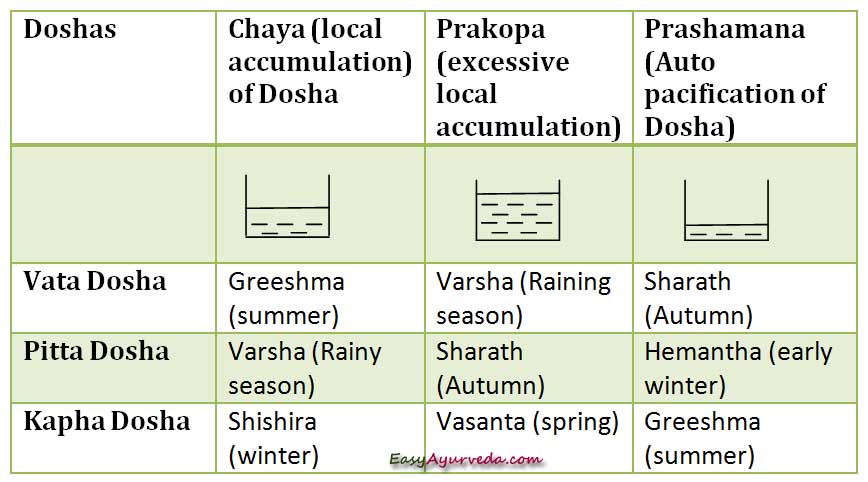
This cycle, driven by the astronomical progression of the Sun you've studied, is the "Ritu" part of our equation. It tells us which Dosha is naturally increasing at any given time of year.
Step 2: Analyze the Ritu × Prakriti Interaction
Now we combine the seasonal cycle with the individual's constitution. The analysis rests on a simple, powerful rule:
The Rule of Similarity (Samanya): A person is most vulnerable during the Prakopa (aggravation) phase of their dominant Dosha. The shared qualities between the season and the Prakriti create a compounding effect, making imbalance much more likely.
- Vata Prakriti: Most vulnerable in Varsha Ritu. The cold, dry, mobile qualities of the season amplify the inherent Vata in their constitution.
- Pitta Prakriti: Most vulnerable in Sharad Ritu. The sharp, hot qualities of the season (the "heat after the clouds") amplify the inherent Pitta in their constitution.
- Kapha Prakriti: Most vulnerable in Vasanta Ritu. The melting of accumulated winter coolness combined with the moist, heavy qualities of spring amplifies the inherent Kapha in their constitution.
Therefore, the standard Ritucharya for a given season must be applied with extra diligence and specificity for a person of the corresponding Prakriti.
The paper you looked at earlier provides excellent details on these specific adjustments.
RITU (SEASON), RITUCHARYA AND PRAKRITI
Let's return to the paper 'RITU (SEASON), RITUCHARYA AND PRAKRITI' to see the clinical application of this analysis. The author details the standard regimen for each season and then adds crucial advice for different Prakriti types.
Please read the entire section titled 'RITUCHARYA', beginning with 'Hemanta Ritucharya' and continuing through 'Sharada Ritucharya'. As you read, your focus should be on the specific paragraphs giving advice for Vata, Pitta, and Kapha individuals within each season. For instance: "In Hemanta (fall winter) especially the Vata prakriti person should observe about Dinacharya..." "In Kapha Prakriti person these changes are more remarkable..." (in Vasanta) "The Pitta Prakriti persons are more affected..." (in Grishma) "Virechana (purgation) is advised to keep the Pitta and Agni normal especially in Pittaja Prakriti." (in Sharada) Identify the logic: why is this specific advice given to that specific Prakriti in that season?
To consolidate this, here is a practical summary matrix for clinical use:
| Prakriti | Season of Highest Risk (Prakopa) |
Primary Ahara Priority |
Primary Vihara Priority |
|---|---|---|---|
| Vata | Varsha Ritu | Emphasize warm, unctuous, easy-to-digest foods. Use Amla & Lavana tastes to support Agni. | Maintain a strict routine (Dinacharya). Daily Abhyanga with warm sesame oil. Protect from wind and cold. |
| Pitta | Sharad Ritu | Emphasize cooling, sweet, bitter, and astringent foods. Avoid spicy, sour, salty tastes. | Avoid midday sun exposure. Engage in calming activities. Perform Virechana if indicated. |
| Kapha | Vasanta Ritu | Emphasize light, dry, warm foods with pungent, bitter, and astringent tastes. Use honey. | Engage in vigorous daily exercise. Avoid daytime sleep. Perform Vamana if indicated. |
Step 3: Analyze the Ritu × Vikriti Interaction
The final layer of analysis is the Vikriti, or the current state of imbalance. A person of any Prakriti can have a Vikriti involving any of the three Doshas.
The Clinical Rule of Precedence: Pacifying the Vikriti is the most immediate therapeutic goal. The regimen must be adjusted to primarily address the imbalanced Dosha, even if it means modifying the standard advice for the Ritu or Prakriti.
Let's consider two scenarios:
Scenario 1: Aligned Forces
- Patient: A Kapha Prakriti individual.
- Season: Vasanta Ritu (Kapha-aggravating).
- Vikriti: Complains of spring allergies, congestion, and lethargy (Kapha Vikriti).
- Analysis: Here, the Prakriti, Ritu, and Vikriti are all aligned. The aggravating force of the season is strongly affecting the person's constitutional weakness, leading to a predictable imbalance.
- Action: The standard Vasanta Ritucharya (light, dry, warm foods; vigorous exercise; avoiding day sleep) must be followed with extreme strictness. This is a classic indication for Vamana (therapeutic emesis) to remove the excess Kapha.
Scenario 2: Opposing Forces
- Patient: A Vata Prakriti individual.
- Season: Sharad Ritu (Pitta-aggravating).
- Vikriti: Complains of hyperacidity, skin rashes, and irritability (Pitta Vikriti).
- Analysis:
- The Ritu is aggravating Pitta.
- The Vikriti is a clear Pitta imbalance.
- The patient's Vata Prakriti means they are also prone to dryness and coldness.
- Action: The Pitta Vikriti takes precedence. The primary focus must be a strict Pitta-pacifying diet (cooling, non-spicy foods). However, because the person is Vata Prakriti, we must ensure the Pitta-pacifying regimen does not excessively increase Vata.
- Modification: Instead of raw salads (cooling but Vata-aggravating), recommend steamed or blanched cooling vegetables (like zucchini and cucumber). Instead of just cold water, use room-temperature water with cooling herbs like mint. The diet must be both cooling (Sheeta) and sufficiently moistening (Snigdha) to pacify Pitta without provoking Vata.
Test your understanding!
A 45-year-old male of Pitta Prakriti complains of seasonal dryness, cracking joints, and anxiety. The season is the beginning of Varsha Ritu (rainy season).
- Identify the Prakriti, Ritu, and Vikriti.
- Analyze the interacting Doshic forces. Which one takes priority?
- What is the primary goal of his Ritucharya, and what is one key modification you would make to the standard Varsha Ritucharya for him?
Show answer
-
Identification:
- Prakriti: Pitta
- Ritu: Varsha Ritu (Vata-aggravating)
- Vikriti: Joint stiffness, dryness, anxiety (Vata Vikriti)
-
Analysis: The Ritu (Varsha) and the Vikriti (Vata symptoms) are aligned in aggravating Vata. The patient's Pitta Prakriti is a secondary consideration. The Vata Vikriti takes clinical priority because it represents the current, active imbalance causing suffering.
-
Goal and Modification: The primary goal is to pacify Vata. Standard Varsha Ritucharya already aims to do this by enhancing Agni and managing the cold, damp, windy environment. However, we must be careful not to aggravate the patient's underlying Pitta Prakriti.
- Key Modification: Standard Varsha Ritucharya often recommends Amla (sour) and Lavana (salty) tastes to stimulate Agni. For this Pitta Prakriti individual, these tastes should be used in moderation. Instead of recommending sour foods like pickles, a better choice would be a warm soup with a squeeze of lime (less heating than fermented sour tastes). The regimen should focus heavily on the Snigdha (unctuous) and Ushna (warm) qualities of Vata pacification, using ghee and warm cooked meals, while ensuring spices are not overly pungent or "hot" (like excessive chili or dry ginger), opting instead for digestive spices like cumin, coriander, and fresh ginger.
Conclusion
You have now assembled the complete analytical toolkit for personalized Ritucharya. You can assess the environment (geography and season) and, most importantly, understand how that environment will specifically interact with an individual's unique constitution and current health status.
Key Takeaways:
- An individual's Prakriti determines their inherent vulnerability to seasonal changes. The season sharing qualities with one's dominant Dosha requires the most vigilance.
- The seasonal Dosha cycle of Chaya, Prakopa, Prashama provides the universal backdrop against which individual responses occur.
- The management of Vikriti (current imbalance) is always the primary clinical priority. The Ritucharya must be adapted to first pacify the aggravated Dosha of the Vikriti.
- Personalized Ritucharya is a dynamic process of balancing the influences of the season, the person's constitution, and their immediate health needs.
Preview of the Next Lesson:
In our next and final lesson, we will move from analysis to synthesis. You will integrate all the principles from this module—geographical adaptation, seasonal analysis, and individual assessment—to design a complete, personalized, and geographically-appropriate Ritucharya plan for a complex case study. This will be the capstone exercise of your study.