Hello! Welcome to your next lesson.
In our previous session, we precisely calculated the durations of Vasanta and Grishma Ritus by summing the time the Sun spends in their respective Rashis. This laid the groundwork for understanding the specific timeline of Adana Kala.
Today, we will investigate the astronomical engine that drives this powerful period. Our learning outcome is to analyze the astronomical factors of peak Adana Kala, including increasing solar intensity and day length. We will explore why the Sun becomes so dominant during Vasanta and Grishma, connecting the abstract principles of Suryasiddhanta to the tangible environmental changes described in the Samhitas.
The Astronomical Identity of Adana Kala: Uttarayana
As you know from the classics, Adana Kala is the period when the Sun "takes away" (adana) the moisture and strength from the world. Astronomically, this period is synonymous with Uttarayana, the Sun's northward journey across the celestial sphere.
Let's formalize this connection using a text grounded in Suryasiddhanta.
The Surya Siddhanta: Ancient Mathematical Genius ... - ZODIAQ
The resource 'The Surya Siddhanta: Ancient Mathematical Genius' provides a concise definition of the astronomical half-years, or Ayanas. This will help solidify the link between the Ayurvedic concept of Adana Kala and its astronomical counterpart.
Please read the short section under the subheading 'Ayana: The Half Year'. Pay close attention to the descriptions for 'Uttarayana', especially the 'Physical effect' which is described as 'increasing daylight hours, ascending solar energy'.
As the text confirms, Uttarayana is the period from the Winter Solstice (~Dec 21) to the Summer Solstice (~June 21), defined by the Sun's northward travel. Vasanta and Grishma Ritus, which we've seen fall approximately between late February and late June, represent the culmination of this period—the peak of Adana Kala.
Now, let's dissect the two key physical effects of Uttarayana: increasing day length and ascending solar energy (intensity).
Factor 1: Increasing Day Length
The most noticeable effect of Uttarayana is that the days get longer. This is not a random occurrence but a direct result of the Sun's changing position on the horizon.
Rtucharya: The 6 seasons and lifestyle, diet, and your Yoga ...
To understand this visually, let's turn to the article 'Rtucharya: The 6 seasons and lifestyle...'. It provides a simple yet effective explanation of the Sun's apparent movement.
Read the first two paragraphs of this resource. Focus on the description of the Sun's rising point moving from the southeast in winter to the northeast in summer. This section explains how this 'northern course' (uttarayana) corresponds to successively longer days.
As the reading explains, during Uttarayana, the Sun's path across the sky becomes a longer and higher arc. This means it spends more time above the horizon each day. The chart below visualizes this phenomenon perfectly for a location in the Northern Hemisphere.
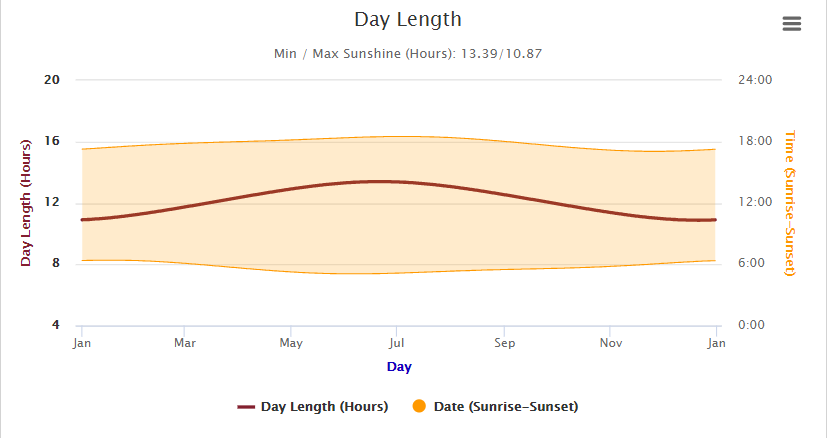
This steady increase in the duration of sunlight is the first major factor contributing to the drying, heating nature of Adana Kala. More hours of sunlight mean more time for evaporation and heating of the environment.
Factor 2: Increasing Solar Intensity (The Power of the Direct Ray)
Longer days are only part of the story. The quality and intensity of the sunlight also change dramatically. This is arguably the more powerful factor in depleting the world's Saumya Guna (cooling quality).
The astronomical concept governing this is the Sun's declination, known in Sanskrit astronomy as Kranti (क्रान्ति).
- Declination (Kranti): This is the Sun's angular height above or below the celestial equator.
- At the Winter Solstice (~Dec 21), the Sun is at its southernmost point, with a declination of -23.5°.
- At the Vernal Equinox (~Mar 21), it crosses the celestial equator, and its declination is 0°. This falls within Vasanta Ritu.
- At the Summer Solstice (~June 21), it reaches its northernmost point, with a peak declination of +23.5°. This marks the end of Grishma Ritu.
Why does this matter? A higher declination means the Sun is higher in the sky at midday. When the Sun is higher, its rays strike the Earth more directly, concentrating its energy over a smaller surface area. Think of a torch beam: when you shine it directly down, you get a small, bright, intense circle of light. When you shine it at an angle, the light spreads out over a larger area, becoming diffuse and less intense.
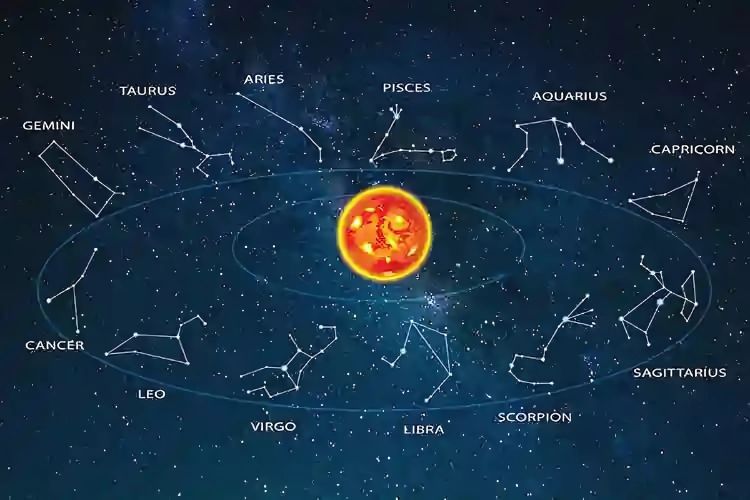
This increasing directness of the Sun's rays is what gives them their Tikshna (sharp, penetrating) quality during Vasanta and especially Grishma. This intense, concentrated energy is what the Charaka Samhita refers to when it says the Sun's rays absorb the moisture from the earth.
Rtucharya: The 6 seasons and lifestyle, diet, and your Yoga ...
The 'Rtucharya' article connects this astronomical reality directly to the Ayurvedic texts.
Please read the paragraph under the heading 'The Effects of Adana and Visagra'. It quotes Charaka Samhita (Sutrasthana 6:6), directly stating that from mid-January to mid-July (adana), 'the sun’s rays and the wind’s sharp velocity and dryness absorb the moisture from the earth'. This is the physical consequence of increasing solar intensity.
Synthesis: The Climax of Solar Power
Vasanta and Grishma Ritus represent the period where these two factors—day length and solar intensity—are not only high but continuously increasing.
- During Vasanta (Spring): We pass the Vernal Equinox. Day length and solar intensity are rapidly climbing, melting the accumulated cold and wetness of winter.
- During Grishma (Summer): Both factors continue to climb towards their absolute annual maximum. The environment becomes progressively hotter and drier, culminating at the Summer Solstice, the longest day and the moment of peak solar intensity.
This is the astronomical essence of peak Adana Kala. It is the combination of longer duration and higher intensity of sunlight that creates the profound physiological effects of weakness (Daurbalya) and dryness (Rukshata) that are central to managing health during these seasons.
Test your understanding!
A friend observes, "The Summer Solstice around June 21st has the longest day and most intense sun, so that should be the hottest day of the year. But in many places, the hottest weather comes in July or August. How does this fit with our astronomical model?"
Show answer
This is an excellent observation that highlights the difference between solar energy input and accumulated heat.
Our astronomical model is correct: the peak input of solar energy into the Northern Hemisphere occurs at the Summer Solstice. However, the Earth's atmosphere, oceans, and land act like a large thermal reservoir. They continue to absorb this peak energy throughout June and take time to heat up and re-radiate that heat.
This phenomenon is called seasonal lag. The atmosphere continues to warm as long as the incoming solar energy is greater than the heat being radiated back into space. This balance typically tips a few weeks after the solstice.
Therefore, while the astronomical Adana force (the "taking away" power of the sun) is maximal at the solstice, the peak ambient temperature (Ushnata) is often experienced later. For clinical practice, this means we must consider both the peak astronomical influence and this thermal lag.
Conclusion
In this lesson, we have analyzed the core astronomical drivers of Adana Kala. You now understand that this period is not just a label but a direct consequence of the Sun's predictable celestial mechanics.
Key Takeaways:
- Adana Kala corresponds to Uttarayana, the Sun's northward journey from the Winter to the Summer Solstice.
- The two defining astronomical factors of peak Adana Kala are increasing day length and increasing solar intensity.
- Increasing day length results from the Sun tracing a longer arc across the sky.
- Increasing solar intensity is due to the Sun's rising declination (Kranti), which makes its rays more direct and concentrated.
- The combination of these two factors during Vasanta and Grishma leads to the powerful heating and drying effect that defines Adana Kala, peaking at the Summer Solstice.
With this astronomical foundation in place, we are now ready to explore the precise physiological impact on the body.
Preview of the Next Lesson:
In our next lesson, we will connect these astronomical causes to their biological effects. We will examine the physiological basis for Kapha Prakopa in Vasanta, followed by Vata Sanchaya in Grishma, explaining how the changing solar environment directly influences the Doshas.