Hello! Welcome back to our exploration of Ritucharya.
In our last lesson, we established the precise astronomical and physiological reasons for Pitta Prakopa in Sharad Ritu. We saw how the sudden, intense solar radiation after the monsoon acts upon the Pitta that accumulated during Varsha Ritu, causing it to aggravate and overflow. This understanding forms the diagnostic foundation for this season.
Today, we transition from diagnosis to treatment. Knowing that Pitta is aggravated, what is the most effective and definitive therapeutic strategy? Our objective is to justify the selection of Virechana (therapeutic purgation) and Raktamokshana (bloodletting) as the primary Shodhana (purification) therapies for Sharad Ritu. We will connect the physiological problem to its precise clinical solution, as outlined by the classical Ayurvedic texts.
1. The Principle of Seasonal Shodhana
Before we discuss the specific therapies, let's revisit a core principle. Ayurveda advises that when a Dosha is in its Prakopa (aggravated) stage, and the season is favorable, the ideal treatment is Shodhana—the elimination of the excess Dosha from the body. While Shamana (pacification) can manage symptoms, Shodhana removes the problem from its root, preventing recurrence and maintaining long-term health.
Sharad Ritu is the perfect season for Pitta Shodhana precisely because the Dosha is naturally aggravated and ready to be expelled.
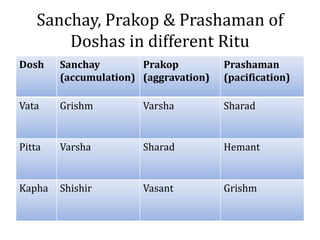
The classical texts are unanimous in their recommendation for this season.
Let's begin by reading a concise explanation from the paper 'Ritu Shodhana - Way to Stay Healthy' by Manjusri and M. Gautham Shetty. This will set the stage by directly stating the classical recommendation.
Please read the section 'Regimen in Sharath ritu'. Pay close attention to how it describes the transition from Pitta Sanchaya to Pitta Prakopa and explicitly names the three indicated procedures: Tiktasarpipana, Virechana, and Raktamokshana. Also, review 'Table 3: Unique preventive measure of Ayurveda - Ritu shodhana' which summarizes the shodhana for each season.
Now that we know what is recommended, let's delve into why.
2. Justification for Virechana (Therapeutic Purgation)
The primary principle of Shodhana is to expel the aggravated Dosha through the nearest possible route (Asanna Marga). To justify Virechana, we must consider the main location (Sthana) of Pitta Dosha.
The primary seat of Pitta is the Amashaya-Pakvashaya Madhyama (the region between the stomach and intestines), which includes the small intestine, liver, and spleen. Virechana, or therapeutic purgation, works by inducing downward movement (Adhomarga Gamana) to expel morbid Doshas through the anal route.
Therefore, Virechana is the most logical and direct method to eliminate aggravated Pitta from its primary seat.
The classic aphorism states, Virechanam Pittaharanam Shreshtam—"Among methods for eliminating Pitta, Virechana is the best."
How does it work?
- Pre-procedure (Purvakarma): The process begins with Snehapana (internal oleation, often with medicated bitter ghee or Tikta Ghrita) and Swedana (sudation). This helps to liquefy the Doshas spread throughout the tissues (Shakhas) and encourages them to move towards the gastrointestinal tract (Koshtha).
- Main Procedure (Pradhana Karma): Virechana herbs, which possess qualities like Ushna (hot), Teekshna (sharp), Sookshma (subtle), and Vyavayi (fast-spreading), are administered. These potent herbs further promote the movement of Doshas into the GI tract and then trigger purgation, forcefully expelling the accumulated and aggravated Pitta and associated Ama (toxins).
By cleansing the liver, intestines, and blood channels, Virechana addresses the root cause of the season's inflammatory and digestive disorders.
3. Justification for Raktamokshana (Bloodletting)
If Virechana targets the root of Pitta in the GI tract, why is a second procedure, Raktamokshana, also recommended? The answer lies in the inseparable relationship between Pitta and Rakta (blood).
Pitta and Rakta share an Ashraya-Ashrayi Bhava (the relationship of the container and the contained). Aggravated Pitta invariably vitiates the blood (Rakta Dushti). This is the pathogenic basis for many classic Sharad Ritu ailments:
- Skin diseases like urticaria, rashes, acne, and Visarpa (erysipelas).
- Burning sensations (Daha) throughout the body.
- Bleeding disorders (Raktapitta).
- Inflammatory conditions like stomatitis or conjunctivitis.
While Virechana cleanses the system and reduces the source of vitiation, Raktamokshana directly targets and removes the already vitiated blood, providing rapid relief from heat- and inflammation-related symptoms.
It is for this reason that Acharya Sushruta, a pioneer in surgery, considered Raktamokshana to be Ardha Chikitsa (half the treatment) for many systemic diseases, especially those of Pitta origin.
To understand the specifics of these two procedures better, the following resource provides an excellent overview.
Critical Review On Different Shodhana In Sharad Ritu With ...
The paper 'Critical Review On Different Shodhana In Sharad Ritu' offers a detailed breakdown of both Virechana and Raktamokshana, including their modes of action and modern correlations.
Please read the section titled 'Mode of Action of Shodhana (According to Ayurveda)'. Focus on the descriptions for '1. Virechana (Therapeutic Purgation)' and '2. Raktamokshana (Bloodletting Therapy)'. Note the tables that explain the different types of each therapy and the comparison between the Ayurvedic and modern perspectives on their mechanisms.

Test your understanding!
A 35-year-old male patient comes to your clinic in October. He has a history of psoriasis that flares up every autumn. This year, along with the skin lesions, he also complains of severe acid reflux and irritability.
Based on today's lesson, how would you justify a Shodhana plan that includes both Virechana and Raktamokshana for this patient?
Show answer
Your justification would be two-fold:
-
Justification for Virechana: The patient's acid reflux and irritability are classic signs of aggravated Pitta in the Koshtha (GI tract) and its effect on the mind (Sadhaka Pitta). Virechana is the primary treatment to eliminate this excess Pitta from its root in the small intestine, thus addressing the systemic cause of his symptoms.
-
Justification for Raktamokshana: The psoriasis flare-up is a clear sign of Rakta Dushti (vitiated blood) secondary to the Pitta Prakopa. While Virechana will help systemically, Raktamokshana (specifically localized methods like Jalauka Avacharana or leech therapy on the lesions) would directly remove the vitiated blood from the affected area. This would reduce the local inflammation, itching, and scaling much more quickly than Virechana alone.
Therefore, the combined plan is justified as a comprehensive strategy: Virechana to treat the root cause in the Koshtha, and Raktamokshana to treat the primary manifestation in the Rakta Dhatu.
Conclusion
Today, we have built a solid clinical justification for the selection of Shodhana therapies in Sharad Ritu. We moved beyond simply knowing what to do and established why we do it, grounding our clinical decisions in the fundamental principles of Dosha Gati and Sthana.
Key Takeaways:
- Timing is Key: Sharad Ritu is the ideal time for Pitta Shodhana because the Dosha is naturally in its Prakopa (aggravated) state, making it ripe for elimination.
- Virechana Targets the Root: Virechana is the primary therapy for Pitta Prakopa because it expels the Dosha from its main seat (Pakvashaya) through the most direct, downward route.
- Raktamokshana Targets the Manifestation: Raktamokshana is indicated to address the inevitable consequence of severe Pitta aggravation—the vitiation of blood (Rakta Dushti). It directly cleanses the blood, offering rapid relief from inflammatory skin conditions, burning sensations, and other signs of toxic heat.
- A Comprehensive Strategy: Together, Virechana and Raktamokshana form a synergistic plan that purifies both the gastrointestinal system and the circulatory system, providing a complete detoxification from the excesses of Sharad Ritu.
Preview of the Next Lesson:
Shodhana is a powerful purification that essentially 'resets' the body. However, to maintain the benefits and prevent the re-accumulation of Pitta, this purification must be followed by the correct diet and lifestyle. In our next lesson, we will focus on the post-Shodhana phase and the general regimen for the season by learning to prescribe a Pitta-pacifying diet and lifestyle for Sharad based on its Guna profile.