Welcome back. In our last lesson, we focused on the therapeutic strategy for Varsha Ritu, deducing the diet (Ahara) and lifestyle (Vihara) needed to counteract Agnimandya and Vata Prakopa. We established that while we manage Vata, the acidic (Amla) and damp (Kleda) nature of the monsoon season simultaneously causes the accumulation (Sanchaya) of Pitta Dosha.
Today, we will investigate what happens when the clouds of Varsha recede and the sun re-emerges. Our objective is to explain the astronomical and physiological basis for Pitta Prakopa in Sharad Ritu, a phenomenon often described as the "heat after the clouds." This lesson will bridge the gap between the Sun's celestial path and the tangible experience of seasonal illness, giving you the tools to understand why autumn is considered a critical season for managing Pitta.
1. The Astronomical Stage: Unveiling the "Heat After the Clouds"
To understand Sharad Ritu, we must first look to the sky. This season marks the middle of Visarga Kala and Dakshinayana, the Sun's southern journey. It astronomically corresponds to the Sun's transit through Kanya (Virgo) and Tula (Libra) Rashis.
But why does this period feel so intensely hot, sometimes even more so than the peak of summer? The answer lies in the interaction between the Sun and the Earth, freshly altered by the monsoon.
- During Varsha Ritu (Monsoon): The Sun, while powerful, has its rays obstructed by a thick blanket of clouds. The environment is dominated by water and humidity, but direct solar heat is minimal.
- During Sharad Ritu (Autumn): The monsoon clouds dissipate. Suddenly, the Earth, which is saturated with water from the preceding rains, is exposed to direct and intense solar radiation. The Sun has not yet reached its weakest point in the winter solstice, so its rays are still strong.
This combination of a water-logged Earth and intense, unobstructed sunlight creates a unique environment. It is not the dry, baking heat of Grishma (summer) but a sharp, penetrating, and humid heat. This specific quality of heat is described as Teekshna (sharp/penetrating), a quality that has a profound effect on Pitta Dosha.
The Rising of Agastya: A Celestial Marker
Classical texts mention a beautiful astronomical correlation for this seasonal change: the appearance of the star Agastya (Canopus). The water, which was muddy and turbid throughout the monsoon, is said to become purified by the rising of this star.
This observation has an astronomical basis. The heliacal rising of Canopus (its first appearance in the pre-dawn sky after being hidden by the Sun's glare) occurs in late August or early September in the Northern Hemisphere, perfectly coinciding with the onset of Sharad Ritu. This celestial event served as a reliable signal to ancient observers that the atmospheric turbidity of the monsoon was ending and the clear, sharp season of Sharad had begun.
2. The Physiological Drama: From Sanchaya to Prakopa
Now that we've set the astronomical stage, let's turn to the physiological response. The entire pathogenesis of Sharad Ritu is a classic case of the Dosha Gati (the stages of doshic imbalance).
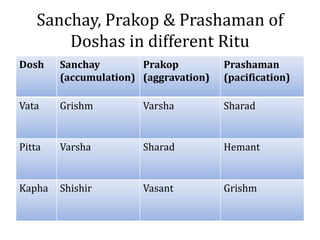
Step 1: Pitta Sanchaya (Accumulation) in Varsha Ritu
As we discussed, the environment of Varsha Ritu is inherently acidic (Amla Paka). The water, the earth, and even the food have a sour quality. This, combined with a weakened digestive fire (Agnimandya), leads to the accumulation of Pitta Dosha within the body. However, the cool temperature of the monsoon keeps this accumulated Pitta in a contained state. It increases in quantity but is not yet "provoked."
Step 2: Pitta Prakopa (Aggravation) in Sharad Ritu
The transition from Varsha to Sharad acts as the trigger. The accumulated Pitta is like fuel waiting for a spark. The intense, penetrating solar heat of Sharad provides that spark.
Acharya Charaka explains this mechanism with masterful precision.
Tasyashiteeya Adhyaya - Charak Samhita
Let's read the foundational shloka from the Charaka Samhita that explains the etiology of Pitta Prakopa in Sharad. This is the core principle you will use in your clinical practice.
Please read the section titled 'Diet and lifestyle guidelines in sharada ritu (autumn season)'. Focus on the very first verse (shloka 41) under the sub-heading 'Status of pitta dosha in autumn season'. This verse contains the entire physiological explanation.
The verse states:
वर्षाशीतोचिताङ्गानां सहसैवार्करश्मिभिः|
तप्तानामाचितं पित्तं प्रायः शरदि कुप्यति||४१||
varṣāśītōcitāṅgānāṁ sahasaivārkaraśmibhiḥ |
taptānāmācitaṁ pittaṁ prāyaḥ śaradi kupyati ||41||
This translates to: "For bodies that have become accustomed to the cold of the rainy season (varṣāśītōcitāṅgānāṁ), when they are suddenly heated by the sun's rays (sahasaivārkaraśmibhiḥ taptānām), the accumulated Pitta (ācitaṁ pittaṁ) often becomes aggravated (prāyaḥ śaradi kupyati) in the Sharad season."
Think of it this way: The accumulated Pitta in Varsha is like a pot of water sitting at room temperature. The sudden solar assault of Sharad is like placing that pot on a high flame. The water doesn't just get warm; it boils over. This "boiling over" is Prakopa.
This aggravation is not limited to the digestive system. Since Pitta and Rakta Dhatu (blood tissue) share a close relationship (ashraya-ashrayi bhava), the aggravated Pitta often vitiates the blood, leading to the skin rashes, inflammatory conditions, and bleeding disorders common in this season.
Test your understanding!
A patient with a Pitta constitution tells you they feel great during the cool, rainy monsoon but predictably develop migraines, acid reflux, and an irritable temper every year in September and October. They are confused because the weather seems pleasant.
Based on today's lesson, how would you explain the underlying Ayurvedic pathogenesis of their "autumnal" symptoms?
Show answer
You would explain it using the concept of Pitta Sanchaya and Prakopa:
- Accumulation Phase (Varsha): During the monsoon, the cool weather keeps their innate Pitta in check, which is why they feel good. However, the acidic nature of the season (Amla Vipaka) is causing Pitta to slowly and silently accumulate in their system.
- Aggravation Phase (Sharad): When September arrives, the clouds clear. Even though the air temperature may feel pleasant, the sun's rays are now direct and sharp (Teekshna). This sudden exposure to solar heat acts on the previously accumulated Pitta, causing it to "boil over" or become aggravated (Prakopa).
- Symptoms: This aggravated Pitta then manifests in its characteristic sites, causing heat in the head (migraines), acidity in the stomach (acid reflux), and affecting the mind (Sadhaka Pitta), leading to irritability. Their symptoms are a direct result of this seasonal physiological shift, not just a random occurrence.
This understanding is further solidified by other texts.
RITU (SEASON), RITUCHARYA AND PRAKRITI
This secondary resource provides a clear summary of the process and explicitly lists the appropriate therapeutic actions, which we will study in depth later.
First, review the table 'Effect of Ritukala on Tridoshas' to confirm the Dosha cycle. Then, read the first paragraph of the 'Sharada Ritucharya' section. Note how it reinforces the Charaka Samhita's explanation and links the provoked Pitta to the vitiation of blood.
Conclusion
Today, we have unraveled the puzzle of Sharad Ritu. We've seen that the infamous "heat after the clouds" is not just a poetic phrase but a precise description of an astronomical event: the impact of direct solar radiation on a water-saturated Earth following the monsoon. This unique environmental condition acts as a powerful trigger, provoking the Pitta Dosha that accumulated during the preceding rainy season.
Key Takeaways:
- Astronomical Basis: Sharad's heat is due to the Sun's strong rays reappearing after the monsoon clouds clear, acting on a moist Earth. This creates a sharp (Teekshna) and penetrating heat.
- Physiological Basis: A body accustomed to the coolness of Varsha is suddenly exposed to this solar heat, which provokes the Pitta that had accumulated due to the acidic environment of the monsoon.
- The Pathogenesis: The process is a textbook example of Dosha Gati: Pitta Sanchaya in Varsha leads to Pitta Prakopa in Sharad. This aggravated Pitta is the root cause of many autumnal ailments, including fevers, skin inflammation, and digestive issues.
Preview of the Next Lesson:
Understanding why a Dosha is aggravated is the first step. The next is knowing how to pacify it effectively. Since Pitta Prakopa is the central event of Sharad Ritu, the classical texts prescribe specific, powerful purification therapies to eliminate the excess Pitta from the body. In our next lesson, we will justify the selection of Virechana (therapeutic purgation) and Raktamokshana (bloodletting) as the primary Shodhana therapies for Sharad Ritu.