Welcome to the first lesson in your journey to understand the modern model of the atom. You're already familiar with the idea of electron shells—the K, L, and M shells from the Bohr model—which picture electrons orbiting the nucleus like planets. Today, we'll refine that picture significantly. We'll explore how those familiar shells are actually composed of more intricate structures called subshells and orbitals, labeled s, p, d, and f.
This lesson directly addresses your goal of bridging the gap between the simple shell model and the more detailed orbital model used by chemists and physicists today. By the end of our session, you will be able to describe how each principal energy level (or shell) is divided into these subshells, and how many orbitals each subshell contains. We'll focus on the "what" and "how many," setting a solid foundation before we visualize the 3D shapes of these orbitals in our next lesson.
From Shells to Subshells: A New Layer of Detail
You'll recall that principal energy levels, or shells, are numbered using the principal quantum number, . The K shell corresponds to , the L shell to , and so on. The higher the value of , the farther the shell is from the nucleus and the higher its energy.
The quantum mechanical model of the atom reveals that these shells are not single, uniform regions. Instead, each shell is split into one or more sub-levels of slightly different energy, known as subshells.
To get a clear visual and conceptual introduction to this idea, let's watch a short video. It does an excellent job of explaining this hierarchy.
What are Shells, Subshells, and Orbitals? | Chemistry
This video, from the channel Najam Academy, will help you visualize the relationship between shells and the newly introduced subshells.
Please watch the section that explains how shells are divided into subshells. The presenter introduces a simple and very helpful rule: the n-th shell contains n subshells. Then, continue watching the next segment which explains how subshells are named, for example, 1s, 2s, 2p, and so on. This notation tells you both the principal energy level and the type of subshell.
As the video explained, we have a clear pattern:
- The 1st shell () has one subshell: the s subshell. We call this the 1s subshell.
- The 2nd shell () has two subshells: the s and p subshells. We call these 2s and 2p.
- The 3rd shell () has three subshells: s, p, and d. These are the 3s, 3p, and 3d subshells.
- The 4th shell () has four subshells: s, p, d, and f. These are the 4s, 4p, '4d, and 4f subshells.
The letters s, p, d, and f originally came from descriptions of spectral lines (sharp, principal, diffuse, and fine), but for our purposes, you can just think of them as labels for different types of subshells, each with its own characteristics.
Orbitals: The Final Level of Detail
We've peeled one layer of the onion, going from shells to subshells. Now we go one step deeper. Each subshell is itself composed of one or more orbitals. An atomic orbital is a three-dimensional region around the nucleus where there is a high probability (typically 90-95%) of finding an electron.
This is the key difference from the Bohr model: electrons do not follow neat, fixed paths. Instead, they exist within these cloud-like regions of probability. The following diagram provides a great visual summary of this entire hierarchy.
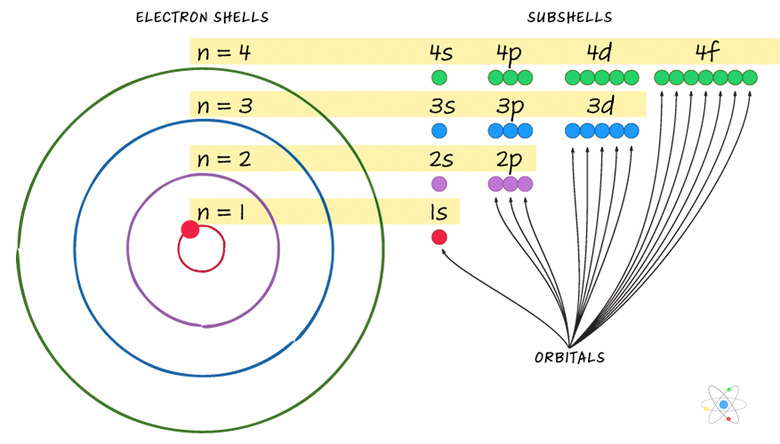
Notice how the diagram shows that:
- An s subshell always contains just one orbital.
- A p subshell always contains three orbitals.
- A d subshell always contains five orbitals.
- An f subshell always contains seven orbitals.
A fundamental rule in chemistry, the Pauli Exclusion Principle (which we will cover in detail later), states that any single orbital can hold a maximum of two electrons.
Combining this with the number of orbitals per subshell gives us the maximum number of electrons each subshell can hold:
- s subshell (1 orbital) can hold electrons.
- p subshell (3 orbitals) can hold electrons.
- d subshell (5 orbitals) can hold electrons.
- f subshell (7 orbitals) can hold electrons.
Tying It All Together: From KLMN to SPDF
Now we can directly answer your core question: how does the old KLMN notation relate to the new SPDF notation? The following reading from a Chemistry discussion forum directly addresses this.
What is the difference between the KLMN and SPDF ...
This text explicitly connects the electron shells you know (K, L, M, N) to their constituent subshells.
Read the first two paragraphs of the top answer. Focus on the explanation of the K shell, which corresponds to n=1, having just one s subshell. Then see how the L shell (n=2) is composed of both s and p subshells. Continue reading to see the breakdown for the M shell (n=3) and N shell (n=4), which include the d subshell and f subshell, respectively.
This confirms the hierarchy we've been building. For example, the L shell (), which you knew holds up to 8 electrons, is now understood to be composed of a 2s subshell (holding 2 electrons) and a 2p subshell (holding 6 electrons), for a total of electrons.
Similarly, the M shell () can hold up to 18 electrons. This is because it contains a 3s (2 electrons), a 3p (6 electrons), and a 3d (10 electrons) subshell, for a total of electrons. This structure perfectly explains the electron capacities you learned with the Bohr model.
To consolidate all these numbers and relationships, let's turn to a final, comprehensive resource.
Energy Levels in Atoms - IB Chemistry Notes
This resource from Save My Exams provides a clear, structured summary of all the concepts we've discussed.
First, read the text under the heading "Sublevels & orbitals". Pay close attention to the list that specifies the number of orbitals per subshell and the subsequent list showing the maximum number of electrons for each. Finally, study the summary table titled The arrangement of electrons in atoms. This table is an excellent reference that puts everything together: shells, subshells, orbitals, and electron counts.
This table is your key takeaway for this lesson. It systematically lays out the structure of the atom's electron cloud, moving from the broadest energy level (shell) down to the specific regions (orbitals).

Conclusion
In this lesson, we have built upon your existing knowledge of the Bohr model to construct a more detailed and accurate picture of electron arrangement. You can now see the atom not as a simple solar system, but as a complex structure of nested energy levels.
Here are the key takeaways:
- Hierarchy: The atom's electronic structure is organized in a hierarchy: Shells → Subshells → Orbitals.
- Shells (): Principal energy levels () that correspond to the K, L, M shells. The n-th shell contains n types of subshells.
- Subshells (s, p, d, f): Each shell is composed of subshells with slightly different energies.
- Orbitals: Each subshell contains a specific number of orbitals: s has 1, p has 3, d has 5, and f has 7.
- Electron Capacity: Each orbital can hold a maximum of 2 electrons. This gives each subshell a maximum capacity: s (2e⁻), p (6e⁻), d (10e⁻), and f (14e⁻).
We've successfully established the organizational rules for electrons. In our next lesson, we will bring this structure to life by visualizing the distinctive 3D shapes of the s, p, and d orbitals and understanding their orientation in space. This will complete the first half of your goal, giving you a strong visual and conceptual foundation before we move on to the rules for filling these orbitals with electrons.