Guten Tag!
In our last lesson, we took a major step in understanding German sentence structure by learning to distinguish between the nominative subject (the "doer") and the accusative direct object (the "receiver"). You learned the most important rule of the accusative case: only masculine nouns change their definite article, with der becoming den.
Today, we will build directly on that foundation. Our goal is to master the use of both definite (the) and indefinite (a/an) articles in the accusative case. This will allow you to express more nuanced ideas, distinguishing between talking about a specific object ("I am reading the book") and a general one ("I am reading a book"). This skill is fundamental for describing the world around you in German.
From "The" to "A": Indefinite Articles in the Accusative
You'll be pleased to know that the core rule you learned last time still applies. The only gender that changes its article in the accusative case is masculine. This is true for indefinite articles as well.
Let's look at the indefinite articles you know from the nominative case:
- Masculine: ein (a/an)
- Feminine: eine (a/an)
- Neuter: ein (a/an)
When a noun is the direct object (in the accusative case), the masculine indefinite article ein gets an -en ending and becomes einen. The feminine and neuter articles do not change.
ein(masculine nominative) becomeseinen(masculine accusative).eine(feminine nominative) stayseine(feminine accusative).ein(neuter nominative) staysein(neuter accusative).
Let's watch a video that breaks this down very clearly, first for indefinite articles, and then as a review for definite articles.
Learn German | Accusative case | Articles | Akkusativ | German for beginners | A1 - Lesson 26
This video from the "Learn German" channel systematically explains the article changes in the accusative case, first for indefinite, then for definite articles, before providing a helpful summary.
Please watch these three segments: First, focus on the indefinite articles from this section. The presenter explains how ein changes to einen for masculine nouns while the others stay the same. Next, watch the review of definite articles from this part, which reinforces how der changes to den. Finally, observe the summary table, which puts all of this information together.
Consolidating Your Knowledge
Now, let's put everything we've covered on the accusative case into a single, comprehensive view. The infographic below shows the forms for the definite article ("the") and the indefinite article ("a") in both the nominative and accusative cases.
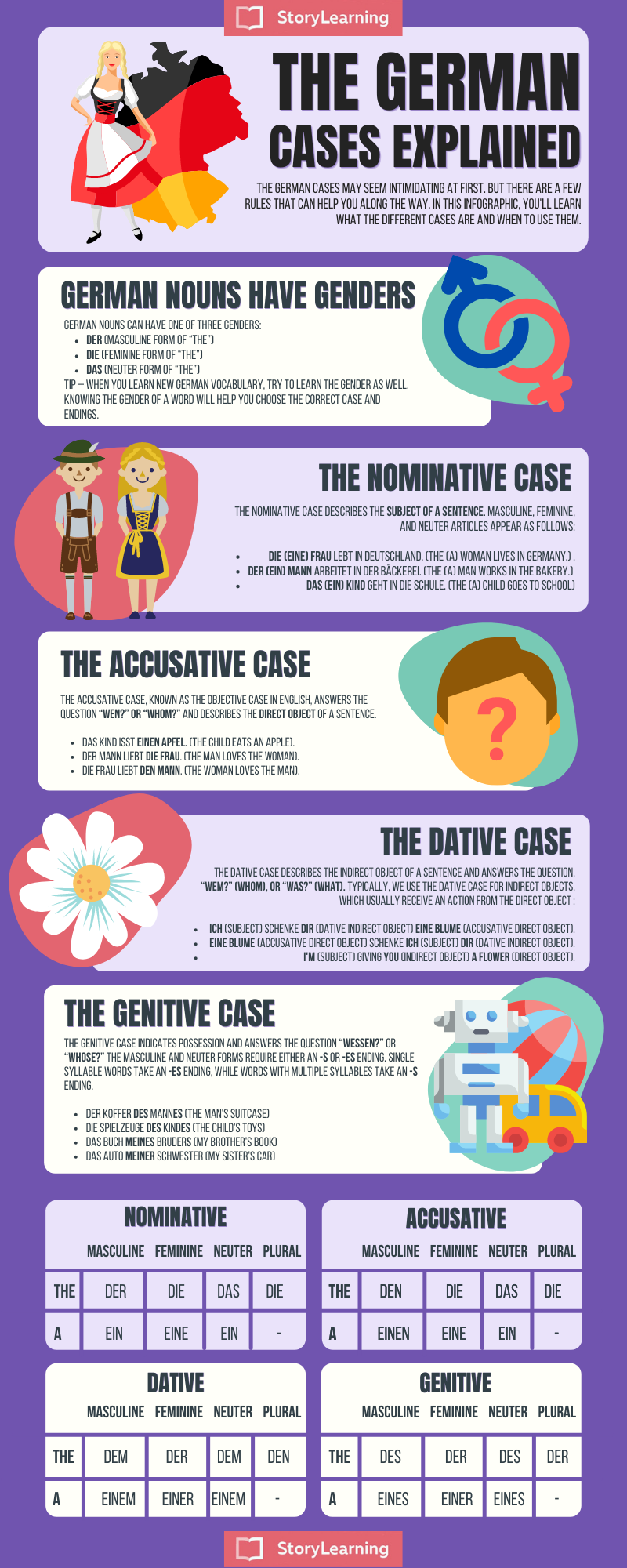
Let's break down the logic with some examples:
-
Masculine:
- Nominative (Subject): Ein Mann liest. (A man reads.)
- Accusative (Object): Ich sehe einen Mann. (I see a man.)
- Nominative (Subject): Der Hund bellt. (The dog barks.)
- Accusative (Object): Das Kind streichelt den Hund. (The child pets the dog.)
-
Feminine:
- Nominative (Subject): Eine Frau singt. (A woman sings.)
- Accusative (Object): Ich höre eine Frau. (I hear a woman.)
-
Neuter:
- Nominative (Subject): Ein Kind spielt. (A child plays.)
- Accusative (Object): Ich sehe ein Kind. (I see a child.)
The pattern is consistent and reliable. Once you internalize that only the masculine form changes, you've mastered the core principle.
Avoiding Common Pitfalls
As you start using the accusative case, there are a couple of common areas where beginners often make mistakes. Let's address them proactively. This next reading provides excellent examples and highlights two crucial points.
Section 2-3: The Accusative Case – German 101
This online textbook chapter reinforces the accusative endings and provides two essential warnings to help you avoid common errors.
Please read the following sections: Start at the text "NEU!". This section gives numerous examples of the masculine -en ending. Notice how it applies not just to ein but also to words like kein (no/none) and mein (my). Next, read the box labeled "TYPICAL MISTAKE". This is a crucial warning: the accusative ending is only for the direct object. The subject, even if it's masculine, remains in the nominative. Finally, read the section on Predicate Nominatives. This explains why, after the verb sein (to be), the noun remains in the nominative case. This is an important exception to the "noun after the verb is the object" assumption.
Let's summarize those two key points:
- Don't over-apply the
-enending. A sentence like "Der Mann kauft den Computer" is correct. "Den Mannkauft den Computer" is incorrect because "the man" is the subject and must be nominative. - The verb sein (to be) is special. It acts like an equals sign. In a sentence like "Das ist ein Stuhl" (That is a chair), "Stuhl" is masculine, but it stays ein because it's not a direct object. It's a "predicate nominative" — it just re-identifies the subject. You're saying "That = a chair."
One more very useful structure from that reading is Es gibt... (There is... / There are...). The noun that follows Es gibt is always in the accusative case.
- Es gibt einen Stuhl im Zimmer. (There is a chair in the room.)
- Es gibt eine Lampe im Zimmer. (There is a lamp in the room.)
- Es gibt ein Bett im Zimmer. (There is a bed in the room.)
Practice
Now it's your turn to apply these rules. For each sentence below, fill in the blank with the correct indefinite article: ein, eine, or einen. Remember to first identify the gender of the noun.
- Ich spiele ______ Videospiel. (das Videospiel, neuter)
- Der Zahnarzt braucht ______ neuen Spiegel. (der Spiegel, masculine)
- Für die Videobearbeitung kaufe ich ______ Computer. (der Computer, masculine)
- Sie hat ______ interessante Frage. (die Frage, feminine)
- Er sieht ______ spannenden Film. (der Film, masculine)
- Ich lese ______ Buch über künstliche Intelligenz. (das Buch, neuter)
Solutions
- Ich spiele ein Videospiel. (Neuter object, no change)
- Der Zahnarzt braucht einen neuen Spiegel. (Masculine object, ein -> einen)
- Für die Videobearbeitung kaufe ich einen Computer. (Masculine object, ein -> einen)
- Sie hat eine interessante Frage. (Feminine object, no change)
- Er sieht einen spannenden Film. (Masculine object, ein -> einen)
- Ich lese ein Buch über künstliche Intelligenz. (Neuter object, no change)
Conclusion
You've done an excellent job today solidifying your understanding of the accusative case. You have moved from simply identifying the direct object to correctly marking it with both definite and indefinite articles. This precision is a hallmark of good German grammar.
Here are the key takeaways from today's lesson:
- The accusative case marks the direct object.
- Only masculine articles change in the accusative.
- The definite article changes: der → den.
- The indefinite article changes: ein → einen.
- The verb sein (to be) is followed by the nominative case, not the accusative.
- The phrase Es gibt is always followed by the accusative case.
In our next lesson, we will introduce a new set of powerful verbs. You've been working with regular ("weak") verbs so far, but many of the most common German verbs are irregular ("strong"). We'll learn how to conjugate verbs like sprechen (to speak), lesen (to read), and sehen (to see), giving you more expressive tools to use with your newfound knowledge of direct objects.
Bis zum nächsten Mal! (Until next time!)