Guten Tag!
Welcome to a new module. In our previous lessons, we built a solid foundation by constructing sentences where a subject performs an action, like Ich lerne Deutsch ("I learn German"). We focused on who was doing the action. Today, we'll expand our abilities significantly by learning how to include the person or thing that receives the action. This will allow us to form much more descriptive and useful sentences, such as "I see the dog" or "The student reads the book."
This lesson will introduce you to a cornerstone of German grammar: the case system. Specifically, your goal is to differentiate between the nominative and accusative cases. The nominative case identifies the subject (the "doer"), which you are already familiar with. The new concept, the accusative case, will allow us to correctly identify and use the direct object (the "receiver" of the action). Mastering this distinction is the first major step toward building complex and correct German sentences.
Why Do We Need Cases?
In English, we primarily rely on word order to understand who is doing what to whom. In the sentence "The dog bites the man," we know the dog is the biter and the man is the victim because of their positions relative to the verb. If we swap them, the meaning reverses: "The man bites the dog."
German, however, allows for more flexible word order. This is where grammatical cases become essential. A "case" is a grammatical marker—often a change in the article (like 'the' or 'a')—that tells you the function of a noun in a sentence, regardless of its position. Think of it like a label that clarifies a noun's role. For example, in dentistry, a scaler and a drill are both instruments, but their specific shapes tell you their distinct functions. Similarly, cases tell you the specific function of a noun in the grammatical "procedure" of a sentence.
To see why this is so important, let's start with a short reading that introduces a "mystery."
German Nominative and Accusative cases + audio
This article from The German Project introduces the concept of cases by comparing the strict word order of English with the flexibility of German. It presents a puzzle involving a bird and a dog that we will solve by the end of this lesson.
Please read the first part of the article, from the beginning down to the end of the section "What is a 'case'?". Focus on the main idea: why cases are crucial for understanding who does what to whom. Pay close attention to the confusing sentence: Ich glaube, dass der Vogel den Hund hasst.
Identifying the Roles: Subject and Object
To use cases correctly, you first need to identify the different "actors" in a sentence. The two key roles for today are:
- The Subject (das Subjekt): The person or thing performing the action. This is the "doer."
- The Direct Object (das Direktobjekt): The person or thing directly receiving the action.
There's a simple method to identify them. To find the subject, ask: "Who or what is doing the action?" (German: Wer oder was...?)
To find the direct object, ask: "Whom or what is the action being done to?" (German: Wen oder was...?)
Let's watch a video that explains this method very clearly.
Akkusativ in German | Simplest Explanation with Examples | Exercise Included | German A1
This video from the "Five Minute German" channel provides a clear, rule-based method for finding the subject and object in any sentence.
Watch from this segment. The presenter gives you simple questions to ask to reliably identify the subject and object. At this point, he will give you the crucial German terms: the subject is Nominativ, and the object is Akkusativ.
The Nominative and Accusative Cases
As you just learned, the subject is in the nominative case, and the direct object is in the accusative case. Let's formalize this.
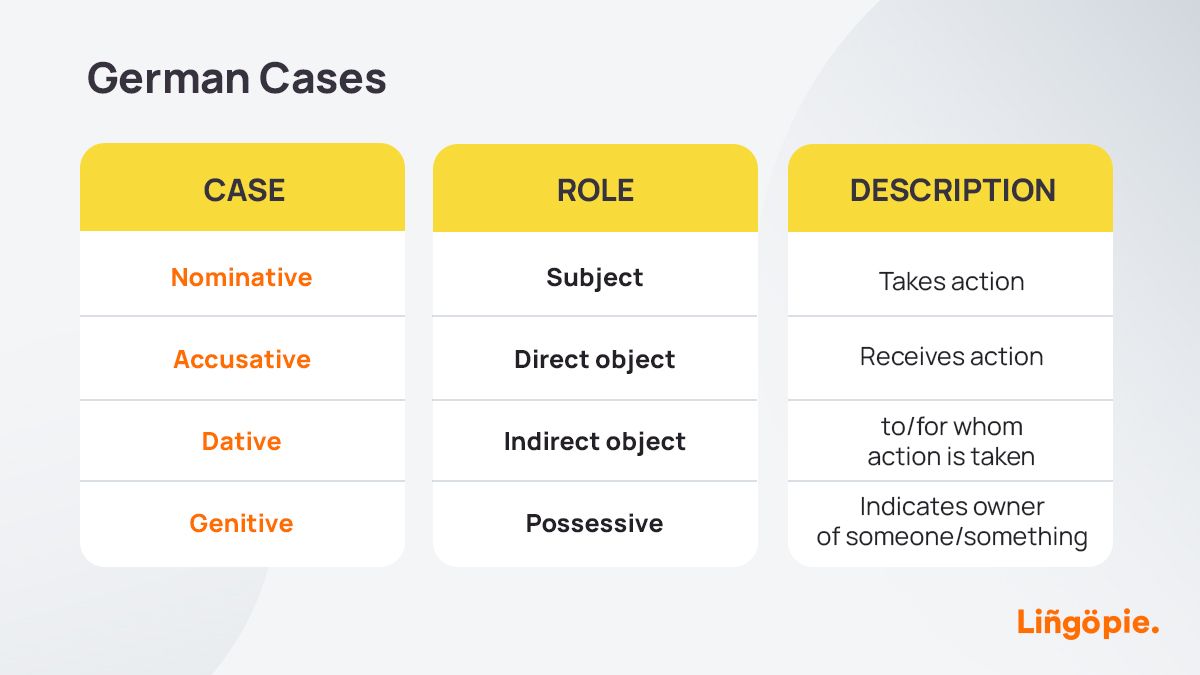
The Nominative Case (der Nominativ)
This is the case for the subject of the sentence. The good news is, you've been using it all along! Every time you've said Ich bin..., Der Mann..., or Die Frau..., you were using the nominative case. The articles you learned for nouns are their nominative forms.
- Masculine:
der(the),ein(a) - Feminine:
die(the),eine(a) - Neuter:
das(the),ein(a) - Plural:
die(the)
The Accusative Case (der Akkusativ)
This is the case for the direct object. When a noun is the direct object, its article might change. Here is the most important rule you will learn today:
In the accusative case, only masculine articles change.
That's it. Feminine, neuter, and plural articles look exactly the same in the accusative as they do in the nominative.
Here's how the masculine articles change:
der(nominative) becomesden(accusative).ein(nominative) becomeseinen(accusative).
Let's read a more detailed explanation and see some examples.
German Nominative and Accusative cases + audio
We return to The German Project to see the formal definitions and article tables. This reading will solidify your understanding of how to identify the parts of a sentence and how the articles change.
Read the following three sections: Parts of a sentence: This reinforces how to break down a sentence into subject, verb, and direct object. The "nominative" case: This section confirms that the nominative articles are the ones you already know. Accusative / direct object: This is the most crucial part. Pay close attention to the comparison table and the examples showing that only the masculine article changes from der to den.
To see this concept explained with a helpful visual, let's watch another short video.
Was ist Akkusativ? | German accusative explained | YourGermanTeacher
The presenter from "YourGermanTeacher" uses simple drawings to illustrate the relationship between the nominative subject and the accusative object.
Watch from this segment. Notice how the roles of the child (das Kind) and the dog (der Hund) can be swapped. When the dog is the object, the article changes to einen Hund (accusative). But when the child is the object, the article remains das Kind because neuter nouns don't change in the accusative.
Solving the Mystery
Now you have all the tools to solve the puzzle from the beginning of our lesson. Remember the sentence?
Ich glaube, dass der Vogel den Hund hasst. (Literally: I believe, that the bird the dog hates.)
Both Vogel (bird) and Hund (dog) are masculine nouns. Based on their articles, can you tell who hates whom?
The article for Vogel is der. This is the nominative article, so der Vogel is the subject.
The article for Hund is den. This is the accusative article, so den Hund is the direct object.
Therefore, the bird hates the dog. The cases make the meaning clear, even with the unusual word order.
Let's confirm this by finishing our first reading.
German Nominative and Accusative cases + audio
This final section of the article from The German Project walks you through the solution to the puzzle, confirming what you just figured out.
Read the short section titled The puzzling case. This will reinforce how the der versus den distinction clarifies the meaning.
Practice
Let's apply your new knowledge. For each sentence below, identify the subject and direct object, then translate the sentence into German using the provided nouns and verbs. Remember to use the correct article (der/die/das or den).
-
The man sees the child.
- Nouns: der Mann (the man), das Kind (the child)
- Verb: sieht (sees)
- Subject: ? | Direct Object: ?
- German sentence: ?
-
The woman reads the book.
- Nouns: die Frau (the woman), das Buch (the book)
- Verb: liest (reads)
- Subject: ? | Direct Object: ?
- German sentence: ?
-
The child has the ball.
- Nouns: das Kind (the child), der Ball (the ball)
- Verb: hat (has)
- Subject: ? | Direct Object: ?
- German sentence: ?
Solutions
- Subject: The man (der Mann). Direct Object: The child (das Kind).
- Der Mann sieht das Kind. (No change for the neuter object.)
- Subject: The woman (die Frau). Direct Object: The book (das Buch).
- Die Frau liest das Buch. (No change for the neuter object.)
- Subject: The child (das Kind). Direct Object: The ball (der Ball).
- Das Kind hat den Ball. (The masculine object's article changes to den!)
Conclusion
Excellent work today! You've tackled one of the most fundamental concepts in German grammar. By understanding the difference between the doer and the receiver of an action, you can now construct and comprehend more detailed sentences.
Here are the key takeaways:
- German uses a case system to define a noun's function in a sentence, which allows for more flexible word order than in English.
- The nominative case marks the subject (the "doer"). You can find it by asking Wer/was? (Who/what?).
- The accusative case marks the direct object (the "receiver"). You can find it by asking Wen/was? (Whom/what?).
- The most important rule for now: only masculine nouns change their definite article in the accusative case, from
dertoden.
In our next lesson, we will continue to build on this foundation. You will learn how to use both definite (the) and indefinite (a/an) articles in the accusative case, and also how to negate nouns in both nominative and accusative using kein/keine.
Auf Wiedersehen!