Hello! Welcome back to our study of the Schwarzschild spacetime.
In our last lesson, we explored the world of timelike geodesics, calculating the perihelion precession of Mercury. We saw how a small relativistic term, , in the orbit equation causes the planet's elliptical path to precess, a prediction that magnificently matched observations.
Today, we shift our focus from massive particles to massless ones: photons. We will analyze the null geodesics to tackle another of the classic tests of General Relativity. Our learning outcome is to calculate the deflection of light by a massive object and explore the fascinating phenomenon of gravitational lensing. This involves very similar mathematical techniques to our last lesson, but applied to a new physical situation with its own unique and profound consequences.
1. The Geodesic Equation for Light
Just as we did for massive particles, we start with the geodesic equations derived from the Schwarzschild metric. The crucial difference lies in the constraint we apply. For a massive particle, the worldline is timelike, and we parameterize it by proper time , which enforces the condition . For a photon, the worldline is null, meaning the spacetime interval along its path is always zero: .
We can follow a very similar procedure to the one we used for massive orbits, leveraging the conserved quantities associated with the time-translation and rotational symmetries of the Schwarzschild metric.
1 Geodesics in Spacetime‣ General Relativity by David Tong
The following section from David Tong's lecture notes provides a concise and rigorous derivation of the orbit equation for a light ray. It elegantly adapts the formalism we used for massive particles to the case of null geodesics.
Please read the section '1.3.5 Light Bending'. Follow the derivation from the null constraint (ds²=0) to the final differential equation for the orbit, which is equation (1.54). Pay close attention to how the effective potential for photons differs from the one for massive particles, and how this leads to a simpler, yet profoundly different, orbit equation.
Let's summarize the key steps and results from the reading.
-
The Null Constraint: We start with the Schwarzschild metric in the equatorial plane () and set :
Here, we've restored and are using as a shorthand for the mass of the central object, not just yet.
-
Conserved Quantities: The conserved energy and angular momentum per unit 'whatever' (since photons have no mass, these are just parameters of the geodesic) are still given by:
where is an affine parameter along the null geodesic. The ratio of these two conserved quantities, which we can call the impact parameter , is what determines the trajectory.
-
The Orbit Equation: After substituting the conserved quantities and changing variables to , just as we did for planetary orbits, we arrive at the differential equation for the photon's path:
Let's pause to appreciate this equation. Compare it to the one for massive particles: . The term corresponding to the Newtonian inverse-square force () is gone. The entire dynamics of light bending is governed by the purely relativistic term!
2. Calculating the Deflection Angle
This equation is non-linear, but for a light ray that only grazes the Sun, the relativistic term is small, making it perfect for a perturbative solution. We assume the path is a small deviation from a straight line.
The zeroth-order solution (when the right-hand side is zero) is a straight line. In polar coordinates, a straight line that passes a distance from the origin is given by , or:
Here, is the impact parameter, the closest distance the light ray would have approached the central mass if there were no gravity.
Now, we feed this approximate solution back into the right-hand side of the full equation and solve again. The same resource you just read carries out this calculation beautifully. Following the steps in Tong's notes (Section 1.3.5, from equation 1.54 onwards) leads to the final deflection angle . The total deflection is the difference between the incoming and outgoing asymptotes. For a straight line, this would be radians. The GR path gives a total angle of . The perturbative calculation yields:
This is the famous result for the gravitational deflection of light. It predicts that the path of a light ray grazing a massive object is bent by this small angle. For a ray just grazing the limb of the Sun, , the angle is about 1.75 arcseconds.
3. Comparison with the Newtonian Prediction
One of the most striking aspects of this result is that it's exactly twice the "Newtonian" prediction. But what does a Newtonian prediction for light bending even mean? We can arrive at one by treating a photon as a classical particle with some effective mass and calculating its trajectory in a Newtonian force field.
The Schwarzschild Metric and Classical Tests of GR
To fully appreciate Einstein's result, it's essential to compare it to the classical prediction. The following notes provide a clear, self-contained derivation of the light deflection angle using purely Newtonian mechanics.
Please read section 3.4.1, 'Newtonian light deflection'. This section treats the photon as a classical particle moving on a hyperbolic trajectory and derives the deflection angle. You don't need to memorize the details of the hyperbola equation, but focus on the final result, equation (3.48).
As the notes show, the Newtonian calculation gives a deflection angle of:
where is the distance of closest approach, equivalent to our impact parameter .
So, . Why the factor of two?
- One half of the deflection () can be attributed to the way gravity affects the flow of time (the component of the metric). This is the part that can be loosely reasoned from the Equivalence Principle.
- The other half comes from the curvature of space itself (the component). This is a purely General Relativistic effect, with no Newtonian analogue. In essence, light is deflected because it follows a straight line (a geodesic) through a spacetime that is itself curved in both its temporal and spatial dimensions.
Arthur Eddington's 1919 eclipse expedition measured the deflection of starlight grazing the Sun and found a result consistent with the GR prediction, not the Newtonian one. This was hailed as a major triumph for Einstein's theory.
4. Gravitational Lensing
The deflection of light is not just a theoretical curiosity; it's a fundamental tool in modern astronomy. When a massive object (like a star, a galaxy, or a cluster of galaxies) lies between us and a distant light source, it acts as a gravitational lens, bending the light and distorting the image of the source.
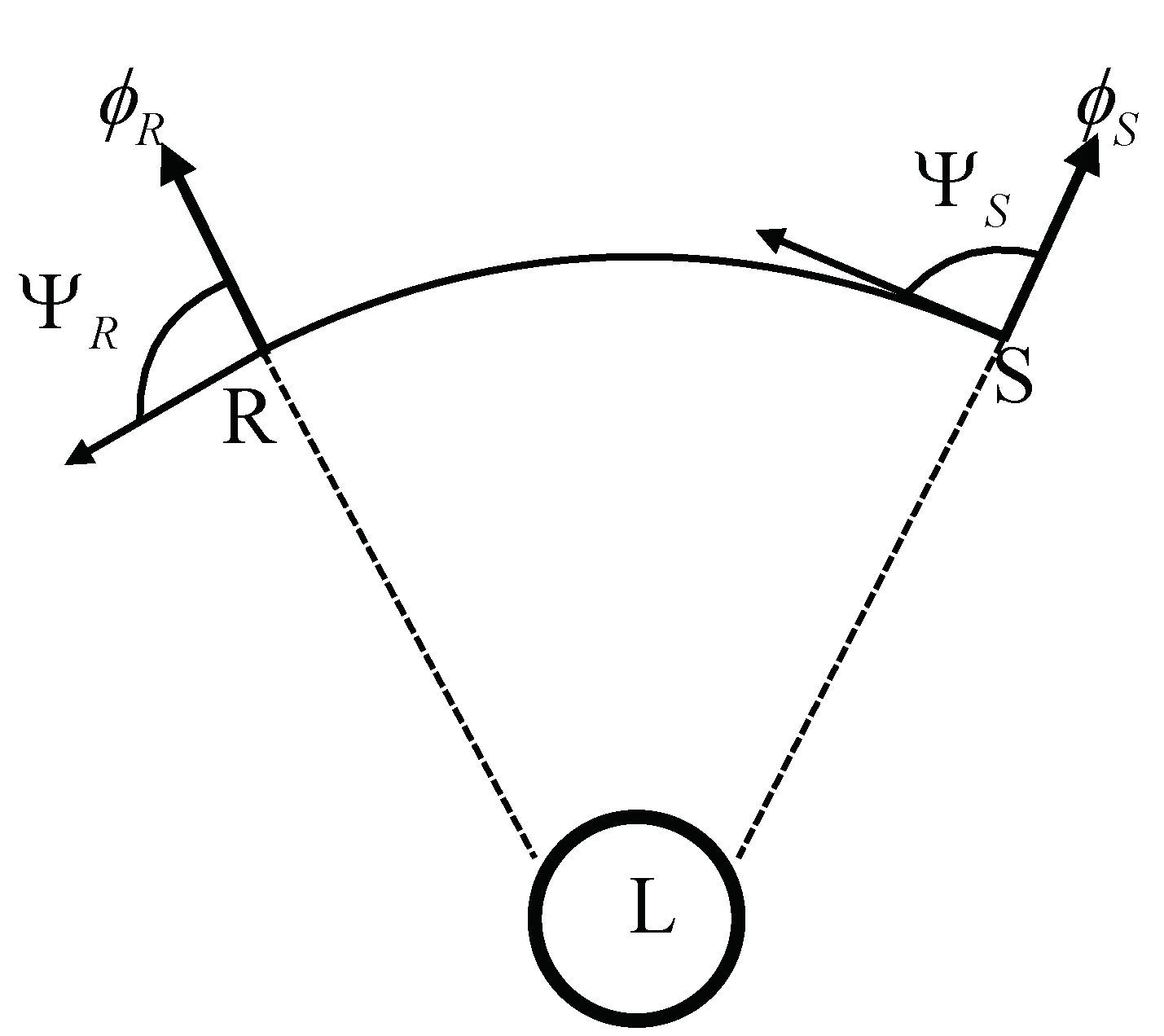
Depending on the alignment and mass distribution, this can lead to spectacular effects.
The Schwarzschild Metric and Classical Tests of GR
The following section expands on the basic idea of light deflection to introduce the rich field of gravitational lensing, discussing the different phenomena observed by astronomers.
Please read section 3.4.3, 'Gravitational lensing'. This section explains how perfect alignment can lead to an 'Einstein Ring' and provides the formula for its angular radius, heta_E. It also introduces the concepts of 'strong lensing' (multiple images) and 'microlensing' (brightness changes), which are active areas of research.
Test your understanding!
Imagine you are observing a distant quasar that is almost perfectly aligned behind a foreground galaxy. According to the reading, what would you expect to see? If the alignment is slightly imperfect, how does the image change?
Show answer
If the quasar (source), the galaxy (lens), and the Earth (observer) are in perfect alignment, the rotational symmetry of the situation means the quasar's light is lensed into a complete circle of light around the foreground galaxy. This is called an Einstein Ring.
If the alignment is slightly imperfect, the symmetry is broken. Instead of a full ring, the observer will typically see multiple, distorted images of the quasar (e.g., two or four bright arcs or spots) around the lensing galaxy. This is the phenomenon of strong lensing.
5. Extreme Bending: The Photon Sphere
The perturbative calculation works for light passing far from the central mass. What happens if the light gets very close? As David Tong's notes briefly mention, the effective potential for photons has a maximum. This corresponds to an unstable circular orbit for light.
Schwarzschild Metric (An Introduction) – Radial & Orbital Motion near a Black Hole
To visualize what happens to light in the extreme gravity near a black hole, this video provides an excellent qualitative and quantitative description of the photon sphere and its observational consequences.
Please watch the segment from 01:18:55 to 01:36:46. This part discusses the orbital motion of light, derives the radius of the unstable photon orbit (the 'photon sphere' at r = 1.5 Rₛ), and explains how it dramatically affects light rays, leading to the complex images we see of black hole accretion disks, like the famous EHT image.
The video explains that at a radius of , known as the photon sphere, light can orbit the black hole. However, this orbit is unstable. Any light ray passing just inside this sphere will spiral into the black hole, while any ray passing just outside will be sharply deflected and escape. This extreme light bending near the photon sphere is responsible for the bright ring seen in the Event Horizon Telescope's image of the M87* black hole.
Conclusion
Today we've made the leap from timelike to null geodesics, uncovering another key prediction of General Relativity.
Key Takeaways:
- The orbit of a light ray in Schwarzschild spacetime is governed by the equation .
- A perturbative solution yields a deflection angle of , where is the impact parameter.
- This result is exactly twice the prediction from a Newtonian model, a difference that was experimentally confirmed by Eddington in 1919. The factor of two arises from the combined curvature of both time and space.
- This deflection is the basis for gravitational lensing, a crucial tool in modern astrophysics that produces phenomena like Einstein rings, multiple images of quasars, and microlensing events.
- In the strong-field limit, there exists an unstable circular orbit for photons at , known as the photon sphere.
Preview of Next Lesson:
We've now analyzed orbits of both massive and massless particles and seen the success of the Schwarzschild metric. However, we've also encountered strange behavior at , the Schwarzschild radius. In our next lesson, we will analyze the coordinate singularity at the event horizon and remove it using Kruskal-Szekeres coordinates, paving the way to understand the full, bizarre geometry of a black hole.