Hello! Welcome to the seventh module of our course. We've just completed a deep dive into the weak-field limit of General Relativity, culminating in our study of gravitational waves. Now, we shift our perspective dramatically—from local, dynamic events to the universe in its entirety. We will begin our study of modern cosmology, which seeks to describe the origin, evolution, and large-scale structure of the cosmos using the language of General Relativity.
Today's lesson addresses the first and most fundamental step in this journey: Postulate the Cosmological Principle and derive the Friedmann-Robertson-Walker (FRW) metric. This metric is the geometric foundation upon which the standard model of cosmology is built. It describes the spacetime of a universe that is, on average, the same everywhere and in every direction, but which can evolve in time.
1. The Cosmological Principle
At first glance, the universe seems anything but uniform. We have planets, stars, galaxies, and vast empty voids. However, as we zoom out, a different picture emerges. On the largest scales, hundreds of millions of light-years, the universe appears remarkably uniform. This observation is formalized as the Cosmological Principle.
To understand this principle and its implications, let's start with a video that introduces its two key components.
Relativity 110b: Cosmology - FLRW Metric Derivation (3 possible geometries)
This video from the eigenchris channel introduces the Cosmological Principle, which is the foundational assumption for deriving the large-scale metric of the universe.
Watch the first 3 minutes and 28 seconds. Focus on the definitions of spatial homogeneity and spatial isotropy, and the crucial point that these principles only apply on 'the largest scales'.
As the video explained, the Cosmological Principle states that, on sufficiently large scales, the universe is:
- Spatially Homogeneous: There are no special places. The universe looks the same from every location. This implies a spatial translational symmetry.
- Spatially Isotropic: There are no special directions. The universe looks the same in every direction. This implies a spatial rotational symmetry.
These principles are not just philosophical assumptions; they are supported by strong observational evidence.
10 Homogeneous, Isotropic Cosmology
This brief text from a set of lecture notes by Andrew Hamilton provides a concise statement of the Cosmological Principle and the key observational evidence supporting it.
Read Section 10.2 'Cosmological Principle'. Note the two primary pieces of evidence: the near-perfect uniformity of the Cosmic Microwave Background (CMB) and the statistical uniformity of the galaxy distribution.
An important geometric fact is that if a space is isotropic about every point, it is automatically homogeneous. The Cosmological Principle therefore posits a universe whose spatial geometry, at any given moment in time, is maximally symmetric. Our task is to find the metric that describes such a spacetime.
2. The Geometry of a Homogeneous & Isotropic Universe
The Cosmological Principle powerfully constrains the form of the spacetime metric. It implies that we can foliate spacetime into a sequence of spacelike 3D hypersurfaces, each corresponding to a moment of constant "cosmic time" . Each of these spatial slices must be homogeneous and isotropic. The distance between these slices can change over time, representing the expansion or contraction of the universe as a whole.
This structure leads to a metric of the general form:
Let's break this down:
- : Cosmic Time. This is the proper time measured by an observer who is at rest with respect to the large-scale expansion of the universe. Such an observer is called a comoving observer.
- : The Scale Factor. This dimensionless function describes the relative size of the spatial slices as a function of time. It encapsulates the entire dynamics of the universe's expansion. If , the universe is expanding; if , it's contracting.
- : The Comoving Spatial Metric. This is the time-independent line element for the 3D spatial hypersurfaces. The coordinates used in this metric are called comoving coordinates. A galaxy with no peculiar velocity of its own will remain at a fixed comoving coordinate as the universe expands.
The physical, or proper, distance between two comoving objects is . Thus, the distance between galaxies grows as grows.

Our central task is to determine the form of . Since the spatial slices must be homogeneous and isotropic, they must be spaces of constant curvature. It is a theorem of differential geometry that, up to scaling, there are only three such possibilities for a 3D space:
- Flat Space (zero curvature)
- Spherical Space (constant positive curvature)
- Hyperbolic Space (constant negative curvature)
To satisfy your preference for both physical intuition and mathematical rigor, we will derive the metric in two parallel ways.
2.1 The Intuitive Embedding Approach
We can visualize these curved 3D spaces by imagining them as surfaces embedded in a higher-dimensional Euclidean or Minkowski space.
Relativity 110b: Cosmology - FLRW Metric Derivation (3 possible geometries)
This video provides a fantastic, step-by-step derivation of the spatial metric for the flat, spherical (closed), and hyperbolic (open) cases by using the embedding technique.
Please watch the segment from 00:03:28 to 00:17:56. The first part (to 06:51) covers the simple flat space case. The second part (to 12:22) derives the metric for a 3-sphere embedded in 4D Euclidean space. Follow the pattern from a 1-sphere (circle) to a 2-sphere to the 3-sphere. The third part (to 17:56) derives the metric for a 3-hyperboloid embedded in 4D Minkowski space, drawing analogies to the spherical case.
The video's derivation leads to three distinct forms for the spatial metric , expressed in hyperspherical coordinates , where is a kind of radial angle:
- Flat (k=0):
- Spherical (k=+1):
- Hyperbolic (k=-1):
2.2 The Rigorous Symmetry Approach
Now, let's derive the same result more formally, starting from the defining property of a maximally symmetric space. For a 3D space, this property is that its Ricci tensor must be proportional to the metric tensor:
where is a constant related to the spatial curvature, and the superscript (3) reminds us these are 3D quantities.
We can assume, without loss of generality, that a spherically symmetric 3D metric can be written as:
Our goal is to find the function that satisfies the maximal symmetry condition.
Sean Carroll: An Introduction to General Relativity plus ...
These lecture slides, based on Sean Carroll's textbook, provide the formal derivation we need. They impose the condition of maximal symmetry on the general spherically symmetric metric to solve for its form.
Study slides 8 and 9 (labeled as part of sections with those numbers). The slides start with the Ricci tensor for a maximally symmetric space, calculate the components of the Ricci tensor for our ansatz metric, and solve the resulting equation to find that e^(2β) = 1 / (1 - kr^2).
This rigorous procedure yields the solution , where is a constant representing the curvature. Substituting this back into our ansatz gives a single, unified expression for the spatial metric:
This powerful expression contains all three geometries, depending on the sign of the curvature constant .
3. The Unified FRW Metric
We now have two different-looking results for the spatial metric : a set of three expressions from the embedding approach and a single unified expression from the symmetry approach. A simple coordinate transformation shows they are identical.
The key is to relate the "circumferential radius" coordinate in the unified metric to the "radial angle" coordinate from the embedding approach. The video you watched earlier explains this unification process beautifully.
Relativity 110b: Cosmology - FLRW Metric Derivation (3 possible geometries)
The final part of the eigenchris video explains how to unify the three separate metrics into one by performing a clever change of variables from χ to r. It also clarifies the physical meaning of the 'r' coordinate.
Watch the segment from 00:17:56 to the end. Pay close attention to how the term 1 / (1 - kr^2) arises from the coordinate transformation dr/dχ. Also, grasp the interpretation of r as a 'reduced circumference' coordinate, not a true proper radius.
By convention, the constant is normalized so that it takes one of three discrete values:
- : Closed Universe (positive curvature, 3-sphere geometry)
- : Flat Universe (zero curvature, Euclidean geometry)
- : Open Universe (negative curvature, hyperbolic geometry)
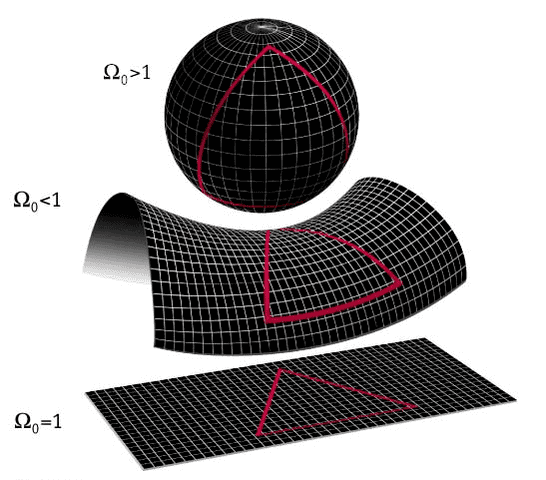
Finally, putting everything together, we arrive at the Friedmann-Lemaître-Robertson-Walker (FRW) metric. In the common coordinates, it is:
This is one of the most important equations in modern physics, describing the geometry of our evolving, homogeneous, and isotropic universe.
Test your understanding!
An observer at the origin of our comoving coordinate system () observes a distant galaxy at a fixed comoving radial coordinate .
- What is the proper distance to this galaxy at a cosmic time ? (Assume for simplicity that the universe is flat, ).
- What is the recession velocity of this galaxy relative to the observer, defined as the rate of change of the proper distance, ?
- How does this result relate to the Hubble-Lemaître Law, ?
Show answer
-
The proper distance is found by integrating the spatial part of the metric along a radial line () at a fixed time .
The proper distance to the galaxy at time is simply its fixed comoving coordinate distance multiplied by the scale factor . -
The recession velocity is the time derivative of the proper distance. Since is constant for a comoving galaxy:
-
We can express in terms of the proper distance: . Substituting this into our expression for velocity gives:
This is precisely the Hubble-Lemaître Law. The term is the Hubble parameter, which measures the expansion rate of the universe at time . Its value today is denoted . This shows that the expansion of the universe is a direct consequence of the FRW metric's structure.
Conclusion
In this lesson, we laid the geometric groundwork for modern cosmology. We have seen how a single, powerful assumption—the Cosmological Principle—leads directly to a specific form for the metric of spacetime on cosmic scales.
Key Takeaways:
- The Cosmological Principle states that on large scales, the universe is spatially homogeneous and isotropic.
- This principle implies the universe can be described by the Friedmann-Robertson-Walker (FRW) metric.
- The FRW metric features a time-dependent scale factor , which governs the overall expansion or contraction of space, and a constant curvature parameter , which determines the spatial geometry.
- The spatial geometry can be flat (), closed/spherical (), or open/hyperbolic ().
Preview of Next Lesson:
So far, we have only discussed the geometry of the universe. We have not said anything about how the scale factor actually evolves. To determine its dynamics, we must connect this geometry to the matter and energy that fills the universe. In the next lesson, we will do exactly that by plugging the FRW metric into the Einstein Field Equations to derive the Friedmann equations. These equations govern the evolution of and are the master equations of cosmology.