Hello! Welcome back to our course.
In the last lesson, we confronted three major puzzles within the standard Hot Big Bang model: the flatness, horizon, and monopole problems. Each of these points to an extraordinary—and unexplained—fine-tuning of the universe's initial conditions. As we concluded, these problems strongly suggest that the standard model is incomplete and that a new physical mechanism was at play in the universe's first moments.
That mechanism is cosmic inflation. Today, we will formally introduce the simplest and most successful model for driving this inflationary epoch. Our learning outcome is to introduce a scalar field (the inflaton) and derive its equations of motion in an FRW background. We will construct the theoretical machinery for this field, see how it can source the required accelerated expansion, and derive the fundamental equations that govern its dynamics.
1. The Engine of Inflation: A Scalar Field
From the previous module, you'll recall the Friedmann acceleration equation (in units where ):
To achieve accelerated expansion (), the universe must be dominated by a component with a sufficiently negative pressure, specifically . This is often called a violation of the "strong energy condition."
What kind of physical entity has this property? Standard matter () and radiation () do not. A cosmological constant, with , works perfectly but is, by definition, constant. To solve the Big Bang problems, we need a mechanism that can initiate this acceleration, sustain it for a period, and then gracefully exit, allowing the hot, matter-filled universe to emerge.
The leading candidate for this role is a hypothetical scalar field, which we will call the inflaton, denoted by . Your background in physics has exposed you to scalar fields before; the Higgs field is a prime example in the Standard Model. We will now treat the inflaton as a new cosmological fluid and explore its properties.
2. Dynamics of the Inflaton Field
To describe the inflaton's behavior, we start from a fundamental principle: the action. Given your background in Lagrangian mechanics, you know that the dynamics of a system are governed by an action whose variation yields the equations of motion. For a scalar field minimally coupled to gravity, the action is the sum of the Einstein-Hilbert action for gravity and the action for the field itself.
The simplest, most general, Lorentz-invariant Lagrangian for a scalar field consists of a kinetic term and a potential term:
Here, is the potential energy of the field, which we leave unspecified for now. Its shape will determine the specific model of inflation.
2.1 The Inflaton as a Cosmological Fluid
To understand how the inflaton affects spacetime's expansion, we must compute its stress-energy tensor, . This tensor acts as the source term in the Einstein Field Equations. For the Lagrangian above, the stress-energy tensor is:
A key assumption of inflation is that the inflaton field was extremely smooth and homogeneous in the early universe, so we can neglect spatial gradients and treat it as a function of time only: . In the context of the flat FRW metric (), the components of the stress-energy tensor simplify dramatically.
The energy density is the time-time component, :
The pressure can be read from the spatial components, e.g., :
These two equations are central to the theory of inflation. They express the energy density and pressure of the universe in terms of the inflaton's kinetic energy () and potential energy ().
2.2 The Condition for Inflation
With these expressions, we can see precisely how a scalar field can drive accelerated expansion. The condition requires . Let's substitute our expressions:
A little algebra simplifies this to:
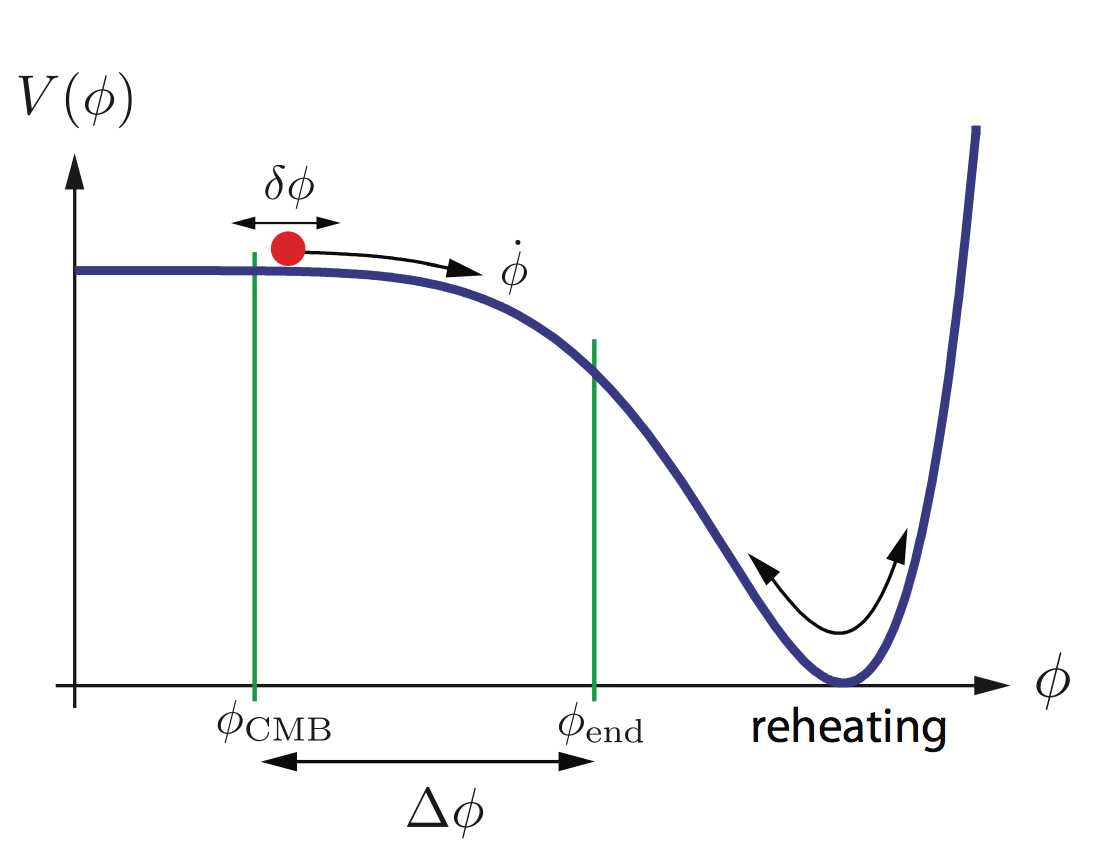
Inflation occurs if the inflaton's potential energy dominates its kinetic energy. In this regime, the field is "slowly rolling" down its potential, rather than moving quickly.
In the limit where the kinetic energy is negligible, , we find:
This gives an equation of state , which is precisely that of a temporary cosmological constant. The large, nearly constant potential energy drives a phase of quasi-exponential expansion.
3. The Equation of Motion
We now have a condition for inflation, but what determines the evolution of itself? We must derive its equation of motion. We can do this in two ways that beautifully illustrate the self-consistency of the physics.
3.1 Derivation from the Euler-Lagrange Equation
The most fundamental way is to apply the Euler-Lagrange equation to the scalar field action in the FRW background. The general equation is:
For a homogeneous field in a flat FRW background (where ), this equation simplifies significantly.
The following resource provides a clear and concise derivation of the inflaton's equation of motion from the Euler-Lagrange equations, as well as the expressions for its energy density and pressure.
Please read Section 2.2, 'Scalar field dynamics', starting from equation (2.8) and ending just before the text 'Slow roll inflation'. Pay close attention to the derivation leading to equation (2.11), which is the final equation of motion.
As the text shows, the calculation yields the Klein-Gordon equation for a homogeneous scalar field in an expanding universe:
where and is the Hubble parameter.
Let's analyze this equation. It is the equation of a classical particle moving in a potential , but with an additional term:
- is the acceleration term.
- is the force term, due to the slope of the potential.
- is a friction or damping term. This "Hubble friction" is a crucial effect: the expansion of the universe resists the motion of the inflaton field, slowing its roll down the potential. This damping is what makes a prolonged period of slow-roll inflation possible.
3.2 Derivation from Energy Conservation
We can also derive this equation from a different physical principle: the covariant conservation of energy, . For any fluid in an FRW universe, this simplifies to:
Let's apply this to our inflaton fluid. We have:
Taking the time derivative of the energy density:
Now, substituting into the conservation equation:
Assuming , we can divide by to recover the exact same equation of motion:
This confirms that the Klein-Gordon equation for the inflaton is simply the statement of energy conservation for the scalar field fluid in an expanding background.
Test your understanding!
Consider a hypothetical inflaton potential that is perfectly flat, constant. What does the equation of motion tell you about the evolution of ? If the field starts with some initial velocity , what will happen to over time? How does this relate to the equation of state ?
Show answer
If , then . The equation of motion becomes . This means that any initial velocity will be damped by Hubble friction, decaying away exponentially as the universe expands. As , the kinetic energy term rapidly becomes negligible compared to the constant potential energy .
Consequently, the energy density and pressure become and . The system naturally evolves to the state , which is identical to a cosmological constant. This shows how Hubble friction is key to establishing the slow-roll condition.
The Complete System
We now have the full set of classical equations that govern the dynamics of the background during inflation. Assuming the universe is dominated by the inflaton and is spatially flat (), the evolution is determined by two coupled differential equations:
- Friedmann Equation:
- Inflaton Equation of Motion:
Given a specific form for the potential , this system can be solved to find the evolution of the scale factor and the field value .
Conclusion
In this lesson, we have laid the essential groundwork for the theory of cosmic inflation. We have moved from the conceptual need for a period of accelerated expansion to a concrete physical model based on a scalar field, the inflaton.
Key Takeaways:
- Cosmic inflation can be driven by a scalar field, the inflaton , with a potential .
- The inflaton field acts as a fluid with energy density and pressure .
- Accelerated expansion () occurs when the potential energy dominates the kinetic energy: . In this "slow-roll" regime, the inflaton mimics a temporary cosmological constant.
- The evolution of a homogeneous inflaton field is governed by the Klein-Gordon equation , which describes a particle moving in a potential with a damping term provided by Hubble expansion.
We now have the equations, but we have not yet shown how they solve the problems of the Big Bang model. To do that, we need to ensure that inflation lasts long enough. This requires a more detailed look at the conditions for slow-roll.
Preview of Next Lesson:
In our next lesson, we will formalize the slow-roll approximation. We will define a set of dimensionless "slow-roll parameters" that quantify the flatness of the potential and the slowness of the field's evolution. Using this approximation, we will then demonstrate explicitly how a sufficient period of inflation naturally drives the universe to flatness () and expands a single, tiny causal patch to encompass our entire observable universe, thereby solving the flatness and horizon problems.