Hello! Welcome to your second lesson.
In our previous session, we established the mathematical setting for general relativity: the smooth manifold. We saw that a manifold is a space that, while possibly curved globally, looks locally like familiar Euclidean space. This "local flatness" is what allows us to do calculus.
Today, we will begin to populate this stage with the actors of physics: vectors and vector fields. In your previous studies, you've worked with vectors as arrows in . On a general manifold, this picture is insufficient because there is no global flat space for the arrows to live in. A vector at one point on a sphere "points" in a different space from a vector at another point.
Our goal is to define the tangent space at a point and construct vector fields as derivations. We will achieve this by:
- Defining a tangent vector at a point
pnot as an arrow, but as an operator that measures the directional derivative of functions. This operator is called a derivation. - Showing that the set of all such derivations at
pforms a vector space, which we call the tangent space . - Constructing a basis for this space using local coordinates, which connects this abstract definition to concrete computations.
- Generalizing from a single point to the whole manifold, defining a vector field as a smooth assignment of a tangent vector to every point.
- Finally, showing that the collection of all smooth vector fields is equivalent to the set of all derivation operators on the algebra of smooth functions on the manifold.
1. The Tangent Space: An Intrinsic Definition
Intuitively, the tangent space at a point on a manifold is the flat space (plane, hyperplane) that best approximates the manifold at that point. It's the collection of all possible "velocity vectors" for curves passing through .
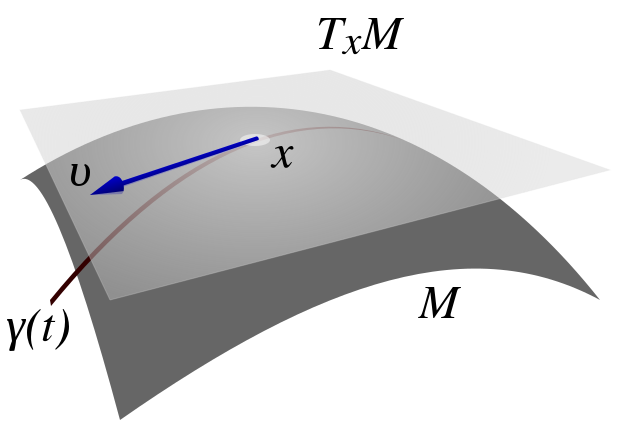
The challenge is to make this definition precise without relying on an embedding in a higher-dimensional space. The modern approach, which is both rigorous and powerful, is to define a tangent vector by what it does: it computes a directional derivative.
Consider a smooth function and a smooth curve such that . The composition is a map from , so we can take its ordinary derivative. The rate of change of along the curve at the point is:
This operation, which takes a function and returns a real number, is the action of the "velocity vector" of the curve at .
The following video segment by Frederic Schuller introduces this idea formally, defining a tangent vector as a specific kind of linear map.
Differential structures: the pivotal concept of tangent vector spaces - Lec 09 - Frederic Schuller
This segment introduces the core idea of defining a tangent vector as a directional derivative operator. It shows how a curve \gamma through a point p gives rise to a linear map from the space of smooth functions to the real numbers.
Please watch from 06:38 to 12:16. Focus on the formal definition of the directional derivative operator X_{\gamma,p} and the key insight that in differential geometry, a tangent vector is this operator.
2. Vectors as Derivations
The video defines the tangent vector associated with a specific curve. The key insight is to abstract away from the curves themselves and focus on the algebraic properties of these operators. This leads to the general definition of a tangent vector.
Definition: Derivation
A derivation at a point is a map that is:
- Linear: for and .
- Satisfies the Leibniz Rule: for .
The directional derivative along any curve is an example of a derivation. We now turn this around and define the tangent space as the set of all such derivations.
Definition: Tangent Space
The tangent space to at , denoted , is the set of all derivations on at the point .
This definition is powerful, but we must verify that this set, , actually forms a vector space. Addition and scalar multiplication are defined pointwise:
It's straightforward to check that if and are derivations, then and are also linear maps that obey the Leibniz rule. The deeper question, however, is whether the sum of two tangent vectors (defined via curves) is itself a tangent vector corresponding to some new curve. Proving this confirms that our definition is consistent.
The following video segment contains a detailed and rigorous proof of this fact. Given your preference for formal proofs, this section is particularly important. The strategy is to use a chart to move the problem to , construct the "sum curve" there, and then map it back to the manifold.
Differential structures: the pivotal concept of tangent vector spaces - Lec 09 - Frederic Schuller
This segment rigorously proves that the set of tangent vectors is closed under addition. It explicitly constructs the curve whose velocity vector is the sum of two other velocity vectors.
Watch from 16:14 to 38:14. Follow the logical steps: The definition of the tangent space T_pM as the set of all tangent vectors from curves through p. The definition of vector addition pointwise. The crucial question: does the sum of two tangent vectors correspond to a tangent vector of some curve? The explicit construction of the sum-curve \Sigma within a chart. The calculation showing that the tangent vector to \Sigma is indeed the sum of the original vectors.
3. A Basis for the Tangent Space
Now that we have established as a vector space, the next step is to find a basis. This will connect the abstract definition to a concrete computational framework. The most natural choice of basis is one induced by a coordinate chart around the point .
The basis vectors are the partial derivative operators . When this operator acts on a function , it yields the partial derivative of the coordinate representation of , evaluated at the coordinates of . More formally:
where are the standard Cartesian coordinates in .
The central theorem is that these operators form a basis for the -dimensional tangent space .
Theorem: The set of vectors is a basis for . Consequently, .
The following video segment provides a full proof of this theorem. It is a constructive proof that is fundamental to our ability to work with vectors in component form.
Differential structures: the pivotal concept of tangent vector spaces - Lec 09 - Frederic Schuller
This segment proves that the dimension of the tangent space equals the dimension of the manifold by explicitly constructing a coordinate-induced basis.
Watch from 56:58 to 01:19:01. Pay attention to: The construction of the special curves \gamma_a that correspond to moving along the coordinate axes in the chart. The calculation showing that the tangent vectors to these curves are precisely the partial derivative operators \partial/\partial x^a. The proof that these operators span the tangent space (any vector can be written as a linear combination of them). The proof that they are linearly independent.
With this result, any tangent vector can be uniquely written as a linear combination of the basis vectors:
The real numbers are the components of the vector in the coordinate basis . This recovers the familiar notion of vector components from your previous physics courses.
Test your understanding!
Consider the manifold with standard Cartesian coordinates . Let be the point . A curve is given by . Note that . Let be the tangent vector to this curve at . Find the components of in the coordinate basis .
Show answer
The tangent vector is the operator . We want to express it as .
The components are given by .
For the -component:
For the -component:
So, the tangent vector is . Its components are .
4. Vector Fields as Derivations
We have defined vectors at a single point. To describe physical fields (like an electric field or fluid velocity), we need a vector at every point. This is a vector field.
Definition: Vector Field
A (smooth) vector field on a manifold is a smooth assignment of a tangent vector to each point .
More formally, we can define the tangent bundle as the set of all tangent vectors at all points. A vector field is then a smooth map such that .
Just as a single tangent vector is a derivation that maps functions to numbers, a vector field can be seen as a derivation that maps smooth functions to smooth functions.
Given a vector field and a smooth function , we define a new function, , whose value at any point is given by the action of the vector on :
It can be shown that if and are smooth, the resulting function is also smooth. This operator is a derivation on the algebra of smooth functions.
Crucially, the converse is also true: any derivation on corresponds to a unique smooth vector field. This gives us a profound equivalence.
Part III - Differential Geometry
The following text from a set of differential geometry notes formalizes the definition of a vector field and proves the isomorphism between the space of vector fields and the space of derivations. This is the capstone result of this lesson.
Read pages 18-21, from Section 2.1 'The tangent bundle' to the end of Section 2.1. Focus on: The definition of a vector field as a smooth map to the tangent bundle. The definition of Der(C^\infty(M)), the space of derivations on the algebra of smooth functions. The lemma establishing the isomorphism between Vect(M) (the space of vector fields) and Der($C^\infty(M)$). Follow the steps of the proof for this lemma. It shows how to construct a vector at each point from a global derivation and proves its smoothness.
This isomorphism is a cornerstone of modern differential geometry. It allows us to treat vector fields and derivations as one and the same. This perspective will be incredibly useful when we later define concepts like the Lie derivative.
Summary and Next Steps
Let's consolidate what we have achieved:
- We moved from an intuitive picture of tangent vectors to a rigorous, intrinsic definition. A tangent vector at is a derivation: a linear operator on smooth functions that obeys the Leibniz rule.
- The set of all such vectors at a point forms the tangent space , a vector space with the same dimension as the manifold itself.
- We constructed the coordinate basis for , which allows us to represent vectors by their components, .
- A vector field is a smooth choice of tangent vector at each point of the manifold.
- We established a fundamental equivalence: the space of smooth vector fields,
Vect(M), is isomorphic to the space of all derivations on the algebra of smooth functions,Der(C^\infty(M)).
You have now built the concept of a vector from first principles in the language of manifolds. In our next lesson, we will explore the "dual" concept. For every vector space, there is a dual vector space. The dual to the tangent space is called the cotangent space, and its elements are called covectors or one-forms. This will be our first step towards constructing general tensors.