Welcome to your second lesson. In our first session, we established the core concept that a stock represents a slice of ownership in a company. You are now a part-owner of Wix.com. But where exactly did that transaction happen? How do millions of buyers and sellers find each other every day to trade these slices of ownership?
Today, we will answer that question by exploring the marketplaces where stocks are traded: the stock exchanges. Our focus will be on understanding the role of the two giants in the U.S. market, the New York Stock Exchange (NYSE) and the NASDAQ, and how they each facilitate the buying and selling of stocks like the ones you own.
What is a Stock Exchange?
At its most basic, a stock exchange is a regulated and centralized marketplace designed for trading securities like stocks. It provides the infrastructure and rules that allow for fair and orderly trading.
To get a simple, intuitive grasp of this concept, a good analogy is a local farmer's market.
NYSE vs NASDAQ: What is the Difference and What's a Stock Exchange? | Finance 101
This short video from NerdWallet uses a great analogy to explain the fundamental purpose of a stock exchange.
Please watch the opening section that explains this idea, from the farmer's market analogy up to the definition of a stock.
Just as the farmer's market provides a physical place for farmers and customers to meet and trade goods under a common set of expectations, a stock exchange provides a formal venue for buyers and sellers of stocks to transact. The key difference is that the "goods" are fractional ownership in corporations.
Two Dominant Models: Auction vs. Dealer
While there are many exchanges around the world, most operate on one of two primary models. The two major U.S. exchanges, the NYSE and NASDAQ, are perfect examples of these different approaches.
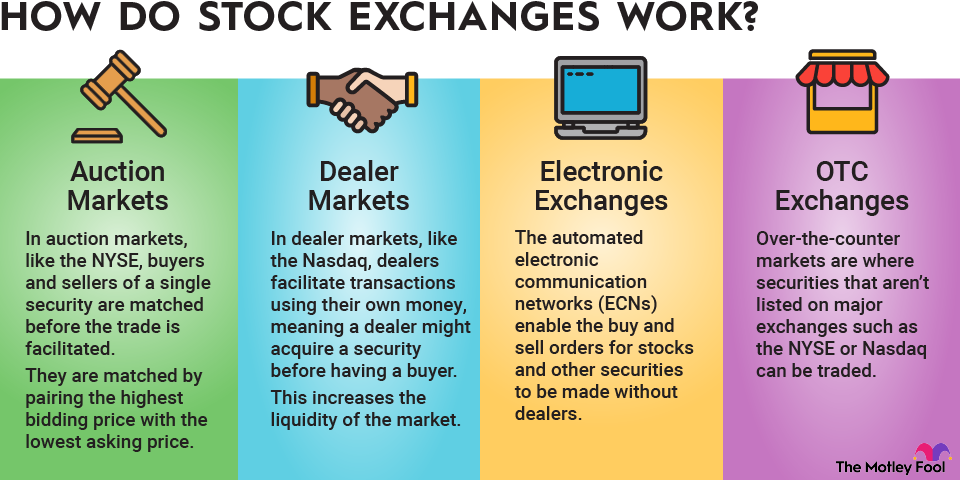
Let's break down these two models.
-
The Auction Market (NYSE): The New York Stock Exchange, founded in 1792, is the classic example of an auction market. In this model, buyers and sellers come together and compete. Buyers submit "bids" (the highest price they're willing to pay) and sellers submit "asks" (the lowest price they're willing to accept). The exchange's system then matches the highest bid with the lowest ask, and a trade is executed. It’s a bit like a continuous, high-speed auction for every stock.
-
The Dealer Market (NASDAQ): The NASDAQ, established in 1971 as the world's first electronic stock market, operates as a dealer market. Instead of buyers and sellers trading directly with each other, they trade through intermediaries known as "dealers" or "market makers." These market makers (who are typically large financial institutions) hold an inventory of stocks and continuously post their own bid and ask prices. You buy from a dealer or sell to a dealer. The competition among many different dealers for the same stock is what ensures fair pricing.
This distinction between an auction and a dealer market is the most fundamental difference in how the NYSE and NASDAQ facilitate trades.
Understanding NYSE and Nasdaq: Key Differences and ...
This Investopedia article provides a clear, detailed explanation of these two market structures and the key players involved.
First, read the section Understanding Nasdaq's Dealer Market vs. NYSE's Auction System to solidify the core difference. Then, continue reading the following section, Nasdaq's Market Makers vs. NYSE's Designated Market Makers, which explains the different roles of the human or institutional facilitators on each exchange. Pay close attention to the distinction between the NYSE's single Designated Market Maker (DMM) per stock and the NASDAQ's multiple, competing market makers.
A Tale of Two Exchanges: Prestige vs. Innovation
Beyond their core trading mechanisms, the NYSE and NASDAQ have distinct characteristics, reputations, and attract different types of companies.
The NYSE, with its iconic trading floor on Wall Street, has long been associated with large, established, "blue-chip" companies—think Coca-Cola, Johnson & Johnson, and Walmart. Listing on the NYSE is often seen as a mark of prestige and stability.
The NASDAQ, being fully electronic from its inception, naturally became the home for innovative technology and growth companies. Given your interest in digital marketing and your experience with Shopify, this is a world you're likely familiar with. Companies like Apple, Amazon, Microsoft, and—most relevant to you—Wix.com are all listed on the NASDAQ. This choice reflects their identity as modern, tech-focused businesses.
The following infographic provides an excellent side-by-side comparison.
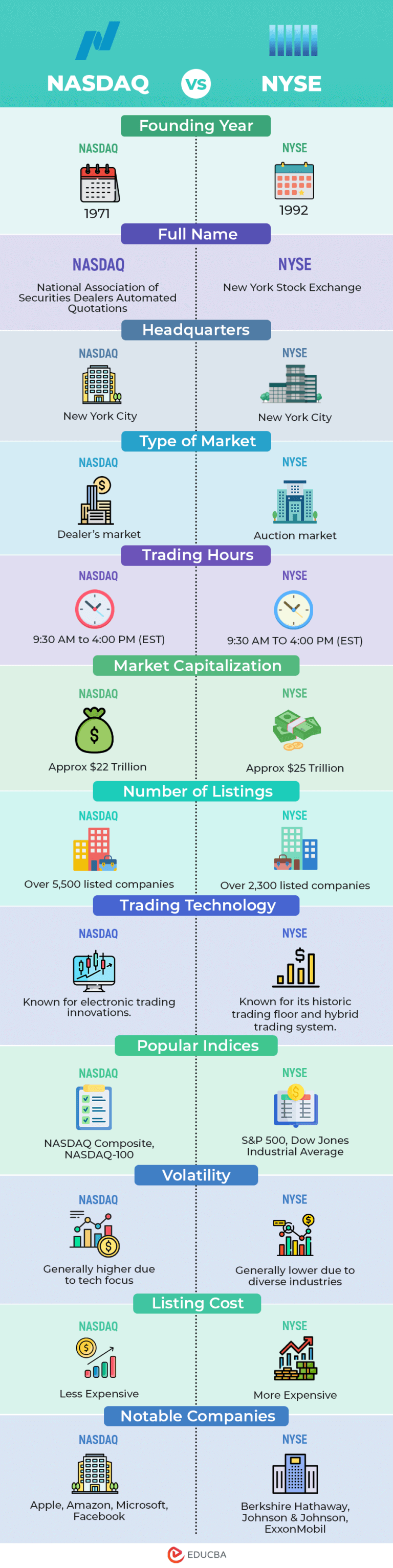
As you can see, the "Type of Market" (Dealer's vs. Auction) and the "Notable Companies" (tech giants vs. industrial and consumer staples) are direct reflections of the operational and historical differences we've discussed.
Conclusion
In this lesson, we've pulled back the curtain on where stock trading actually takes place. You now know that exchanges are the organized markets that make it all possible.
Here are the key takeaways:
- A stock exchange is a regulated marketplace where stocks are bought and sold.
- The NYSE operates as an auction market, where bids and asks from buyers and sellers are matched, often facilitated by a single Designated Market Maker (DMM). It's home to many older, established companies.
- The NASDAQ operates as a dealer market, where multiple market makers compete to buy from and sell to investors. It is fully electronic and is the preferred exchange for most technology and growth-oriented companies, including your investment in Wix.com.
We've seen how the exchanges match buyers and sellers. In our next lesson, we will dive deeper into the forces that drive the prices in these transactions: the fundamental principles of supply and demand.