In our last lesson, we explored the organized marketplaces where stocks are traded—the NYSE and NASDAQ. We saw how they function as either auction or dealer markets to facilitate transactions. But what actually determines the price at which a stock like your Wix.com shares are bought or sold within those exchanges?
Today, we will answer that fundamental question. We'll delve into the core economic principle that drives all price movements in a free market: the law of supply and demand. By the end of this lesson, you will be able to explain precisely how this constant tug-of-war between buyers and sellers sets the price for every stock traded.
The Balancing Act: Supply vs. Demand
At its heart, the stock market is a dynamic auction driven by one simple relationship: the interaction between those who want to buy a stock (demand) and those who want to sell it (supply). The price of a stock at any given moment is simply the point where these two forces find a temporary balance.

When more people want to buy a stock than sell it, there is high demand for a limited supply of shares. This competition among buyers pushes the price up. Conversely, when more people want to sell a stock than buy it, there is a high supply of shares with low demand. This competition among sellers pushes the price down.
To see this "see-saw" effect in action, let's watch a short, animated explanation.
How does the stock market work? - Oliver Elfenbaum
This animated video from TED-Ed provides a clear and concise visual of how demand and supply affect a stock's price and a company's value.
Watch the section from "as it becomes more successful" to understand how rising demand increases a stock's price. Then, watch the following section from "the reverse can also happen" to see how falling demand causes the price to drop.
From Concept to Market Price: The Bid-Ask System
This balancing act isn't just a theoretical concept; it happens in real-time on the exchanges through a process of bids and asks.
- A bid is the highest price a buyer is currently willing to pay for a stock.
- An ask (or offer) is the lowest price a seller is currently willing to accept for that same stock.
A trade occurs when a buyer and seller agree on a price—either a buyer raises their bid to meet the ask, or a seller lowers their ask to meet the bid. That transaction price becomes the new "current price" of the stock.
The following resource explains this auction process clearly.
How Are Stock Prices Determined? | Stash Learn
This article from Stash Learn breaks down how the abstract idea of supply and demand translates into the concrete prices you see on your screen.
Start by reading the introductory paragraph under the main title, from the definition. Then, read the section "How do stock prices work?" to understand the auction mechanism. Finally, read the section "How supply and demand work", which directly explains how these forces create upward or downward pressure on prices.
What Shifts Supply and Demand?
If prices are set by supply and demand, the next logical question is: what causes supply and demand to change? The answer is new information. Investors are constantly reacting to news, data, and events that change their perception of a company's future value.
This short video from The Motley Fool introduces this idea perfectly.
Why Stock Prices Go Up and Down, Explained With Tilray
This video directly answers the question of why prices move and connects it to the flow of information.
First, watch the brief section from "In short, stock prices change" which reinforces the auction analogy. Then, watch the critical segment from "what determines investors' interest" that explains how new information influences investor behavior and, consequently, supply and demand.
As the video explained, information is the catalyst. Here are some of the key factors that can cause a shift in the supply and demand balance for a stock:
- Company Performance: Strong earnings reports, successful product launches, or market share growth can increase demand. Poor results, on the other hand, can lead to a surge in sellers (supply).
- Broader Economic News: Data on inflation, interest rates, or unemployment can affect the entire market. A strong economy often boosts investor confidence and demand for stocks in general.
- Market Sentiment: Sometimes, the "mood" of the market, driven by news headlines or social media trends, can create waves of buying (demand) or selling (supply), even without a specific change in a company's fundamentals. This is often described as "hype" or "fear."
The following graphs illustrate these shifts. An increase in supply or a fall in demand both result in a lower equilibrium price. The opposite is also true: a decrease in supply or a rise in demand would push the price higher.
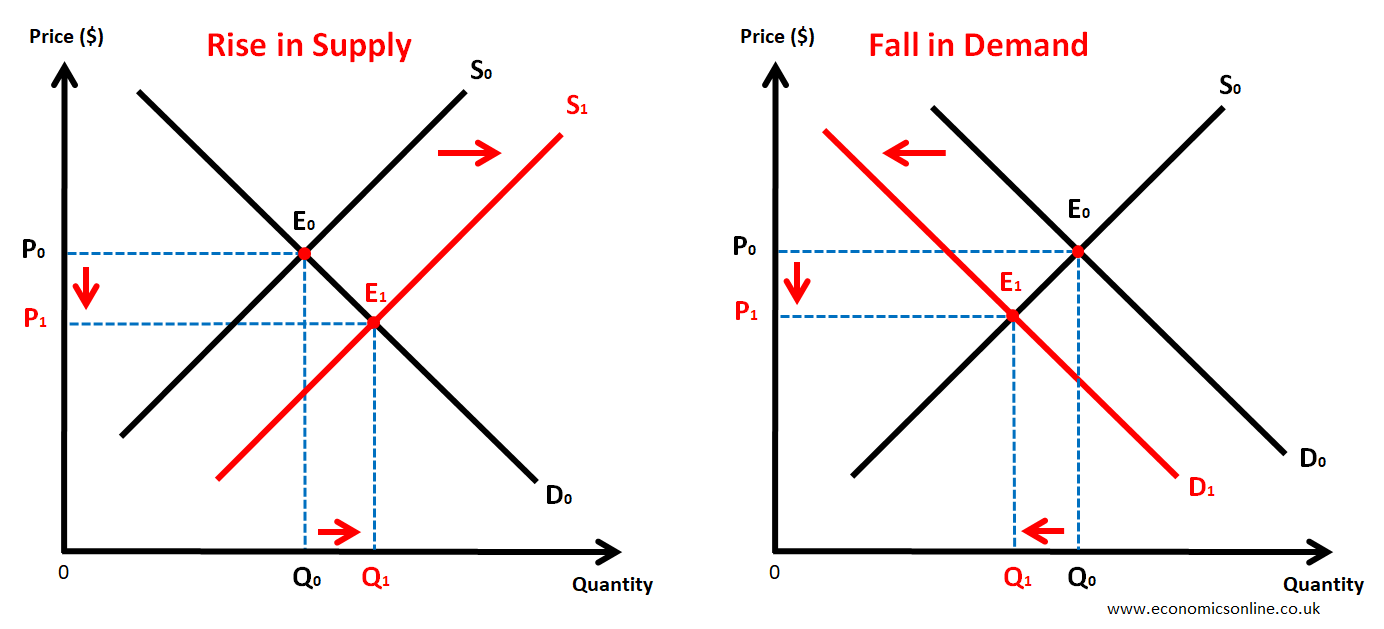
To solidify your understanding, let's read a short article that ties these factors together with practical examples.
Understanding Supply and Demand in Stocks plus How Prices Move
This article from Gotrade provides excellent, concise examples of what causes demand or supply to increase.
Read the section "How Supply and Demand Moves Prices" for a clear breakdown. Then, continue to the section "Factors That Influence Supply and Demand" for a list of catalysts. Finally, read the "Practical Market Example" which walks through a hypothetical earnings report scenario.
Case Study: Tilray's Wild Ride
Let's look at a dramatic real-world example of supply and demand at work. The cannabis company Tilray (ticker: TLRY) had one of the most volatile debuts in recent stock market history.
Why Stock Prices Go Up and Down, Explained With Tilray
The Motley Fool video we watched earlier contains a perfect case study on Tilray that demonstrates both sides of the supply-demand equation.
Please watch the section covering the Tilray example. Pay close attention to the two key phases: The initial price surge, caused by high demand (investor hype around cannabis) and low supply (a limited number of publicly available shares). The subsequent price crash, caused by waning demand (more cannabis stocks became available) and surging supply (early investors were allowed to sell their shares).
Tilray's story is a powerful illustration of how market mechanics, not just a company's intrinsic value, can create massive price swings. It shows that even a company with exciting prospects can see its stock price fall if the supply of shares suddenly overwhelms demand.
Conclusion
Today we've uncovered the engine that drives stock price movements. The price you see for any stock is not a fixed number, but the dynamic result of a global auction between buyers and sellers.
Here are the essential takeaways:
- Stock prices are determined by the law of supply and demand.
- High demand relative to supply pushes prices up.
- High supply relative to demand pushes prices down.
- The market finds its price through the bid-ask system, where a transaction occurs at the point of agreement between a buyer and a seller.
- Shifts in supply and demand are caused by new information, including company performance, economic data, and overall market sentiment.
In the last lesson, we learned where stocks are traded (exchanges). Today, we learned why prices move. In our next lesson, we'll connect these ideas by exploring the difference between a company's initial offering of stock to the public (the primary market, or IPO) and the everyday trading that follows (the secondary market).