Welcome back! In our last lesson, we distinguished between the primary market, where companies issue new stock to raise capital, and the secondary market, where investors trade those existing stocks among themselves. This raised a crucial question: who exactly are these "investors" participating in the daily give-and-take of the market?
Today, we'll pull back the curtain on the main players whose actions collectively create the market dynamics you see every day. We will identify three key groups of market participants: retail investors, institutional investors, and market makers. Understanding their distinct roles, motivations, and scale is essential to making sense of why and how stock prices move.
The Two Major Types of Investors
When you bought your shares of Wix.com, you became one of the two main types of investors. The market is broadly divided between individuals investing for themselves and large organizations managing vast sums of money.
This short video clip uses a simple and effective analogy to illustrate this difference.
Why retail investing has taken off in the U.S. - but not Europe
This video from CNBC International clearly distinguishes between retail and institutional investors using an analogy of buying flowers.
Please watch the opening segment, from the beginning of the video. Pay close attention to the distinction between buying in "bulk" versus buying a single "bouquet."
As the video explained, let's break down these two categories.
1. Retail Investors
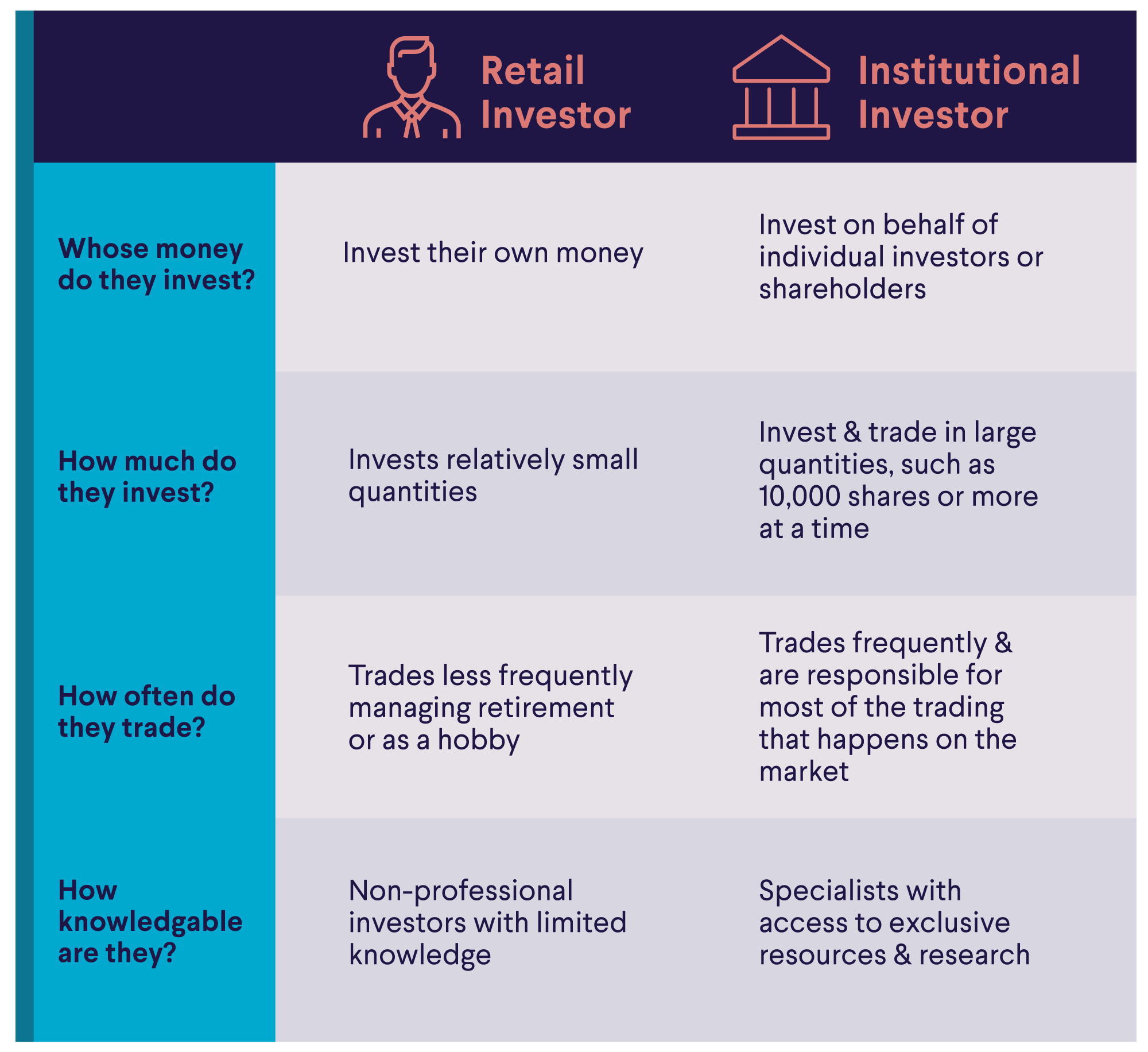
A retail investor is an individual who buys and sells securities for their personal account, not for another company or organization. When you invest your own money for your financial goals—whether it's for retirement, a down payment, or simply to grow your wealth—you are acting as a retail investor.
Retail investors, sometimes called individual investors, are just like you and me. The rise of online brokerage platforms has made it easier than ever for individuals to participate in the market.
2. Institutional Investors
Institutional investors are the "wholesalers" from the video's analogy. These are large organizations that pool money to purchase securities in massive quantities. Their clients can be pension plan members, university endowments, insurance policyholders, or people who have invested in a mutual fund.
Because they manage enormous amounts of capital and trade in very large volumes (often thousands or millions of shares at a time), their actions can have a significant impact on stock prices and overall market trends.
The image below provides a great summary of the key differences between these two groups.
To deepen your understanding of these two groups and introduce our third key participant, please read the following sections from the article "Market Participants".
8.3: Market Participants - Business LibreTexts
This article from Business LibreTexts provides clear, concise definitions of the key players in the financial markets.
Start by reading the sections on Individual (Retail) Investors and Institutional Investors. This will solidify the concepts we've just discussed.
The Facilitators: Market Makers
So, we have retail investors like you wanting to buy a few shares, and institutional investors wanting to sell thousands of shares. How do these trades happen so quickly and efficiently? What ensures that when you want to buy, there's always someone ready to sell, and vice-versa?
This is where market makers come in. They are the essential "plumbers" of the financial markets.
A market maker is a firm that stands ready to buy and sell a particular stock on a regular and continuous basis at a publicly quoted price. They aren't investing based on a long-term belief in a company's future; their job is to provide liquidity, ensuring that trading can always take place.
They do this by quoting two prices for a stock:
- The Bid Price: The price at which the market maker is willing to buy the stock from you.
- The Ask Price: The price at which the market maker is willing to sell the stock to you.
The market maker profits from the small difference between these two prices, known as the bid-ask spread.
This diagram illustrates the process perfectly.

The following video offers a very clear and engaging explanation of the market maker's role and how they profit from the spread.
Stock Market Explained 2024: Understanding How It Works for Beginners
In this clip, the Wallstreet Trapper breaks down the role of a market maker in simple, practical terms.
Watch the section from "the market makers are your people". Note how he describes them as the "middleman" who gets paid from the "spread in between."
To round out your understanding, let's turn to a more detailed textual explanation of why market makers are so crucial.
Who Are Market Makers, Institutional Investors, and Other ...
This article from Britannica Money gives excellent context on the necessity of market makers for creating an efficient market.
Please read the section under the heading Why do we need market makers?. It clearly explains the problem of illiquidity that market makers solve.
Without market makers, buying or selling a stock would be a slow and difficult process. You'd have to wait for another investor to come along who wanted to make the exact opposite trade as you, at the same time, and for the same number of shares. Market makers eliminate this friction, allowing trades to execute in fractions of a second.
Conclusion
In this lesson, we've identified the three primary participants that make the secondary market function. Their interplay forms a dynamic ecosystem where stocks are traded continuously.
Here are your key takeaways:
- Retail Investors: Individuals like you, investing their own money, typically in smaller quantities.
- Institutional Investors: Large organizations managing huge pools of capital on behalf of others. Their large trades can significantly influence market direction.
- Market Makers: Intermediary firms that provide liquidity by always being willing to buy and sell securities. They profit from the bid-ask spread.
Now that you know who the players are, the next logical question is how you, as a retail investor, access this vast marketplace. In our next lesson, we will explore the essential role of a stock broker and how brokerage accounts work as your gateway to buying and selling stocks.