Welcome back! In our last lesson, we demystified the role of stock brokers and brokerage accounts, establishing your personal gateway to the stock market. You now have a complete picture of the market's structure, from the exchanges down to your own account.
Today, we address the final fundamental question of when you can trade. The stock market, much like a physical business, doesn't operate 24/7. It has specific hours for buying and selling. This lesson will describe the difference between regular trading hours and the sessions that happen before the market opens (pre-market) and after it closes (after-hours). Understanding these distinct periods is crucial for navigating the market effectively and managing risk.
The Official Business Day: Regular Trading Hours
The main U.S. stock exchanges, the New York Stock Exchange (NYSE) and NASDAQ, operate on a set schedule. This primary trading window is known as regular trading hours or the core trading session.
- Time: 9:30 a.m. to 4:00 p.m. Eastern Time (ET), Monday through Friday.
- Characteristics: This is when the vast majority of trading occurs. The market is at its most active, meaning there is high liquidity (many buyers and sellers) and high volume (a large number of shares are traded). For most retail investors, this is the main, and often the only, time they will trade.
The video "When do stock markets open/close?" from the Think Stocks channel offers a simple analogy to get us started.
When do stock markets open/close?
This video provides a straightforward explanation of market hours for new investors.
Watch these short segments: The initial explanation compares the market to a bank with specific opening and closing times. The section on regular hours confirms the 9:30 a.m. to 4:00 p.m. ET window as the time when you can actively buy and sell. A quick note on weekends and holidays, when the market is closed entirely.
Trading Before and After the Bell: Extended Hours
While the core session ends at 4:00 p.m. ET, trading doesn't stop completely. Transactions can also occur in what are called extended-hours trading sessions. These are broken down into two main periods:
- Pre-market Trading: The session that occurs before the market opens.
- After-hours Trading: The session that occurs after the market closes.
This infographic provides a clear visual timeline of a typical trading day, including these extended sessions.
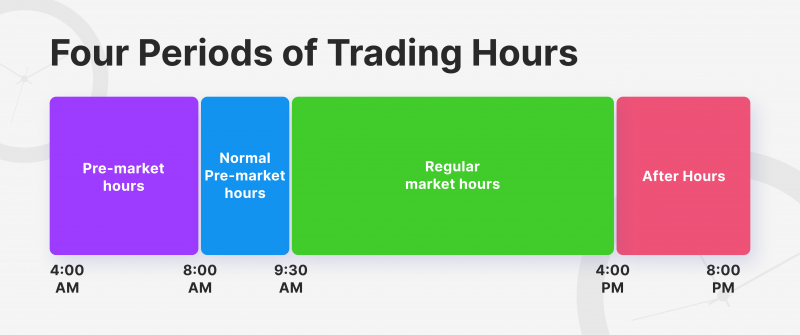
The exact times can vary slightly by broker, but generally, the schedule is as follows:
- Pre-market: 4:00 a.m. to 9:30 a.m. ET
- After-hours: 4:00 p.m. to 8:00 p.m. ET
Why Trade Outside of Regular Hours?
You might wonder why these sessions exist. They offer a couple of key advantages, primarily centered around time and information. The Charles Schwab video "Trading in the Pre-Market and After-Hours" explains this well.
Trading in the Pre-Market and After-Hours on Schwab.com | Comment Below
This video clearly outlines the primary motivations for participating in extended-hours trading.
Watch the segment from the "why trade" section. It covers the two main benefits: convenience and the ability to react to news.
As the video notes, the main benefits are:
- Convenience: It offers flexibility for investors who cannot actively trade during a standard 9-to-5 workday.
- Reacting to News: This is the most significant reason. Major company news, such as quarterly earnings reports, is often released after the market closes. This is done intentionally to give investors time to digest the information without making knee-jerk reactions. Extended-hours trading allows investors to act on this news before the next core session begins.
The Risks of Trading in Extended Hours
While the ability to react quickly to news sounds appealing, extended-hours trading carries significant risks that every beginner must understand. The environment is very different from the core trading session.
Pre-market, after-hours, and overnight trading
This article from Wealthsimple provides a clear summary of the unique risks associated with trading outside of regular market hours.
Please read the section titled Potential risks. Focus on the definitions of lower liquidity, wider spreads, and increased volatility.
To summarize the key risks you just read about:
- Lower Liquidity: There are far fewer buyers and sellers. This can make it difficult to execute a trade at a desirable price, or at all.
- Wider Bid-Ask Spreads: Because liquidity is lower, the gap between the highest price a buyer is willing to pay (the bid) and the lowest price a seller is willing to accept (the ask) widens. This effectively makes the transaction cost higher.
- Increased Volatility: With fewer participants, even a relatively small trade can cause a large, sudden price swing. Prices can be much more erratic and unpredictable.
- Price Uncertainty: The price you see in after-hours may not be representative of the broader market sentiment, as it's based on a much smaller pool of trading activity.
How After-Hours Activity Impacts the Market Open
Activity during the pre-market session, often driven by news released overnight, can have a dramatic effect on a stock's opening price at 9:30 a.m. If positive news sends a stock's price soaring in the pre-market, it may open much higher than its previous closing price. This is known as a "gap up." The opposite, a "gap down," can occur with negative news.
The chart below shows a real example of this. Notice the flurry of activity after the market closes, and how the price opens the next day at a significantly lower point than where it closed.

The article from Wealthsimple provides an excellent story-based example of how this plays out.
Pre-market, after-hours, and overnight trading
This section explains the concept of a price gap using a clear, narrative example.
Read the section How extended hour trading affects opening price. The "Nut Milks Worldwide" example illustrates perfectly how after-hours and pre-market news can lead to a gap up.
One final important detail: trading in extended hours usually requires you to use a specific type of order called a limit order, where you set the exact price you are willing to buy or sell at. This is a safety measure to protect you from the high volatility. We will cover order types in detail in a future module.
Conclusion
You now understand that the stock market has a main session and extended sessions, each with distinct characteristics. For you as a beginner, sticking to regular trading hours is the safest approach until you gain more experience.
Here are the key takeaways from today's lesson:
- Regular Trading Hours are from 9:30 a.m. to 4:00 p.m. ET and are characterized by high liquidity and trading volume.
- Extended Hours include pre-market (before 9:30 a.m.) and after-hours (after 4:00 p.m.) sessions.
- The main benefit of extended hours is the ability to react to news released outside the core session.
- The primary risks are low liquidity, wide bid-ask spreads, and high volatility, which make it a riskier environment, especially for new investors.
- Activity in extended hours can cause a stock's price to gap up or down at the next market open.
This lesson concludes Phase 1 of our course. You've built a solid foundation by understanding what a stock is, who the market participants are, how the exchanges and brokers work, and when you can trade.
In our next lesson, we will begin Phase 2 by looking closer at the assets themselves. We'll start by exploring the difference between the two main types of stock: common stock and preferred stock.