Hello! In the previous lessons, you used an appliance’s power rating to estimate its current and electricity consumption. Those figures describe normal use. This lesson turns to faults: what happens if too much current flows, or if current takes a path it should not take?
You will distinguish three protections commonly described in Turkey as topraklama (protective earthing), sigorta (a fuse or circuit breaker), and kaçak akım rölesi (a residual-current device, or RCD). They work together, but none makes it safe to touch household wiring. Allow about 35–40 minutes for the short videos, reading, and explanations. There is no need to open a panel or test a live circuit.
Start with the path current takes
In normal operation, current travels to an appliance through the phase conductor and returns through the neutral conductor. An appliance with a conductive outer case may also have a protective-earth connection. That connection is not meant to carry the appliance’s normal operating current.
Now imagine a fault inside a metal-cased appliance: a phase conductor comes loose and touches the case. Without effective protection, someone touching the case could become part of a path for current. Protective earthing provides an intentional path from the case back through the electrical installation. A sufficiently large fault current may cause a fuse or breaker to operate; an RCD may also detect current that is not returning through neutral.
Watch how the first video introduces overcurrent protection and the purpose of an earth wire.
GCSE Physics - Fuses & Earthing | Safety Precautions to Reduce Risks from Surges (2027/28 exams)
Watch GCSE Physics - Fuses & Earthing by Cognito for its visual explanation of fuses, breakers, and a fault involving an appliance case.
Watch fuses and breakers for how each interrupts excessive current, then earthing for the metal-case fault and the brief contrast with double insulation. Focus on the different jobs of the devices, rather than the video's example fuse ratings: protective-device ratings must suit the particular installation.
Earthing reduces risk; it does not guarantee that a faulty appliance is harmless. Its protection depends on a sound earth connection and a correctly designed installation. Do not defeat an appliance’s earth connection or improvise one. Conversely, some appliances are designed with double insulation and have no protective-earth connection by design; a two-pin plug alone does not tell you whether an unknown or damaged appliance is safe.
A fuse or breaker responds to too much current
A fuse and an ordinary circuit breaker provide overcurrent protection. An overload occurs when a circuit is asked to supply more current than it is designed to carry. A short circuit is an unintended low-resistance connection that can produce a very large current. Either can overheat wiring and create a fire hazard.
A fuse opens its circuit when its element operates and must then be replaced with the correct type and rating. A circuit breaker trips open and can be reset, but resettable does not mean that the reason it tripped has disappeared. In either case, the protective device must be selected for the wiring and circuit, not simply for the wattage of an appliance you want to plug in. Increasing a fuse or breaker rating to prevent trips can leave the wiring inadequately protected.
The following booklet makes that distinction particularly clear. It describes a different country’s household hardware, so use it for the principle, not as a source of fuse sizes for a Turkish installation.
Read the Electrical Safety Foundation International booklet to see why an overcurrent device protects a circuit and why a larger replacement fuse can be dangerous.
On printed pp. 11–12, under “Fuses/Circuit Breakers,” read the comparison of fuses and breakers. On p. 12, under “Fuses,” read the rating warning, including the note that the branch-circuit wire determines the appropriate fuse rating. On p. 13, under “Circuit Breakers,” read from the paragraph beginning “Just like fuses” through its description of breakers’ current ratings; notice that breakers, too, are overcurrent devices.
Recall a 2000 W heater drawing approximately from a nominal 230 V supply. That operating current is useful when thinking about circuit loading. It does not mean a breaker will protect someone who touches a live part: a dangerous current through a person can be far smaller than the current that an ordinary household breaker is designed to interrupt. An ordinary fuse or breaker is therefore not a substitute for shock protection.
An RCD looks for missing return current
An RCD, or kaçak akım rölesi, asks a different question: Is the current returning through neutral equal to the current going out through phase? If some current instead takes another path—perhaps through a faulty appliance’s earth connection or through a person—the currents no longer match. An RCD designed for that level of imbalance disconnects the circuit.
Watch the second video for this comparison of phase and neutral currents, then for the situations it cannot detect.
RCD (Residual Current Device) protection - Protection against Earth Faults
Watch RCD (Residual Current Device) protection - Protection against Earth Faults by chrvoje_engineering to see the operating principle and its limits.
Begin with small fault currents, which explains why an ordinary breaker may not respond to current through a person. Watch current comparison for the phase–neutral imbalance. Finish with RCD limits: the video distinguishes residual-current protection from overcurrent protection and shows why a current returning normally through neutral may go undetected.
For scale, 30 milliamperes is —much less than the heater’s approximate operating current. An appropriately installed 30 mA RCD is intended to respond to a sufficiently large difference between phase and neutral currents, even while a much larger normal current supplies an appliance. 30 mA is a device sensitivity, not a declaration that a shock below that current is safe. RCDs have different sensitivity ratings and purposes; do not assume every device labelled “kaçak akım rölesi” provides the same level of personal protection.
The labelled RCD below distinguishes two ratings that are easy to confuse. Nominal current describes current the device is rated to carry. Residual-current sensitivity describes the imbalance at which it is designed to trip. The image also identifies a test button and on/off switch; the printed values are not clear enough here to determine this particular device’s ratings.
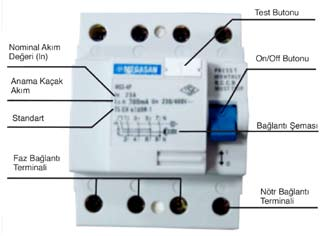
An ordinary RCD does not replace a fuse or breaker. During an overload or a phase-to-neutral short circuit, outgoing and returning currents can still match even though both are excessive. Equally, an RCD cannot be relied on to detect a shock where current passes from phase through a person to neutral and returns through the RCD as usual. It can reduce the risk of severe shock in faults it does detect, but it cannot prevent every shock or guarantee that no injury occurs.
The RCD’s test button checks its trip mechanism when used according to the manufacturer’s instructions. It does not prove that the installation’s earthing and wiring are sound. If a device fails its prescribed test or trips repeatedly, do not bypass it or investigate inside the panel yourself; arrange assessment by a qualified electrician.
Put the three roles together
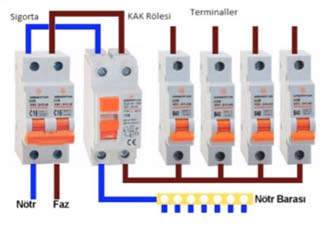
This illustration shows a protective-device arrangement with a residual-current device and several downstream breakers. It is useful for seeing why an installation may contain both kinds of device, but it is not a wiring guide. In particular, it does not show the protective-earth connections needed to assess earthing, and real terminal arrangements must not be inferred from it.
| Protection | Main job | Important limit |
|---|---|---|
| Protective earthing (topraklama) | Provides an intentional fault-current path from exposed conductive parts, helping protective devices disconnect a fault. | Depends on a sound connection; is not itself a switch that disconnects power. |
| Fuse or ordinary breaker (sigorta) | Opens a circuit for excessive current, helping protect wiring against overheating and fire. | May not react to a smaller but dangerous current through a person. |
| RCD (kaçak akım rölesi) | Disconnects when it detects sufficient difference between outgoing and returning current. | Does not, by itself, protect against overload; cannot detect every shock path. |
Return to the metal-cased appliance fault. Earthing gives fault current an intended path; a breaker may open if that fault produces enough current; an RCD may open if some current leaves the phase–neutral path. These are complementary protections, not three names for one device. Some installations use a combined device that provides both overcurrent and residual-current protection, so identify a device by its markings and function rather than its appearance alone.
Key takeaways
Ask three questions when distinguishing household protections: Is there a sound fault path from exposed metal? That is earthing’s role. Is the circuit carrying excessive current? That is the fuse or breaker’s role. Is some current failing to return through neutral? That is the RCD’s role. Each has limits, and none makes live electrical work safe for a household user.
Next, you will apply these distinctions to practical decisions about damaged cables, overloaded extension leads, wet equipment, and repeated trips—particularly when to stop using equipment and call a qualified electrician.