Hello! Last time, you used an appliance’s wattage to estimate its current while operating on a 230 V supply. Now you will use that same wattage to answer a different question: how much electrical energy does it use over time? The answer is usually expressed in kilowatt-hours, or kWh, the unit you will see on an electricity bill.
Allow about 35–40 minutes for the video, examples, and label interpretation. Everything here can be calculated from ratings and estimated usage times; there is no need to measure a household outlet.
Power is a rate; energy accumulates
An appliance rated 2000 W has a power rating. That tells you how quickly it uses energy while operating at that power. Electricity consumption also depends on how long it operates. A 2000 W heater used for ten minutes consumes less energy than the same heater used for an hour.
For these calculations, convert watts to kilowatts by dividing by 1000, then multiply by operating time in hours:
Equivalently, if the rating is in watts:
The units help explain the name: kilowatts multiplied by hours give kilowatt-hours. One kilowatt-hour is the energy used by a 1 kW appliance operating at that power for one hour. It also equals 1000 watt-hours (Wh). Despite its name, a kilowatt-hour is an amount of energy, not a power rating.
What is a kWh - kilowatt hour + CALCULATIONS 💡💰 energy bill
Watch “What is a kWh - kilowatt hour + CALCULATIONS” from The Engineering Mindset for a visual explanation of power, time, and billed energy.
Watch power and energy to distinguish an appliance’s W or kW rating from its kWh consumption. Then watch unit conversion, the heater example, and the lamp example. Focus on which quantity is multiplied by time. Finally, monthly totals shows how estimates for several appliances can be combined.
Notice what has changed from the previous lesson: you do not need the 230 V supply figure when the appliance’s input power is already given in watts. Voltage was needed to estimate current; power and operating time are what you need to estimate energy.
Estimate one period of use
Return to the 2000 W heater from the previous lesson. Its rated power is . Suppose its heating element operates continuously for 45 minutes. Convert the time first:
Then calculate its estimated consumption:
The previous lesson’s 8.7 A described its approximate current while heating. The 1.5 kWh describes the energy used over those 45 minutes. Neither number substitutes for the other.
Short uses can be handled the same way. For example, if an 1800 W kettle operates at that power for six minutes, its estimated consumption is
That is an estimate for this specified run, not a claim that every kettle takes six minutes or draws its rated power throughout every use.
Extend an estimate across days
If usage is similar each day, calculate one day’s kWh and multiply by the number of days. The following image does this for a 2000 W appliance used for 1.5 hours per day over 30 days.
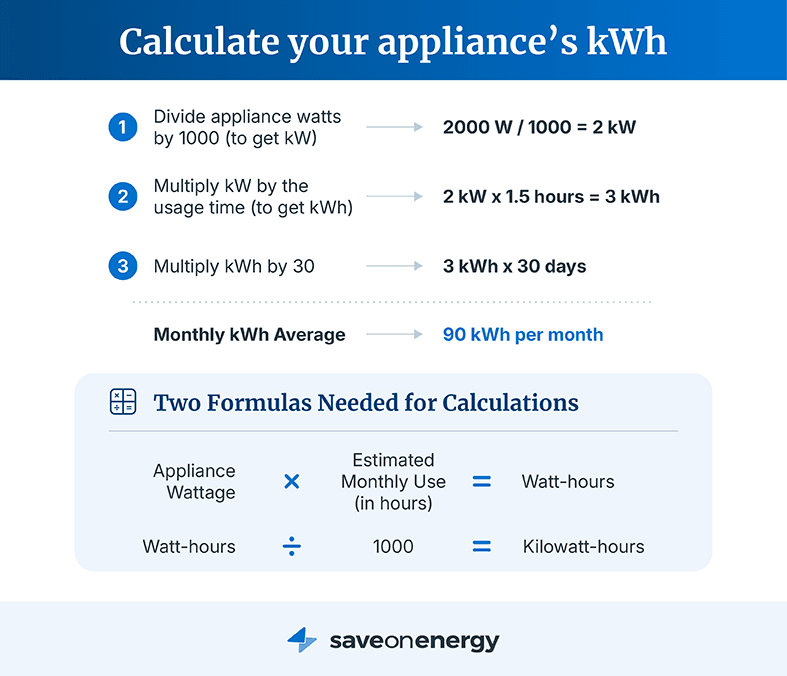
The result is per day, or 90 kWh over 30 days. The crucial assumption is that 1.5 hours is the daily operating time, not the total for the month. If usage varies, add the operating hours for the period instead of assuming that every day is identical.
You can also add estimates for different appliances. A 40 W lamp operating for 5 hours per day over 30 days would use approximately
Under the stated assumptions, the heater and lamp together would account for an estimated 96 kWh that month. This is a subtotal for those two appliances—not a prediction of the entire household bill. The comparison also shows why both wattage and time matter: a low-power device left on for many hours can accumulate meaningful consumption.
Know what the estimate assumes
The calculation is exact for the power and operating time you put into it. The uncertain part is often whether an appliance actually draws its printed wattage throughout that time.
A basic heater may have a thermostat that switches its heating element on and off. If it is switched on for three hours but the element operates at 2 kW for only one of those hours, the element’s estimated consumption is 2 kWh, not the 6 kWh you would get by treating all three hours as full-power operation. Other appliances can change power as their settings or workload change. A refrigerator being plugged in all day does not mean its compressor runs at its rated power for 24 hours.
Also check which rating you have. As in the appliance-label lesson, a power adapter’s DC output rating is not necessarily the power it takes from the wall. For a household electricity estimate, look for an appropriate AC input rating or a stated energy-consumption figure. A rating-based calculation is useful for a rough estimate; it should not be presented as a measured result.
Some energy labels provide consumption directly rather than asking you to start with watts. The display label below gives 91 kWh per 1000 hours for SDR viewing and 133 kWh per 1000 hours for HDR viewing. These are different stated test conditions, not two figures to add together.

For example, at the label’s SDR test condition, four hours of viewing per day for 30 days is hours. Scale the label figure to that time:
The label does not say the display uses 91 kWh each hour. Its lettered efficiency class is also not itself a kWh figure. Actual consumption can differ from the test figure with settings and use, but the stated kWh per 1000 hours offers another basis for an estimate.
Key takeaways
To estimate consumption, use input power in kilowatts multiplied by operating time in hours. Convert watts by dividing by 1000, and convert minutes to a fraction of an hour before multiplying. For a daily routine, multiply the daily kWh by the number of days; for several appliances, add their individual kWh estimates.
Most importantly, distinguish time switched on from time operating at the assumed power. Your result is only as reliable as those assumptions. Next, you will turn from how electricity is used to how household protective devices—earthing, breakers, and residual-current devices—serve different safety roles.