Hello! Welcome to your fourth lesson.
In our last session, we explored the auditor's essential mindset, focusing on professional skepticism and professional judgment. We established that these are not just abstract ideas but the very tools an auditor uses to navigate the complexities of an audit.
Today, we will build on that by formalizing the roles within an audit. The learning outcome for this lesson is to describe the respective responsibilities of management and the auditor in the context of a financial statement audit.
Understanding this clear division of roles is fundamental. During your articleship, you've seen this separation in practice. This lesson will provide the precise technical framework and language from the Standards on Auditing (SAs) that the ICAI expects in exam answers. Clarifying 'who does what' prevents misunderstandings and forms the basis for the entire audit engagement.
1. The Core Principle: A Clear Division of Labour
At the heart of an independent audit is a simple but critical distinction: Management is responsible for preparing the financial statements, and the auditor is responsible for expressing an opinion on them. This separation ensures the auditor remains objective. The auditor's job is not to create the information but to provide assurance on the information created by management.
Let's start with a short video that lays out this fundamental relationship.
SA-200 "Overall Objectives of an Auditor" in English | CA Inter & Final
This clip from 'SA-200 "Overall Objectives of an Auditor"' effectively explains the basic setup of an audit: management prepares the financial statements for users, and the independent auditor examines those statements to provide credibility.
Please watch from the beginning until 01:56. Focus on how the video positions the auditor as an independent intermediary between the company (management) and the users of the financial statements (like investors).
This establishes our starting point: Management owns the financial statements; the auditor owns the audit opinion. Let's now break down what each of these responsibilities entails, using the specific terminology of the SAs.
2. Management's Responsibilities
While you know from experience that management runs the company, SA 210, Agreeing the Terms of Audit Engagements, formally defines their specific responsibilities in the context of an audit. These are considered preconditions for an audit – without management agreeing to them, an audit cannot be conducted.
There are three key responsibilities that management must acknowledge:
- Preparation of Financial Statements: Management is responsible for preparing the financial statements in accordance with the applicable financial reporting framework (FRF), such as Ind AS under Schedule III of the Companies Act, 2013. This includes ensuring they present a true and fair view.
- Internal Control: Management must design, implement, and maintain internal controls necessary to enable the preparation of financial statements that are free from material misstatement, whether due to fraud or error.
- Providing Access to the Auditor: Management must provide the auditor with:
- Access to all relevant information, records, and documentation.
- Any additional information the auditor may request.
- Unrestricted access to persons within the entity from whom the auditor needs to obtain audit evidence.
To see how the ICAI wants you to articulate these points, let's look at their official guidance.
[PDF] Implementation Guide to Standard on Auditing (SA) 210, “Agreeing ...
The ICAI's 'Implementation Guide to SA 210' provides a very clear, exam-focused explanation. We'll look at a question from its FAQ section.
Please read 'Question 3: How to establish whether the preconditions for an audit are present?' on page 8. Focus on point (b), which lists the three core responsibilities of management that we just discussed. This is the precise language you should aim to use.
This clear "three-point" structure is perfect for exam questions that ask about management's responsibilities or the preconditions for an audit.
3. The Auditor's Responsibilities
With management's role defined, let's turn to the auditor. The auditor's primary responsibility is to obtain reasonable assurance and express an opinion.
Let's watch a clip that defines the auditor's main objective.
SA-200 "Overall Objectives of an Auditor" in English | CA Inter & Final
We'll return to the video on SA 200. This segment clearly outlines the auditor's objective, which is the foundation of their responsibilities.
Watch from 01:56 to 04:36. Pay close attention to the key phrases: 'reasonable assurance,' 'free from material misstatement,' 'expressing an opinion,' and conducting the audit 'in accordance with Standards on Auditing.'
Based on the video and SA 200, the auditor's key responsibilities are:
- To obtain reasonable assurance about whether the financial statements as a whole are free from material misstatement, whether due to fraud or error.
- To express an opinion on whether the financial statements are prepared, in all material respects, in accordance with the applicable financial reporting framework.
- To report on the financial statements and communicate as required by the SAs, based on the auditor’s findings.
- To conduct the audit in accordance with Standards on Auditing (SAs) and maintain professional skepticism and judgment throughout the engagement.
A crucial part of the auditor's responsibility is acknowledging the inherent limitations of an audit. This is why we provide reasonable, not absolute, assurance. It's impossible to check every transaction or guarantee the detection of all fraud. This concept is vital for setting realistic expectations with management.
4. How Responsibilities are Formalized: The Engagement Letter
These responsibilities aren't just theoretical; they are formally documented in the audit engagement letter before the audit begins. This letter is a contract between the auditor and the client that clearly outlines the objective and scope of the audit, the responsibilities of the auditor, and the responsibilities of management.
Having these responsibilities in writing is mandatory and serves to avoid any confusion. Let's look at how the ICAI tests this.
[PDF] SA 210: RTP Nov 2019 Q no. 12 Mr. Ram Kapoor, Chartered ... - ICAI
This PDF contains past exam questions and model answers. We will look at a question that directly addresses the contents of an engagement letter, highlighting the importance of defining responsibilities.
Find the question labeled 'MTP-Apr-19 Q No 5(a)'. Read the question and the corresponding answer. Note how points (b) 'The responsibilities of the auditor' and (c) 'The responsibilities of management' are essential components of the engagement letter as per SA 210.
This example shows that simply stating both parties' responsibilities is a key requirement and a common subject for exam questions.
5. Visual Summary and Comparison
To bring everything together, let's look at a flowchart for SA 210 and then summarize the responsibilities in a table.
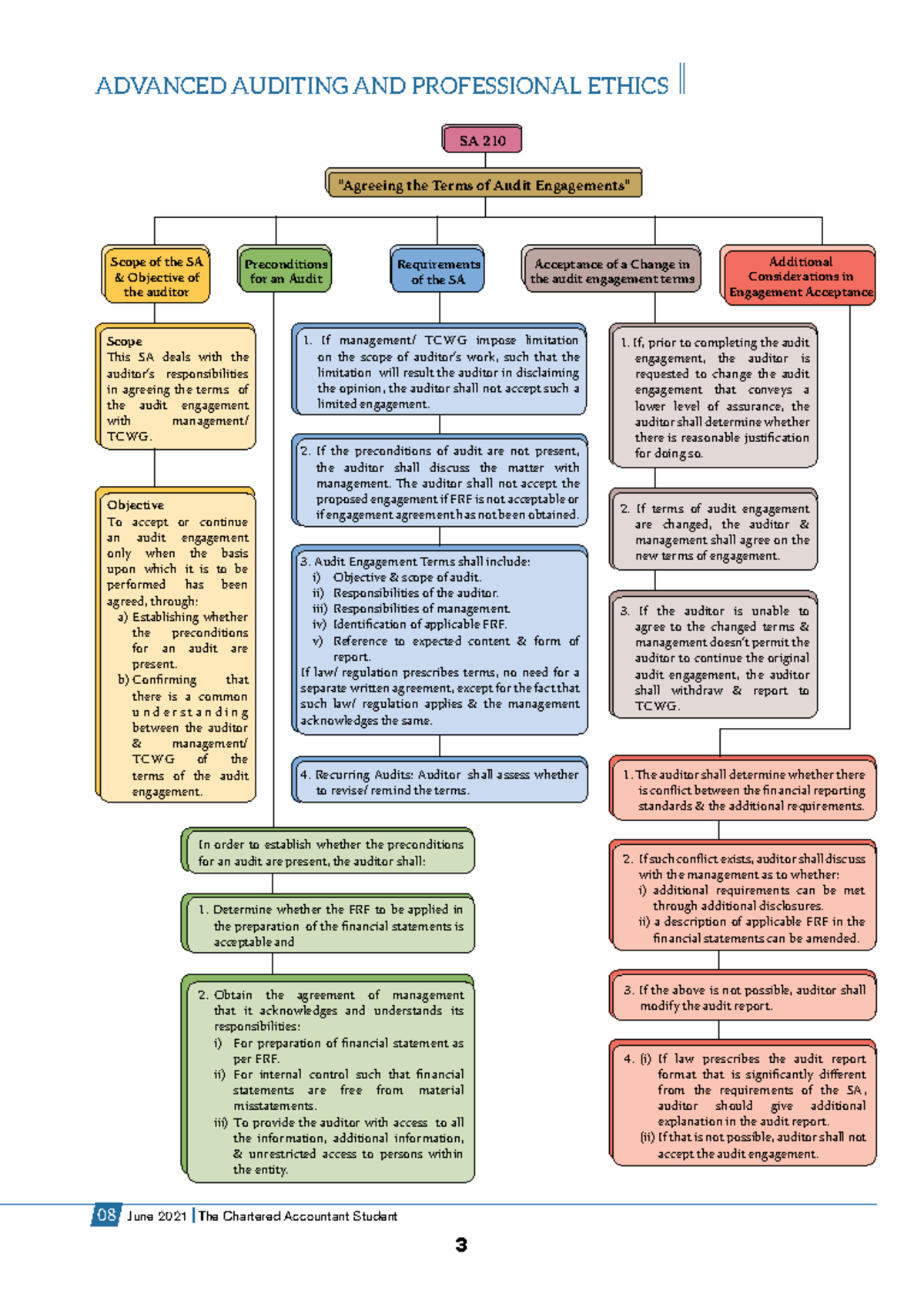
Here is a side-by-side comparison to help you structure your understanding:
| Area of Responsibility | Management's Responsibility | Auditor's Responsibility |
|---|---|---|
| Financial Statements | To prepare and present the financial statements in accordance with the applicable FRF. | To express an opinion on whether the financial statements are prepared, in all material respects, in accordance with the applicable FRF. |
| Internal Control | To design, implement, and maintain internal control relevant to the preparation of financial statements that are free from material misstatement. | To obtain an understanding of internal control relevant to the audit in order to design appropriate audit procedures. (Note: Not to express an opinion on the effectiveness of internal control, unless specifically engaged to do so). |
| Misstatements (Fraud/Error) | To prevent and detect fraud and error through the implementation of adequate internal controls. | To obtain reasonable assurance that the financial statements are free from material misstatement, whether due to fraud or error. The auditor is not responsible for detecting all fraud or error, especially if it is concealed through collusion. |
| Process | Governance and Operations. This includes making accounting estimates, selecting accounting policies, and safeguarding assets. | Audit and Assurance. This includes planning the audit, performing risk assessment, testing controls and transactions, and evaluating evidence to form an opinion. |
This table is a powerful tool for revision. It clearly contrasts the roles and uses the specific language that will help you in your exams.
Key Takeaways
- The foundation of an audit rests on a clear separation of duties: Management prepares, the auditor audits.
- Management's responsibilities, as per SA 210, include (1) preparing the financial statements, (2) implementing internal controls, and (3) providing the auditor with full access to information and personnel.
- The Auditor's primary responsibility, as per SA 200, is to obtain reasonable assurance that the financial statements are free from material misstatement and to express a formal opinion in the auditor's report.
- These respective responsibilities are not left to chance; they are formally agreed upon and documented in the audit engagement letter before the audit commences.
Preview of the Next Lesson
We've now established the distinct responsibilities of both management and the auditor. The next logical step is to examine the process of formalizing this understanding. In our next lesson, we will take a deeper dive into SA 210, focusing on the preconditions for an audit and the purpose of agreeing on the terms of engagement. We will explore what an auditor must do before accepting an audit and the detailed contents of the engagement letter.