Hello! Welcome to the tenth module of our course, "Advanced Research Methodologies."
In our previous module, we concluded our case studies by applying the theoretical concepts you've learned to a comparative analysis of several Moroccan films. You compared films across different periods, genres, and directors, practicing the kind of analytical work central to film scholarship.
This new module shifts our focus from applying analysis to formalizing it. Over the next few lessons, we will consolidate your skills into the kind of systematic, rigorous framework required for a PhD dissertation.
Today, we begin that process. Your learning outcome is to describe established methodologies for analyzing film sound at the academic level (e.g., close listening, audiovisual analysis). We will explore several structured approaches that move beyond intuitive listening to provide a defensible and repeatable process for academic inquiry.
Our lesson will cover:
- A foundational analytical dichotomy: Fidelity vs. Intelligibility.
- Techniques for audiovisual deconstruction: Michel Chion's "masking method."
- A comprehensive system: The Film Sound Analysis Framework (FSAF).
- Tools for implementation: A brief look at software for qualitative analysis.
1. Foundational Lenses for Analysis
A robust analysis often begins with a core question or a guiding conceptual tension. In film sound studies, one of the most productive tensions is the one between realism and narrative clarity.
To explore this, please watch the following video. It introduces two fundamental and opposing approaches to sound design that also serve as powerful analytical lenses: environmental fidelity and rhetorical intelligibility.
Sound and Silence in Gravity: Fidelity vs Intelligibility
The video 'Sound and Silence in Gravity' by the Film & Media Studies channel provides an excellent definition of environmental fidelity and rhetorical intelligibility, using a clear example from Citizen Kane to illustrate the concepts.
Please watch the segment from 01:04 to 04:04. Focus on how James Lastra's historical distinction between the phonograph (fidelity) and the telephone (intelligibility) provides a basis for these two analytical approaches. Pay close attention to how the analysis of Citizen Kane demonstrates both methodologies within the same film.
As the video explains, this dichotomy presents a starting point for any analysis:
- Environmental Fidelity: To what extent does the soundscape faithfully represent the physics and acoustics of the environment shown on screen? This approach values realism and world-building.
- Rhetorical Intelligibility: To what extent is the soundscape designed to deliver narrative information as clearly as possible, even if it sacrifices realism? This approach values storytelling efficiency.
Thinking back to our previous lessons, you can see how this lens applies directly to Moroccan cinema. The use of Nass El Ghiwane's music in Transes is a powerful act of environmental fidelity, capturing the authentic sound of a specific community. Conversely, Mohamed Afifi's use of a Charles Mingus jazz score in Retour à Agadir is a clear move toward rhetorical intelligibility; the sound is not faithful to the scene's reality but is chosen to convey a specific political and aesthetic argument.
A More Nuanced Tool: Point of Audition
The fidelity/intelligibility binary is a strong start, but analysis often requires more nuance. A key concept for refining this analysis is Michel Chion's point of audition, which asks from where and through whom we are hearing.
The same video provides a concise explanation.
Sound and Silence in Gravity: Fidelity vs Intelligibility
Let's continue with the same video, which now introduces Michel Chion's concept of 'point of audition' as a more sophisticated tool for analyzing sound perspective.
Please watch the section from 07:29 to 11:23. The video breaks down 'point of audition' into two types, which are crucial for analysis: Spatial point of audition: Where is the 'hearing' located in the scene's space? Subjective point of audition: Are we hearing from a specific character's perspective?
Analyzing the point of audition allows you to deconstruct how a film achieves its sense of fidelity. As the video demonstrates with Gravity, the sound design maintains fidelity not to the "objective" reality of space (which is silent), but to the subjective point of audition of the character—hearing sounds as vibrations through their suit. This is a crucial distinction in academic analysis.
2. Close Listening: The "Masking Method"
Your learning outcome specifically mentions "close listening" and "audiovisual analysis." These are not just casual terms; they refer to a specific, systematic practice. Perhaps the most influential method was developed by Michel Chion himself as a way to break what he famously called the "audiovisual contract"—the perceptual fusion of sound and image that we typically take for granted.
His method involves deconstructing the audiovisual text to understand how each element contributes to the whole. The following article details Chion's practical approach.
[PDF] Michel Chion in Audio-Vision and a practical approach to a scene ...
The paper 'Michel Chion in Audio-Vision and a practical approach...' by Josep Torelló provides a clear, step-by-step explanation of Chion's analytical procedures. We will focus on two of his key experimental techniques.
Please read two key sections that describe Chion's methodology: Start with the section titled '1. The masking method'. This explains the core techniques of acousmatic listening (listening to the soundtrack without the image) and deaf viewing (watching the image without the sound). Then, read the section titled '2. Forced marriage'. This describes the experimental process of replacing a film's original soundtrack with different music to reveal new relationships between sound and image. Focus on understanding the purpose of these methods: to make the analyst consciously aware of the 'added value' that sound brings to the image, and vice-versa.
To summarize Chion's methodology for close listening:
- Verbal Requirement: Begin by describing the scene in detail—both what you see and what you hear—without any initial interpretation.
- Masking Method (Deconstruction):
- Acousmatic Listening: Listen to the soundtrack without the image. What does the sound alone tell you? What is its texture, rhythm, and spatial quality? What information or mood does it convey independently?
- Deaf Viewing: Watch the sequence without sound. What is the rhythm of the editing? What information and emotion are conveyed by the images alone? What sounds do the images suggest that might be absent from the actual soundtrack?
- Forced Marriage (Experimentation): Replace the original soundtrack with a completely different piece of music. How does this new "marriage" change the meaning, emotion, and rhythm of the scene? This reveals how much of the original scene's meaning was dependent on the specific audio-image pairing.
This process transforms "watching a film" into a rigorous analytical procedure. It allows you to isolate the function of each element and make concrete, evidence-based claims about how they work together.
3. A Systematic Grid: The Film Sound Analysis Framework (FSAF)
While Chion's method is excellent for a deep dive into a single scene, a larger project like a dissertation requires a more comprehensive and repeatable framework for analyzing an entire film or a corpus of films. The Film Sound Analysis Framework (FSAF) is one such model. It proposes a systematic way to categorize and interpret every sound in a film.
[PDF] THE FILM SOUND ANALYSIS FRAMEWORK - Kristine Dizon
The article '[PDF] THE FILM SOUND ANALYSIS FRAMEWORK' by Kristine Dizon and Álvaro Barbosa presents a powerful conceptual tool for systematically analyzing film sound. It integrates many of the concepts we've discussed into a single, organized structure.
Please read the introduction and the section titled '2. THE FILM SOUND ANALYSIS FRAMEWORK'. Focus on understanding the conceptual model presented in Figure 1 and Figure 2. The framework is built on two intersecting axes: Syntactic vs. Semantic Analysis (Structure vs. Meaning) Taxonomical vs. Applied Analysis (Classification vs. Technique) This will give you the high-level structure of the methodology.
The FSAF creates a 2x2 grid that allows for a four-pronged analysis of any sonic event. Let's break it down, as it connects directly to your practical background and our theoretical discussions:
| Syntactic Analysis (The structure of the sound; how it's built) | Semantic Analysis (The meaning of the sound; what it represents) | |
|---|---|---|
| Taxonomical (Classification) | Syntactic Taxonomy: Classifying sound based on its post-production stem. This is familiar territory for you: Dialogue, Backgrounds (Ambiance), Sound Effects (Foley, Hard FX), Music. | Semantic Taxonomy: Classifying sound by its relationship to the narrative world. This uses film theory concepts you know: Diegetic, Non-diegetic, Meta-diegetic (sound imagined by a character), etc. |
| Applied (Technique) | Applied Syntax: Analyzing the manipulation of sound's physical properties. This is the technical side of your work: manipulating loudness, pitch, timbre, and spatialization (e.g., adding reverb, panning). | Applied Semantics: Analyzing established narrative audio techniques. These are classic conventions like the leitmotif, sound bridge (overlapping), mickey-mousing, etc. |
The power of the FSAF is that it provides a systematic checklist for your analysis. For any sound you want to analyze, you can ask:
- What is its syntactic category? (e.g., It's a sound effect).
- What is its semantic category? (e.g., It's diegetic).
- What techniques were applied to its syntax? (e.g., Its pitch was lowered and reverb was added).
- What semantic technique is it part of? (e.g., It functions as a sound bridge to the next scene).
This framework creates a common language and ensures that your analysis is comprehensive, moving from technical construction to narrative function.
4. Tools for Rigorous Implementation
These methodologies require meticulous data management, especially at the PhD level. Manually tracking sounds, timestamps, and analytical notes across dozens of films is impractical. This is where Computer Assisted Qualitative Data Analysis Software (CAQDAS) becomes an essential methodological tool.
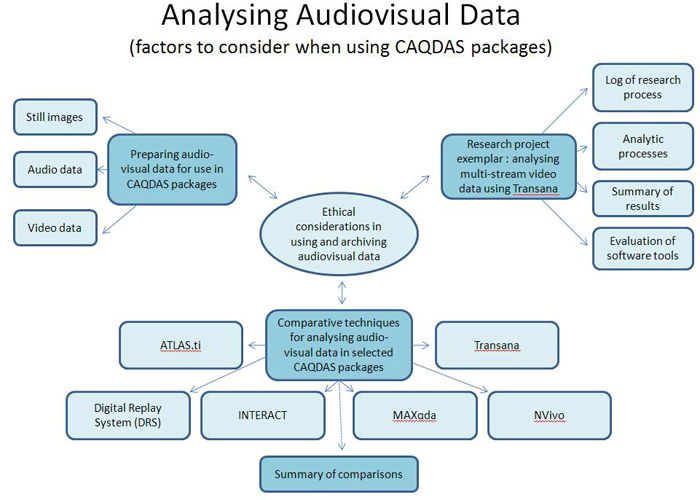
Software like this allows a researcher to:
- Import video files.
- Create transcripts.
- Log and annotate specific sonic and visual events on a timeline.
- "Code" these events using a structured framework—for instance, you could create codes for every category in the FSAF.
- Analyze patterns across a single film or an entire corpus (e.g., "Show me every instance of meta-diegetic sound in the films of Nabil Ayouch").
Using such a tool adds a layer of methodological rigor, making your analytical process transparent, verifiable, and scalable.
Conclusion
Today, we have moved from the what of film sound theory to the how of film sound analysis. We've established that academic analysis is a structured, systematic process, not just a series of subjective impressions.
Key Takeaways:
- Methodological Lenses: Analysis can be guided by core dichotomies like environmental fidelity vs. rhetorical intelligibility and refined with tools like point of audition.
- Close Listening: This is a practice of deconstruction, exemplified by Chion's masking method, which breaks the audiovisual contract to reveal the specific contributions of sound and image.
- Systematic Frameworks: Comprehensive models like the FSAF provide a structured vocabulary and a repeatable process for classifying and interpreting every sound in a film based on its structure, meaning, and technical application.
- Technological Rigor: Tools like CAQDAS enable the systematic application of these frameworks to large bodies of work, ensuring the analysis is robust and evidence-based.
Preview of the Next Lesson
You are now familiar with several established methodologies. The next logical step is to decide how to combine them into a research design that fits your specific project. In our next lesson, we will "Explain a process for integrating concepts from soundscape theory, film sound theory, and cultural studies into a cohesive analytical framework." We will discuss how to select and synthesize these methodological tools to build the precise analytical engine you need for your dissertation on Moroccan film soundscapes.