Introduction
Welcome to the first lesson of our module on "Psychoacoustics and Sonic Perception." In our previous module, we concluded by analyzing how sound designers function as authors, making deliberate choices to construct narrative meaning. We examined how Ben Burtt authored tension in Munich by isolating key sounds, and how the team behind Gravity navigated the problem of sound in a vacuum by shifting the "point of audition" to a subjective, character-based perspective.
A key theme in that discussion was rhetorical intelligibility—the need for crucial sounds to "read" through the clutter of a complex soundtrack. Today, we will explore the science behind this challenge. Our objective is to explain the psychoacoustic principle of auditory masking and its application in film sound mixing.
We will first delve into the science of why and how certain sounds obscure others. Then, we will explore how this phenomenon presents both a fundamental technical problem for sound mixers and a powerful creative tool for filmmakers to shape narrative and emotional experience. This lesson will bridge the gap between your practical experience as a mixer and the theoretical analysis required for your research.
1. The Science of Auditory Masking
At its core, auditory masking is the perceptual phenomenon where one sound (the "masker") makes it more difficult to hear another sound. To understand how this works, we need to distinguish between two primary types: spectral masking and temporal masking.
Let's begin with a detailed video that explains these principles with helpful charts and audio demonstrations. Given your background, the technical explanations and audio examples should be particularly insightful.
The video 'Auditory Masking' from Simcenter Testing provides a clear, scientific breakdown of the core concepts. It explains how our threshold of hearing is not fixed, but is dynamically altered by the presence of other sounds.
Please watch the following segments carefully: Introduction to Masking (00:00 - 05:24): This section defines the human hearing threshold and demonstrates spectral masking, specifically how broadband noise (like white noise) can raise the hearing threshold and mask a pure tone. Tonal Masking (05:24 - 15:07): This is a more detailed look at how one tone masks another. Pay attention to the concept of critical bands and the general rule that low-frequency sounds are more effective at masking higher-frequency sounds. Temporal Masking (15:07 - 19:58): This segment explains how a sound can be masked in time, even if it doesn't overlap spectrally. Focus on the definitions of post-masking and pre-masking.
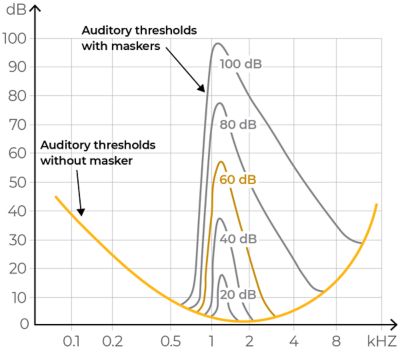
The central idea from the video is that the presence of a masking sound effectively raises the minimum level at which other sounds can be perceived. The following graph illustrates this concept visually.
Let's summarize the key principles:
-
Spectral Masking: This occurs when two sounds are present simultaneously and their frequencies overlap or are close to each other.
- Broadband Masking: A sound with a wide frequency spectrum (like a waterfall, engine noise, or dense musical texture) can mask a wide range of other sounds.
- Tonal Masking: A single tone primarily masks tones of higher frequency than itself. This is why a low-frequency rumble is so effective at obscuring higher-pitched sounds. The effectiveness of the masking depends on the frequency proximity and relative amplitude of the two sounds.
-
Temporal Masking: This occurs when two sounds are close together in time. The auditory system needs time to recover from a loud sound.
- Post-masking (or forward masking): A quiet sound occurring shortly after a loud sound is masked. This effect can last for up to 200 milliseconds.
- Pre-masking (or backward masking): A quiet sound occurring shortly before a loud sound can also be masked. This effect is shorter, typically within 50 milliseconds, and is a fascinating consequence of how our brain processes auditory information.
Understanding these principles is fundamental to sound mixing. A mixer is, in essence, constantly managing and manipulating auditory masking.
2. Masking as a Technical Challenge in Sound Mixing
In film sound production, masking is often treated as a problem to be solved. A dense mix containing dialogue, music, Foley, and ambient sound creates a battle for perceptual real estate. If not managed carefully, crucial narrative information will be lost.
This is where the concept of "hyperreal" sound, which you may have encountered in your work, becomes relevant. Sounds are often recorded and mixed to be more prominent or exaggerated than they would be in reality precisely to overcome masking from other elements in the soundtrack.
[PDF] Sound for film and television
The textbook 'Sound for Film and Television' by Tomlinson Holman provides context on how psychoacoustic principles are addressed in professional practice. This brief excerpt discusses the practical need to make sounds 'read'.
Please read the section titled SOUND IS OFTEN “HYPERREAL” found in the book's Introduction (page xii of the PDF). It directly addresses why sounds like Foley footsteps are often exaggerated to 'read through the clutter'.
The mixer's task is to create a hierarchy and ensure intelligibility. This involves techniques that are direct countermeasures to frequency masking:
- Level Adjustments: The most straightforward method is to adjust the relative loudness of elements, ensuring dialogue, for example, is consistently louder than the score or background effects.
- Equalization (EQ): This is a more surgical approach. A mixer might use a parametric EQ to "carve out" a frequency pocket for an important sound. For instance, since the core frequencies for speech intelligibility are in the 1-4 kHz range, a mixer might slightly reduce the level of music or atmospheric sound in that specific range whenever dialogue is present. This reduces the masking effect without significantly changing the perceived loudness of the music.
- Panning: Placing sounds in different spatial locations (left, right, center) can also help the brain distinguish between them, a topic we will explore further in the next lesson on Auditory Scene Analysis.
As a sound operator and mixer, you have likely used these techniques intuitively. Now you can frame them as direct applications of psychoacoustic theory—you are actively working to prevent the film's soundscape from masking itself into incoherence.
3. Masking as a Narrative and Expressive Tool
While often a technical problem, auditory masking can also be wielded as a powerful tool for storytelling and artistic expression. By deliberately obscuring sounds, filmmakers can enhance realism, drive the plot, and convey a character's subjective experience.
This academic paper discusses this expressive potential, with several useful examples.
[PDF] The Impact of Auditory Effects on the Expressive Power of Sound Art ...
The paper 'The Impact of Auditory Effects on the Expressive Power of Sound Art...' explores how psychoacoustic effects are used for artistic purposes in film. It provides a clear theoretical bridge from the science of masking to its narrative application.
Please read sections 4.1 Concept of the masking effect and 4.2 Appropriate application of the masking effect in film. Focus on the two key applications discussed: Contributing to the narrative: How masking dialogue in The Legend of 1900 creates a sense of regret and moves the plot. Enhancing realism: How the overwhelming noise of battle in war films masks commands, heightening the sense of chaos and crisis.
Let's crystallize these applications with two examples:
1. Masking for Realism and Immersion:
In a chaotic scene—a steel mill, a battlefield, a crowded nightclub—the sound design can use masking to create an overwhelming and immersive environment. In the steel mill opening of Terrence Malick's Days of Heaven, the roar of the machinery is so loud that it masks the dialogue, making the arguments difficult to discern. This isn't a technical flaw; it's a deliberate choice. The masking serves to:
- Establish the Environment: It communicates the oppressive, deafening nature of the industrial workplace.
- Convey Character State: It reflects the powerlessness of the workers, whose voices are literally drowned out by the factory.
- Create Authenticity: It mirrors reality, where communication in such an environment would indeed be fragmented and difficult.
2. Masking for Narrative and Subjectivity:
Masking can be used to signify that a character cannot hear something, or that their attention is focused elsewhere. This is a powerful way to represent a subjective point of audition.
- In the example from The Legend of 1900, the protagonist's hesitant words are masked by the ship's ambient sounds (steam, crowds). The masking becomes a sonic metaphor for his inability to connect with the world outside the ship, fueling a key plot point. We, the audience, understand his intention, but the masking ensures his failure, creating dramatic irony and pathos.
- This technique can also be used for suspense. Imagine a character in a loud bar. A crucial line of dialogue from across the room is momentarily masked by a burst of laughter or the clatter of glasses. That brief moment of lost information can create tension and uncertainty for the audience.
By choosing what to mask and what to let through, the sound designer authors the sonic narrative, directing our attention and shaping our understanding of the scene in profound ways.
Conclusion
In this lesson, we have dissected the psychoacoustic principle of auditory masking and connected it directly to the practice of film sound mixing and analysis. You are now equipped to explain not just that some sounds are difficult to hear in a mix, but precisely why, based on the principles of spectral and temporal masking.
Key Takeaways:
- Auditory Masking is a psychoacoustic phenomenon where the perception of one sound is affected by the presence of another. It operates in both the frequency domain (spectral masking) and the time domain (temporal masking).
- Low-frequency sounds are particularly effective at masking high-frequency sounds, a crucial principle in audio mixing.
- In film sound, masking is a technical challenge that mixers overcome using techniques like level balancing and equalization to ensure the intelligibility of key sounds (especially dialogue).
- Masking is also a creative tool used by sound designers to enhance realism (e.g., chaotic battle scenes), convey a character's subjective perspective, and drive the narrative (e.g., a deliberately obscured line of dialogue).
Preview of the Next Lesson:
Today, we focused on how sounds can blend together and obscure one another. In our next lesson, we will explore the opposite process: Auditory Scene Analysis (ASA). We will examine the principles our brains use to take a complex soundscape and segregate it into distinct objects and streams—a phenomenon often called the "cocktail party effect." This will complete the picture of how our perceptual system parses the intricate sound mixes that filmmakers create.