Introduction
Welcome back. In our last lesson, we examined how ambient sound, room tone, and silence function as foundational materials for constructing a sense of place and immersion. We touched on the idea that certain sounds, particularly low-frequency room tones, can foster an "embodied" experience—a physical "feeling of being there."
Today, we will build a robust theoretical foundation for that idea. The learning outcome for this lesson is to explain key phenomenological concepts (e.g., embodied perception) relevant to analyzing sensory experience in cinema, drawing on the work of the philosopher Maurice Merleau-Ponty.
Phenomenology is a branch of philosophy dedicated to studying the structures of experience and consciousness from a first-person perspective. For a scholar of soundscapes, it provides a powerful vocabulary to move beyond technical descriptions of a soundtrack and instead analyze how that soundtrack is lived and felt by an audience. This lesson is central to the "Perception" and "Immersion" pillars of your research framework, providing the philosophical tools to articulate the sensory engagement at the heart of the cinematic experience.
1. From Mind-Body Dualism to the Lived Body
To understand Merleau-Ponty's contribution, we first need to understand the philosophical problem he was addressing: the long-standing separation of mind and body, most famously articulated by René Descartes. This dualism treats the mind as a rational, thinking entity, and the body as a separate, mechanical object that the mind inhabits and controls.
Phenomenology, and Merleau-Ponty's work in particular, seeks to overcome this split by insisting that we start our analysis not with abstract ideas, but with our actual, direct experience of being in the world.
To get a concise overview of Merleau-Ponty's project, let's start with a short video.
Merleau-Ponty, The Phenomenology of Perception
The 'Overthink Podcast' provides an excellent introduction to Merleau-Ponty's seminal work, Phenomenology of Perception. This will clarify his core argument for grounding philosophy in the 'living body'.
Please watch the first 6 minutes and 49 seconds of the video (from 00:00 to 06:49). Focus on these key points: How Merleau-Ponty moves beyond mind-body dualism by focusing on 'lived experience'. The phenomenological method of 'bracketing' the natural attitude. The crucial distinction between the objective body (Körper) and the living, subjective body (Leib).
This introduction establishes the central premise of our lesson. Merleau-Ponty argues that our primary reality is not that of a disembodied mind observing the world, but of an embodied being fundamentally intertwined with it.
The distinction between Körper (the body as an object, a collection of physiological parts) and Leib (the body as experienced from the inside, our "lived body") is fundamental.
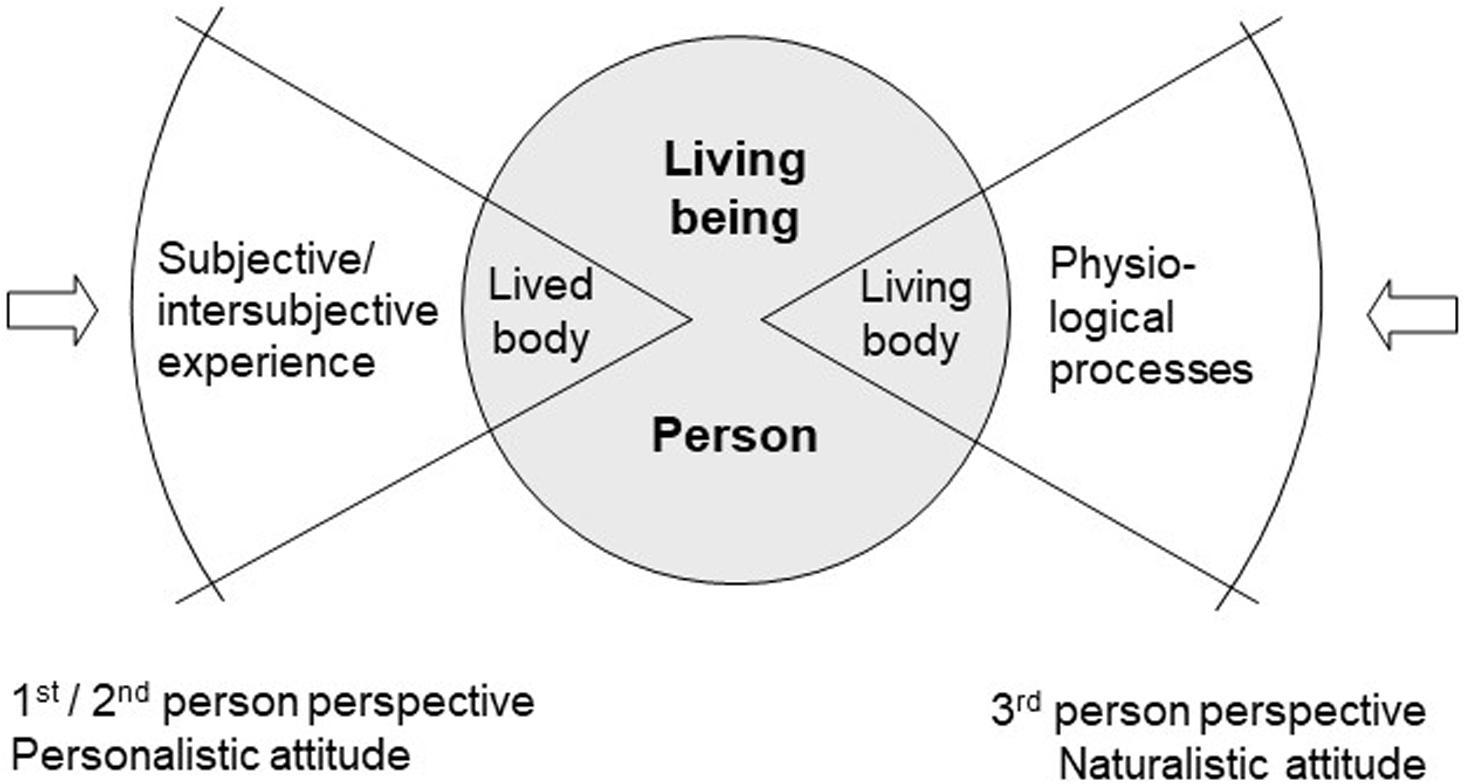
When we analyze film sound, we are primarily interested in how it addresses the Leib, the lived body. The sonic experience of a film is not merely a matter of sound waves hitting the eardrum (Körper); it is a holistic experience that engages our memory, emotions, and our very sense of being physically present in a space. This is the essence of embodied perception.
2. Analytical Concepts from Phenomenology
Now that we have the foundational idea of the lived body, we can explore several specific concepts from Merleau-Ponty that are directly applicable to analyzing the sensory experience of cinema. These concepts help us describe how a film engages our embodied perception.
A. The Body Schema and Motility: "I Can"
Merleau-Ponty argues that our fundamental relationship to the world is not one of thinking ("I think, therefore I am"), but one of action and possibility ("I can"). We possess a body schema, which is a practical, pre-reflective grasp of our body's capabilities and its position in space. It’s the tacit knowledge that allows you to reach for a doorknob without calculating the distance or consciously thinking about the trajectory of your arm.
Merleau-Ponty, The Phenomenology of Perception
Let's return to the 'Overthink Podcast' video, which explains the concept of the body schema and motility.
Watch the segment from 08:00 to 09:27. Note the shift from 'I think' to 'I can' and the definition of the body schema as a 'tacit knowledge of the body's situation in space'.
In cinema, a well-designed soundscape engages this body schema. The spatial positioning of sounds—a voice from behind, an approaching footstep—doesn't just provide information; it cues a bodily sense of space. We intuitively feel the presence of off-screen entities because the sound design taps into our body's innate spatial awareness.
B. Situated Space vs. Objective Space
Building on the body schema, Merleau-Ponty distinguishes between two kinds of space:
- Objective Space: A neutral, geometric, third-person space, like a map. It is allocentric (world-centered).
- Situated or Oriented Space: The space we inhabit, organized around our body as the center. It is egocentric (self-centered) and defined by our potential for movement.
Merleau-Ponty, The Phenomenology of Perception
The 'Overthink Podcast' video provides a clear analogy to explain this distinction.
Watch from 09:27 to 12:06. Pay close attention to the Google Maps analogy, which brilliantly contrasts the 'allocentric' map view with the 'egocentric' navigation view.
This distinction is crucial for understanding immersive audio. Channel-based stereo sound often presents an objective space—a sonic picture happening "over there," in front of us. In contrast, surround sound and spatial audio technologies aim to create a situated space, enveloping the listener and making them the center of the sonic world. As a sound designer, when you place ambiences in rear channels, you are shifting the perceptual mode from observing an objective space to inhabiting a situated one.
C. Pre-reflective Experience and Kinaesthesia
Much of our embodied experience happens without conscious thought. This is pre-reflective experience. When you catch a ball, your body calculates the trajectory and moves to intercept it before you have time to "think" about the physics involved.
For a deeper dive into how this relates to sound, let's turn to an academic text.
[PDF] Introduction to a phenomenological approach to sound and listening
In this article, 'Introduction to a phenomenological approach to sound and listening', researcher Martine Huvenne applies these concepts directly to sound. She introduces another key term from phenomenology: 'kinaesthetic experience'.
Please read the section titled 'Kinaesthetic experience' (pages 6-7). Focus on the definition of kinaesthetic experience as the 'unthematic experience of the position and movement of the body' that is 'indispensable' for perception. Also, note the distinction between a reflective, thematic awareness of sound and a pre-reflective, non-thematic one.
Kinaesthetic experience is the bodily self-awareness that accompanies our perception of the world. It’s the feeling of our own body's posture and potential for movement. Sound, especially low-frequency and ambient sound, directly engages this kinaesthetic sense. We don't just hear a deep rumble; we feel it as a vibration. This "felt sound" is a pre-reflective, kinaesthetic experience. It creates a sense of presence not by giving us information to interpret, but by causing our own body to resonate with the cinematic world. This is the theoretical explanation for the "embodiment" we discussed in the last lesson.
D. The Unity of the Senses
Finally, phenomenology challenges the common-sense notion that our five senses operate independently. Merleau-Ponty argues that in lived experience, the senses are constantly translating each other in a unified perceptual field. We see the coldness of steel, feel the sharpness of a high-pitched sound, and hear the weight of a heavy object hitting the floor.
Intro to Phenomenology and Vivian Sobchack's Film Theory
The channel 'Film & Media Studies' offers a fantastic introduction to phenomenology in film theory, directly addressing this intermingling of the senses.
Watch from 12:23 to 19:04. This segment discusses pre-reflective 'knowledge in the hands' and then moves to the core idea that the five senses are not discrete. Pay special attention to the Merleau-Ponty quote about seeing the 'resilience or dryness of the fiber' in linen.
This concept is profoundly important for sound design. Your work as a mixer is a practical application of this principle. When you select a specific footstep sound, you are not just matching an action; you are defining the texture of the ground, the weight of the character, and the mood of the scene. The "crunch" of a footstep on gravel is a sound that allows us to feel the roughness of the terrain with our ears. This "synaesthetic" quality of perception, where one sense modality evokes another, is a primary mechanism through which sound helps construct a rich and believable sensory world. The body synthesizes these inputs into a single, unified experience of the film world.
Conclusion
Today we have moved from a practical discussion of sound's effect to a formal philosophical framework for describing it. By grounding our analysis in the phenomenology of Maurice Merleau-Ponty, we have developed a precise vocabulary for discussing sonic immersion.
Key Takeaways:
- Phenomenology prioritizes lived experience over abstract theory, focusing on our embodied being-in-the-world.
- Merleau-Ponty's key contribution is centering the lived body (Leib), moving beyond the classic mind-body split.
- Embodied perception is the understanding that we perceive with and through our bodies, not just with our minds.
- We can use several key concepts to analyze this process in cinema:
- Body Schema: Our tacit, bodily grasp of space and our capacity for action ("I can").
- Situated Space: The egocentric world organized around our body, which immersive sound aims to create.
- Kinaesthetic Experience: The pre-reflective feeling of our body's own position and movement, which is directly engaged by "felt sounds."
- The Unity of the Senses: The way our senses intermingle to create a single, unified perceptual world, allowing sound to convey texture, weight, and temperature.
Preview of the Next Lesson:
We have established the core philosophical principles of Merleau-Ponty. In our next lesson, we will see how these ideas have been directly imported into film theory. We will focus on the work of Vivian Sobchack, who uses Merleau-Ponty's framework to develop a methodology for analyzing the viewer's "carnal" or embodied relationship to film. We will transition from pure philosophy to applied film-phenomenology.