Introduction
Welcome back. In our previous lesson, we traced the historical and political contours of Moroccan cinema, from its colonial beginnings to the diverse voices of the new millennium. This gave us a map of the narrative and artistic traditions your research will engage with.
This lesson shifts our focus from the cinematic representation to the raw material of the soundscape itself. Before we can analyze how filmmakers construct sonic worlds, we must first understand the real-world sonic environments from which they draw inspiration, which they capture, and which they sometimes transform. Our objective is to describe the characteristic sonic environments of Morocco's key geographic regions (e.g., the Atlas mountains, coastal plains, and the Sahara).
To guide this exploration, we will use the work of Gilles Aubry, a sound artist and researcher whose concept of "sonic pluralism" offers a powerful framework for understanding sound in Morocco. This approach moves beyond a simple inventory of sounds to consider how sound is culturally perceived and embodied.
1. A Framework for Listening: Sawt and Sonic Pluralism
In Western contexts, "sound" is often treated as a physical phenomenon, measurable and separable from the listener. However, to understand Moroccan sonic environments, we must adopt a more integrated perspective.
The following text, an excerpt from Gilles Aubry's book Sawt, Bodies, Species, introduces two foundational concepts for our lesson. It will explain the cultural specificity of sound in Morocco and provide a theoretical lens for our analysis.
Please read the two short sections from the introduction: Start from the beginning and read down to the paragraph ending, "As a manifestation of human or extra-human voice, sawt intimately relates to the body." Then, find the paragraph beginning "Sonic pluralism reveals alternative genealogies of sound and listening..." and read to the end of that section. Focus on how the Arabic word sawt differs from the Western concept of sound, and how 'sonic pluralism' accounts for the diverse ways sound is known and experienced.
As Aubry explains, the Arabic word sawt (صوت) means both "sound" and "voice." This is not a simple linguistic curiosity; it reveals a worldview where sound is rarely abstract. It is almost always a "sound body," a manifestation of a human or extra-human voice that relates intimately to the listener's own body.
This leads to the concept of sonic pluralism, which acknowledges that there is not one single way of listening. Instead, there are multiple, coexisting ways of knowing the world through sound, rooted in different cultural practices, spiritual beliefs (like Sufism), and cosmologies (including Berber-Amazigh traditions).
With this framework in mind, we can now explore Morocco's distinct geographical regions not as collections of noises, but as complex, culturally resonant soundscapes.
2. Regional Sonic Environments
Morocco's diverse geography—from its long coastline to its high mountains and vast desert—gives rise to profoundly different sonic characteristics. We will examine three key regions.
a. The Atlantic Coast and Coastal Plains
This region is a dynamic interface between the ocean and some of Morocco's most populous urban centers. The soundscape here is one of constant negotiation between natural forces and intense human activity.
A powerful way to understand this is through the work of Gilles Aubry, who explores specific sonic phenomena along the coast.
Sawt, Bodies, Species. Sonic Pluralism in Morocco - Gilles Aubry ...
The following reading is a review of Aubry's book that provides concrete examples of his research on the coast. It will give us two very different entry points into the coastal soundscape: one related to ecology and labor, the other to geological trauma.
Please read the two chapters summarized in the review: Chapter Six, “Atlantic Ragagar”: Focus on the distinction between the “intimate voice of the sea” (traditional harvesting) and the sounds of industrial activity. Chapter Three, “Salam Godzilla”: Pay attention to the description of the 1960 Agadir earthquake and the concept of “Unsound.”
Based on this, we can characterize the coastal soundscape in two ways:
-
The Voice of the Sea and Human Activity: The soundscape is not merely the keynote of waves and wind. It is defined by the human relationship with the sea. Aubry's "Atlantic Ragagar" example highlights the sonic textures of traditional seaweed harvesting—a practice that involves "listening" to the sea's rhythms. This "intimate voice" exists in tension with the sounds of industrial extraction, port machinery, and urban life that often dominate the coastline. The soundscape is a site where ecological and economic forces become audible.
-
Geological Memory and the 'Unsound': The 1960 Agadir earthquake provides a dramatic example of a sonic event that forever marked a place. Beyond the audible devastation, Aubry introduces the concept of "Unsound": the dimensions of a sonic experience that cannot be measured or recorded, but which live on in collective memory, trauma, and affect. The soundscape of a city like Agadir is therefore layered; it contains not only its present sounds but also the resonant ghost of a past catastrophe. For a filmmaker, this 'unsound' memory offers a rich subtext to explore.
b. The Atlas and Rif Mountains
The mountainous regions of Morocco present a starkly different sonic environment, characterized by vastness, exposure, and a unique materiality.

The soundscape here is shaped by:
- Materiality and Dialogue: Life in the mountains is a direct engagement with the physical environment. Aubry's research on "stonesound" offers a compelling illustration of this.
Sawt, Bodies, Species. Sonic Pluralism in Morocco - Gilles Aubry ...
Let's return to the review of Aubry's book to explore his encounter with the sonic properties of stone. This will help us understand the mountain soundscape as a material dialogue.
Please read the section summarizing Chapter Five, “Stonesound.” Focus on how sound is used to gain knowledge about the material world and the idea of a “dialogue between stones and me.”
This practice of listening *to* stone reveals a soundscape defined by its core materials. The sound of wind across rock faces, the trickle of water carving through gorges, the clatter of scree, and the sharp echoes in a valley are not just background noise. They are sources of information and part of a "dialogue" with a non-human environment. This perspective is deeply connected to the Berber-Amazigh cosmologies Aubry mentions, where the land itself has agency.
- Pastoralism and Altitude: The sounds of human and animal life are distinct and carry far. The keynote sounds include the wind and the bleating of sheep and goats. Important signals would be the sounds of herd bells, dogs barking, and human calls echoing across valleys. This creates what R. Murray Schafer would call a hi-fi soundscape, where individual sounds are clearly perceptible against a low-noise background.
c. The Sahara Desert
The soundscape of the desert is often stereotyped as one of absolute silence. In reality, it is a subtle and powerful acoustic environment dominated by meteorological and geological forces.
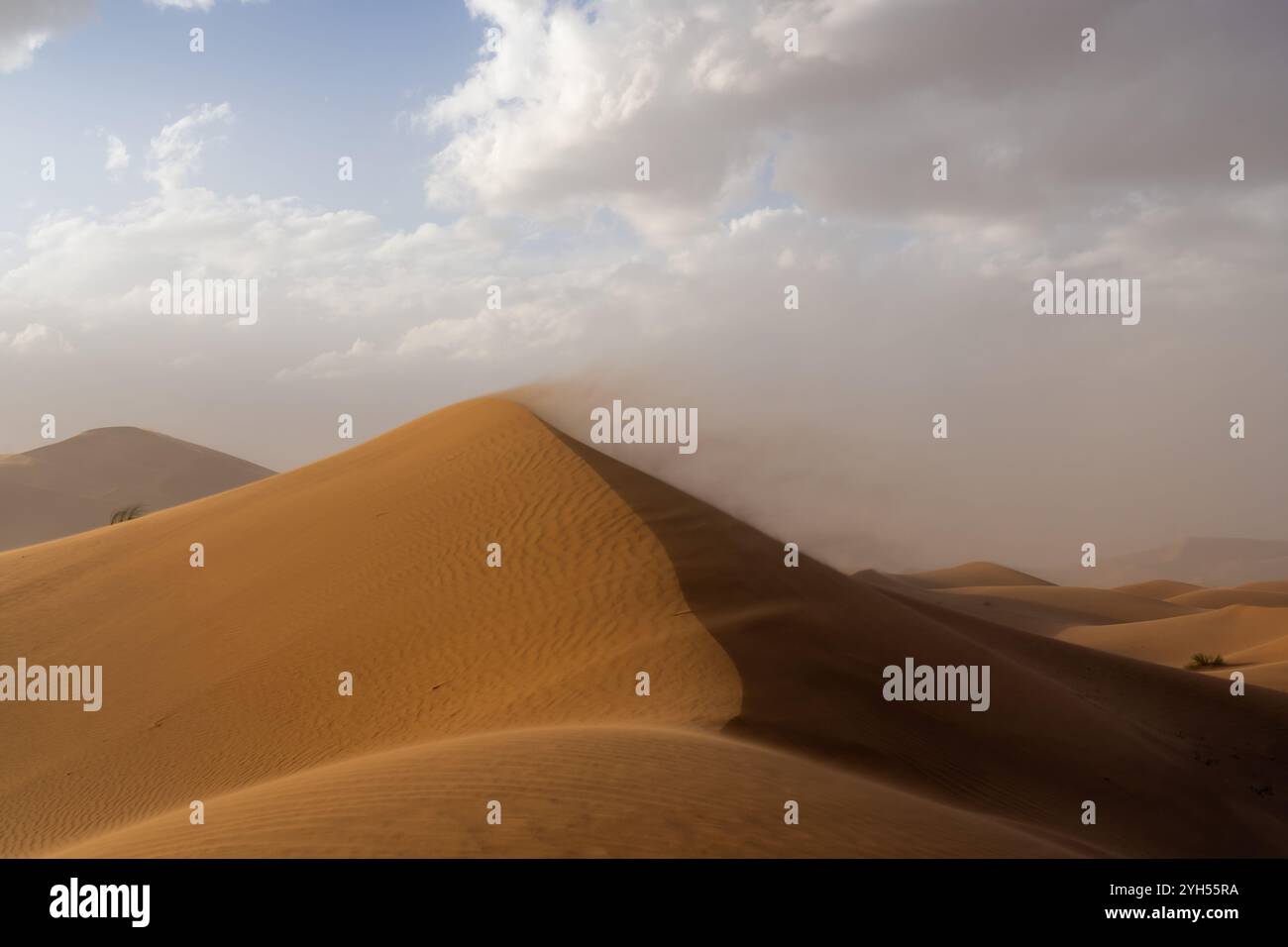
Key characteristics of the desert soundscape include:
-
The Primacy of Wind and Sand: The keynote sound is undeniably the wind. It is not a monolithic sound but a complex one: the high-frequency hiss of fine sand saltating across dunes, the low-frequency rumble of a distant sandstorm, and the whistle of air over sharp-crested ergs. The sound is inseparable from the tactile sensation of wind and sand on the skin.
-
Profound Ambience and the 'Sound of Silence': In moments of calm, the desert soundscape is defined by an extremely low ambient noise floor. This "silence" is not an absence of sound but a presence of quiet that heightens auditory perception. In this environment, the smallest sounds become significant events: the buzz of an insect, the rustle of a reptile, the distant cry of a camel, or a human voice can travel with stunning clarity.
-
Acoustic Islands: Oases function as "acoustic islands" within the desert. The sound of water, the rustling of palm fronds, birdsong, and the concentration of human and animal life create dense and vibrant soundscapes that stand in stark contrast to the sparse sonic environment of the open desert.
Conclusion
In this lesson, we have moved beyond a simple listing of sounds to describe the characteristic sonic environments of Morocco's key regions through a culturally-informed lens.
Key Takeaways:
- Theoretical Framework: Understanding Moroccan soundscapes requires moving beyond Western concepts. The ideas of
sawt(sound-as-voice) and sonic pluralism provide a framework for appreciating sound as an embodied, culturally-specific, and multi-layered experience. - The Coast: A complex soundscape defined by the dialogue between the "voice of the sea" and human activity (traditional and industrial), and layered with the "unsound" of historical memory and trauma.
- The Mountains: A hi-fi soundscape characterized by its materiality (stone, wind), altitude, and the sonic practices of pastoralism, where listening can be a form of dialogue with the non-human world.
- The Desert: A subtle and powerful environment dominated by the sound of wind and sand, and defined by a profound low-level ambience that makes individual sounds highly significant.
By understanding these real-world sonic palettes, you are now better equipped to analyze how Moroccan filmmakers select, shape, and imbue these sounds with meaning to construct the specific soundscapes of their films.
Preview of the Next Lesson:
Having explored the physical environments, we will now turn to the human vocal layer that populates them. The next lesson will focus on a crucial element of sawt: Identify the primary languages and dialects spoken in Morocco (e.g., Darija, Amazigh languages, French) and their typical social contexts. We will examine how this linguistic diversity forms a complex social soundscape that is central to constructing cultural identity in Moroccan cinema.