Hello, and welcome back to our course.
In our last two lessons, we built a foundational vocabulary for soundscape analysis. We started by defining the soundscape and its components (keynotes, signals, soundmarks) and then explored the qualitative distinction between hi-fi and lo-fi environments. We noted that R. Murray Schafer's framework is not just descriptive but also critical, carrying an implicit judgment about the "health" of a sonic environment.
This lesson expands on that critical perspective by formally introducing the interdisciplinary field Schafer pioneered: acoustic ecology. We will address the learning outcome: Explain the principles of acoustic ecology and its relationship to the study of environmental sound. This will shift our focus from a static inventory of sounds to understanding the soundscape as a dynamic system of relationships, a system that can be healthy or unhealthy, balanced or unbalanced.
1. The Ecological Metaphor: A World Composition
At its heart, acoustic ecology applies the principles of biological ecology to the study of sound. Just as a biologist studies the intricate web of relationships between organisms and their physical surroundings, an acoustic ecologist studies the relationships between living beings (including humans) and their sonic environment.
Schafer himself articulated this with a powerful metaphor: the world as a piece of music that we are all composing.
R. MURRAY SCHAFER: LISTEN | Full Documentary | National Film Board of Canada
In this clip from a documentary about his work, R. Murray Schafer explains this core tenet of acoustic ecology: the idea that the world is a vast musical composition for which we are responsible.
Please watch the segment from 01:40 to 02:48. Listen for Schafer's description of the world as a 'huge musical composition' and our role as its composers.
This idea—that we can "improve" or "destroy" our sonic environment—is the central, motivating principle of acoustic ecology. It is not a purely descriptive science; it is a field with an explicit ethical and aesthetic mission.
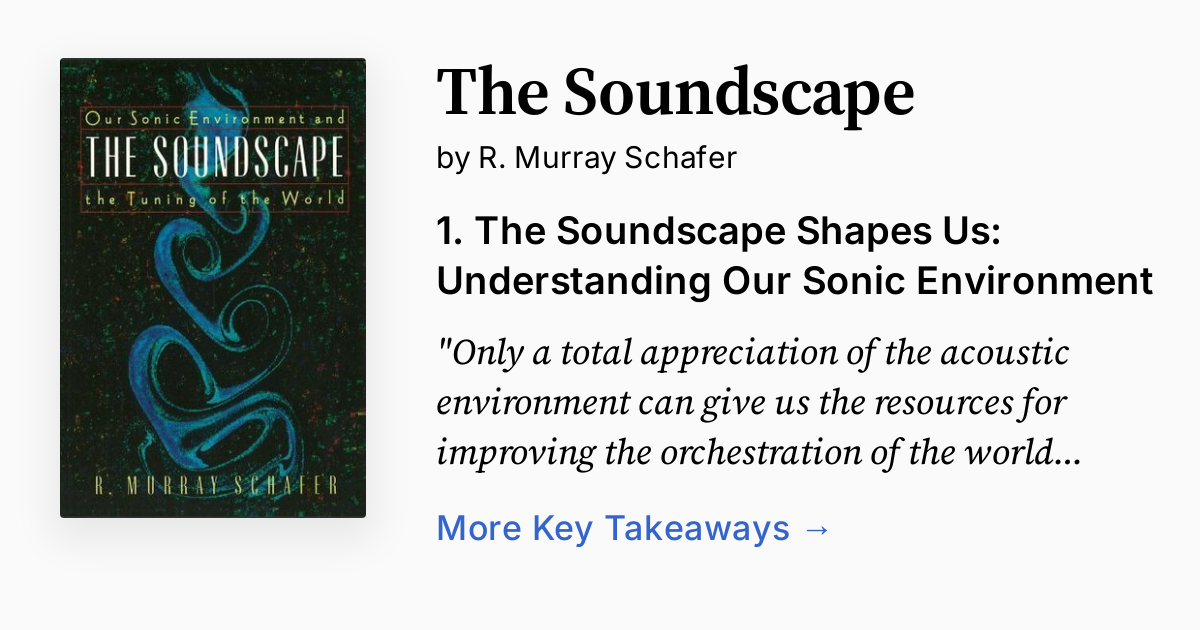
2. Defining Acoustic Ecology
While Schafer provided the philosophical impetus, his student and collaborator Barry Truax offers a more formal, academic definition that clarifies the field's focus.
[PDF] Music, Soundscape and Acoustic Sustainability
This brief excerpt from a paper by Barry Truax, a leading figure in the field, provides a concise and widely accepted definition of acoustic ecology and situates it within a broader framework.
Please read the first paragraph of the document, starting from 'The challenge is not merely...' and ending at '...long-term viability.' Focus on Truax's specific definitions for 'acoustic ecology' and the related concept of 'acoustic sustainability'.
Truax defines acoustic ecology as:
"...the system of relationships between organisms and their sonic environments with particular emphasis on a functional balance or an attention to dysfunctional behavior."
This definition directly connects to our previous lesson. The "functional balance" he speaks of is embodied in the hi-fi soundscape, while "dysfunctional behavior" describes the noise and masking of the lo-fi soundscape. The ultimate goal, as Truax notes, is acoustic sustainability: creating and maintaining soundscapes that are viable and positive in the long term.
The principles of acoustic ecology, therefore, include:
- A Relational Focus: It studies the interactions within the soundscape, not just isolated sounds.
- A Concern for Balance: It evaluates the health of a soundscape based on the relationships between its components.
- A Conservation Ethic: It advocates for the protection of healthy soundscapes and the improvement of unhealthy ones. This involves tackling noise pollution and preserving unique sonic environments.
- An Emphasis on Listening: It argues that enhanced listening skills are the first step toward environmental awareness and improvement. Truax, in the same paper (in the section "Musicians and Ethical Responsibility"), champions practices like the "soundwalk" as essential tools for sharpening our aural perception.
3. Acoustic Ecology vs. Soundscape Ecology: An Important Distinction
As you delve into academic literature, you will encounter a closely related term: soundscape ecology. While often used interchangeably in casual discussion, they represent different, albeit complementary, approaches. For your doctoral work, understanding the distinction is crucial.
- Acoustic Ecology (Schafer, Truax): More human-centered and interdisciplinary, drawing from music, sociology, and design. It is fundamentally concerned with human perception, aural awareness, and the quality of the listener's relationship with the environment. Its stance is often critical and activist.
- Soundscape Ecology (Pijanowski, Farina): More deeply rooted in the natural sciences, particularly biology and landscape ecology. It seeks to be a more objective, quantitative science, using sound as a measurable indicator of ecological health, biodiversity, and the impact of human activity.
The following reading makes this distinction explicit and introduces the analytical framework used by soundscape ecologists.
[PDF] Soundscape Ecology: The Science of Sound in the Landscape
This excerpt from the foundational paper on 'Soundscape Ecology' defines the field, explains its conceptual framework, and directly contrasts it with the 'human-centered inquiry' of acoustic ecology.
Please read the section that begins 'The term “soundscape” has been used by a variety of disciplines...' and ends with '...the larger socioecological systems approach taken here.' Focus on how the authors differentiate their field from the acoustic ecology of Schafer and Truax.
4. Categorizing Environmental Sound: A Scientific Framework
To study the soundscape as an ecological system, soundscape ecologists developed a taxonomy that categorizes sounds by their source. This framework, first proposed by Bernie Krause, is now standard in the field.
A good way to familiarize yourself with these categories is through a clear, accessible presentation.
Sound Ecology: A Better Sounding Planet | Cedric Engels | TEDxULB
This TEDx talk by Cedric Engels introduces and explains the three core categories of environmental sound.
Watch the segment from 03:49 to 06:50. Pay close attention to the definitions and examples for geophony, biophony, and anthrophony.
Let's formalize those categories, drawing on the more detailed descriptions in the "Soundscape Ecology" paper (LINK, sections 1 and 3):
- Geophony: Sounds from non-biological natural sources. These are the sounds of the earth itself.
- Examples: Wind, rain, thunder, running water, avalanches.
- Biophony: Sounds generated by non-human living organisms. This is the collective voice of a habitat's animal life.
- Examples: Birdsong, insect stridulation (crickets), amphibian choruses (frogs), mammal vocalizations.
- Anthrophony: Sounds generated by humans. This category includes both intentional sounds (music, speech) and unintentional sounds (noise).
- Examples: Machine noise, traffic, sirens, music, construction sounds.
This geophony-biophony-anthrophony framework is a powerful tool. It allows researchers to analyze a soundscape recording and quantify the relative contributions of each category, track changes over time, and diagnose problems. For instance, a recording that shows a decrease in biophony and a simultaneous increase in anthrophony is a clear indicator of human encroachment impacting an ecosystem.

Conclusion
This lesson has situated the soundscape within a broader ecological framework. We have moved from simply identifying sounds to understanding the complex, dynamic relationships they form.
Key Takeaways:
- Acoustic Ecology is the study of the relationship between living beings and their sonic environment, with an explicit goal of promoting a "functional balance" and achieving "acoustic sustainability."
- It is founded on an ecological metaphor, viewing the world soundscape as a composition for which humans have responsibility.
- A key principle is the importance of active, critical listening as the primary tool for environmental assessment and appreciation.
- It is distinct from Soundscape Ecology, a related field that takes a more quantitative, natural science approach to studying sounds as indicators of ecosystem health.
- The study of environmental sound relies on a framework that categorizes sound sources into geophony (geophysical), biophony (biological), and anthrophony (human-made).
This ecological perspective is fundamental. It provides the "why" behind the detailed analysis of sound. When we critique a noisy film soundscape, we are, in essence, performing an act of acoustic ecology—diagnosing a dysfunctional system.
Preview of the Next Lesson:
Having explored the broad ecological system, our next lesson will focus on a more specific model of how meaning is created and exchanged within the soundscape. We will examine Barry Truax's communicational model, which details the flow of information between the listener and their environment. This will provide another crucial layer to our developing theoretical toolkit.