Introduction
Welcome to your second lesson in the module "Production and Design as Theoretical Practice." In our last session, we established a crucial theoretical framework by distinguishing between recorded, designed, and composed sound. We concluded that film sound is rarely a simple recording but a meticulously manufactured artifact, balancing the needs of environmental fidelity with rhetorical intelligibility.
This lesson builds directly on that foundation, moving from the what to the how. Your practical experience as a sound operator and mixer has given you an intuitive understanding of the techniques used to shape a soundtrack. Today, our goal is to formalize that intuition into a theoretical framework. The learning outcome is to theorize how professional sound design choices (layering, mixing, and editing) construct a film's soundscape, drawing on your practical experience.
We will deconstruct these core professional practices and analyze them not as mere technical steps, but as acts of authorship that build narrative, create atmosphere, and guide the audience's perception. This will further equip you to analyze the sonic authorship in the Moroccan films central to your research.
1. From Elements to a Cohesive World
In the previous lesson, we categorized the elements of a soundtrack. But how do these disparate parts—dialogue, Foley, ambiences, effects, music—become a seamless, meaningful whole? This transformation is the core of the sound designer's and mixer's craft.
Let's begin by grounding our discussion in the professional realities you know well. The following video features the sound team for Ford v Ferrari and provides an excellent overview of the collaborative process.
‘Ford v Ferrari’ Sound Editors Explain Mixing Sound for Film | Vanity Fair
The sound editors and mixers of 'Ford v Ferrari' discuss their workflow. This segment establishes the fundamental separation of elements and the ultimate goal of blending them into a coherent whole.
Please watch from 00:31 to 02:19. Focus on their 'tree of sound' analogy (dialogue, music, sound effects) and the re-recording mixer's role as the 'controller of the flavors' who creates the final recipe.
The "recipe" they describe is what constructs the film's soundscape. This term, which we first encountered in the context of R. Murray Schafer's work, can be adapted for cinema. In a cinematic context, the soundscape is not a found environment but a deliberately crafted one, designed to produce a specific cognitive and emotional experience.
Academic Budhaditya Chattopadhyay terms this the cinematic soundscape, arguing it's crafted through digital techniques to create a spatial reordering of sound that fosters audience engagement. We will use this concept as our theoretical goal: layering, editing, and mixing are the principal methods for constructing this cinematic soundscape.
2. Theorizing the Techniques
Let's break down the three core activities identified in our learning outcome and examine them as theoretical practices.
A. Layering: Building Sonic Density and Meaning
At its most basic, layering is the vertical stacking of audio tracks in a digital audio workstation (DAW). From your work as a mixer, you know this view intimately.

Theoretically, layering is the primary method for creating sonic density and texture. It is not about adding more sound for its own sake, but about combining specific elements to generate an atmosphere or meaning that no single sound could achieve on its own.
To see this in practice, let's return to the Ford v Ferrari video.
‘Ford v Ferrari’ Sound Editors Explain Mixing Sound for Film | Vanity Fair
The team from 'Ford v Ferrari' provides two excellent examples of building a soundscape through meticulous layering.
First, watch from 09:33 to 11:31. Note how they recorded the GT40 with multiple microphones and then layered these diverse recordings to create one powerful, controllable sonic entity. Then, watch from 11:31 to 13:47, focusing on how they build the Le Mans race atmosphere by layering multilingual crowds, PA announcers, sound effects, and the musical score.
This practical approach can be analyzed through a more theoretical lens. The academic paper on the sound design of Sicario (2015) provides a compelling case study of how layering constructs a specific, unsettling mood.
[PDF] Sound design as narrative device in contemporary film
This paper by Lidia Kniaź analyzes how Jóhann Jóhannsson's score and Alan Robert Murray's sound design for 'Sicario' use layering to create a subliminal soundscape of dread.
First, read the section 'Sicario’s unconventional orchestral sonic palette' (p. 37-38), focusing on how unconventional orchestral textures, processing, and pulsing rhythms are layered to create a sense of threat. Then read the fifth paragraph of the section 'Sound design as a narrative tool' (p. 40), starting 'Sicario’s sound design plays on spatial relations...'. Focus on the concept of the 'vertical arrangement of narrative planes'—sounds that are underground, on the surface, and in the sky.
As the Sicario analysis shows, layering is a way to structure the sonic world thematically. The "vertical arrangement" of sound in the film—the subterranean drone of "The Beast," the surface-level gunshots, the overhead drone of helicopters—is a direct sonic metaphor for the film's moral and geographical border-crossing.
Reflection: Think of a project you've mixed. How did you use layering to create an atmosphere that wasn't present in any single recorded element? What specific sounds did you combine, and what was the intended emotional or narrative effect?
B. Editing: Shaping Time, Rhythm, and Narrative
If layering is the vertical axis of sound design, editing is the horizontal axis. It is the art of selection, placement, and juxtaposition of sounds in time. Editing controls the soundtrack's rhythm and pace, and in doing so, it directly shapes narrative tension.
The opening sequence of Sicario is a masterclass in sonic editing.
[PDF] Sound design as narrative device in contemporary film
Let's return to the analysis of 'Sicario' to see how sound editing creates and manipulates tension over time.
Read section 6, 'Opening scene as an atmospheric prelude to terror' (p. 41). Note the description of how the soundscape evolves: a barely audible pulse becomes louder, adds layers, crescendos with an engine sound, is punctuated by a moment of silence, and then isolates the gunshot sounds. Also, read the analysis of the shootout sequence in section 7 (p. 42), which is described as a 'master class in the production of tension' through sound editing.
The analysis reveals that the tension is not constant; it's dynamically managed through editing. The strategic use of crescendos, sudden silence before an impact, and the isolation of key sounds are all temporal choices that manipulate the audience's physiological and emotional state. The editing creates what the author calls "tortuous tension" in a scene that is visually static (the traffic jam), demonstrating that sound can propel the narrative even when the image does not.
Editing also involves the choice to remove sound.
‘Ford v Ferrari’ Sound Editors Explain Mixing Sound for Film | Vanity Fair
This short clip from the 'Ford v Ferrari' featurette demonstrates how the absence of sound, an editing and mixing choice, can be a powerful narrative device.
Watch from 04:05 to 04:51. Pay attention to how they describe creating an 'internal moment' for the driver by taking sound away, which in turn makes the subsequent sounds more impactful.
This deliberate creation of a sonic vacuum highlights the character's internal state, a choice that prioritizes subjective experience over objective reality.
C. Mixing: Perspective, Space, and Intelligibility
Mixing is where all the elements are balanced and finalized. As a mixer, you know this involves controlling levels, equalization (EQ), dynamics, and spatialization (panning, reverb). Theoretically, these choices are what determine the final hierarchy of the soundscape, directing the listener's attention and establishing sonic perspective.
One of the most powerful theoretical concepts related to mixing is Michel Chion's point of audition. This refers to the perceived origin of the sound we hear. Is it an objective, "camera-like" perspective, or is it a subjective one, tied to a character's experience? Mixing choices are fundamental to establishing this.
Sound and Silence in Gravity: Fidelity vs Intelligibility
This analysis of 'Gravity' offers a superb explanation of Chion's 'point of audition' and how it's achieved through specific sound design and mixing choices.
Please watch from 07:19 to 09:44. Focus on the distinction between the spatial sense and the subjective sense of 'point of audition.' Note how the mix changes as the camera moves inside the helmet (spatial) and how the sound reflects the character's internal state, like the high-pitched ringing (subjective).
The sound design of Gravity solves the "problem" of sound in a vacuum by anchoring the soundscape to the characters' subjective experiences. The muffled vibrations they feel and the ringing in their ears are not "realistic" from an objective standpoint, but they create a fidelity to the character's perception. This is a profound authorial choice actualized through mixing.
Mixing choices can also be more direct narrative tools, as seen in Ford v Ferrari.
‘Ford v Ferrari’ Sound Editors Explain Mixing Sound for Film | Vanity Fair
Here, the sound team explains how a specific mixing technique—adding reverb—was used to convey a character's personality.
Watch from 07:26 to 09:22. The key example is the treatment of Henry Ford II's voice. They add heavy reverb to make it 'boom' throughout the factory, reflecting his powerful personality. They also discuss how they designed foley (feet on metal) to sonically characterize him. This directly links a mixing choice to narrative meaning.
Treating a voice with reverb is a technical decision. Choosing to do so to make a character sound "in charge" is a theoretical and narrative one.
Reflection: Recall a time you used reverb, EQ, or panning not just for technical correction, but to create a sense of space, imply a character's psychological state, or guide the listener's attention to a specific detail. What was the narrative justification for your mixing decision?
3. Synthesis: A Model of Soundscape Construction
We have seen that layering, editing, and mixing are interconnected practices used to construct the cinematic soundscape. The technical choices made during these stages are laden with theoretical intent: to create atmosphere, manage tension, and establish perspective.
We can visualize this entire process, from technical choice to audience perception, using a conceptual model adapted from environmental psychology.
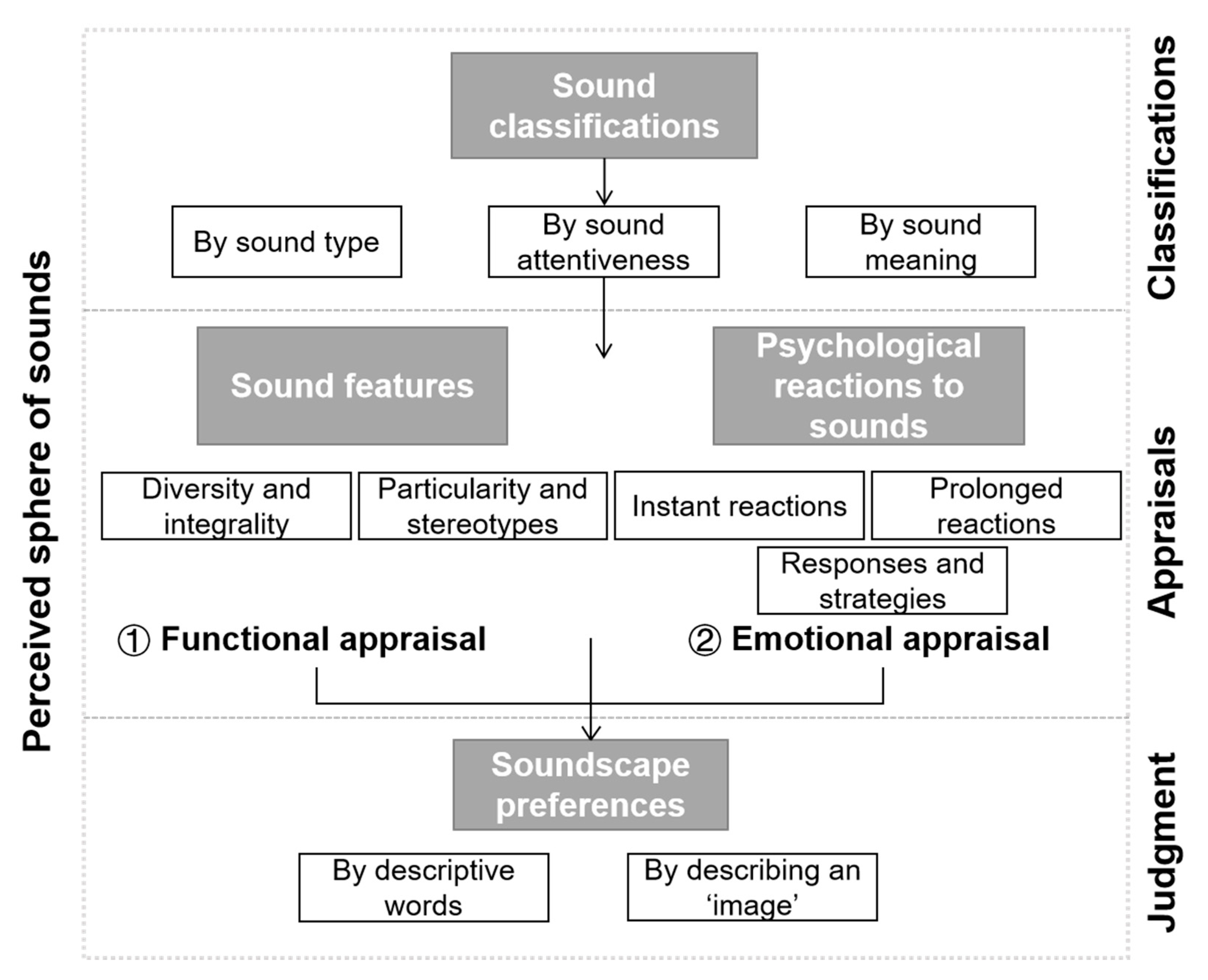
This model provides a powerful theoretical bridge.
- Sound Features: These are the direct results of professional choices. The "diversity" of sounds in the Le Mans scene, the "particularity" of Henry Ford's booming voice, the "integrality" of the pulsing drone and SFX in Sicario.
- Appraisals: The audience's cognitive and emotional reaction. The Le Mans crowd is appraised as exciting and chaotic. Ford's voice is appraised as powerful and authoritative. The Sicario drone is appraised as unsettling and threatening.
- Judgment: The ultimate interpretation. The audience judges the race as an epic event, Ford as a formidable figure, and the world of Sicario as one of pervasive danger.
Your work as a sound professional is to manipulate the "Sound features" to guide the audience toward a specific "Judgment."
Conclusion
In this lesson, we have theorized the fundamental practices of sound production, framing them as deliberate acts of sonic authorship. By connecting your own professional experience to these academic concepts, you can build a robust methodology for your future research.
Key Takeaways:
- Professional sound design choices like layering, editing, and mixing are not merely technical; they are theoretical practices that construct the cinematic soundscape.
- Layering builds sonic density and texture, creating complex atmospheres and thematic verticality.
- Editing controls the temporal flow of the soundtrack, managing rhythm, pace, and narrative tension.
- Mixing directs audience attention and establishes perspective, most notably through the manipulation of the point of audition.
- The goal of these techniques is to guide the audience through a process of perception, appraisal, and judgment, ultimately shaping their interpretation of the film.
Preview of the Next Lesson:
Having examined the "how" of sound design at a macro level, our next lesson will focus on a foundational tool: the microphone. We will explore how the very first step in the audio chain—the choice of microphone and its placement—is itself a critical authorial decision. Our learning outcome will be to analyze how microphone choice, placement, and perspective shape the viewer's sonic point-of-audition.