Introduction
Welcome to the first lesson of our new module, "Production and Design as Theoretical Practice." In the previous module, we concluded by comparing the theoretical frameworks of Michel Chion and Rick Altman. We saw that Chion provides tools for analyzing the film as a perceptual audiovisual text, while Altman urges us to consider the broader cinema event, including the material history of sound technology.
This lesson builds directly on that foundation. If film sound is, as Altman suggests, a material object shaped by technology and intention, then the choices made during its production are not merely technical—they are deeply theoretical acts. We will begin to bridge this gap between abstract theory and your own practical experience as a sound professional.
Our learning outcome for this lesson is to describe the theoretical distinction between recorded, designed, and composed sound in film production. Understanding these categories is fundamental. It moves us beyond a simplistic notion of "film sound" to a more nuanced appreciation of how a soundtrack is constructed, layer by layer, to create meaning, emotion, and a sense of reality. This framework will be crucial for your future analysis of how Moroccan film soundscapes are authored and articulated.
1. The Myth of "Natural" Sound: From Recording to Design
At first glance, it might seem that the goal of film sound is to capture reality as faithfully as possible. However, as you know from your professional work, what we hear in the cinema is almost never a simple, direct recording of the on-set environment. The first crucial theoretical step is to dismantle this idea of "natural" sound.
To start, let's explore this foundational concept in a key text on sound theory.
This brief excerpt from Howard Gotfrit's 'Film Sound Theory' lecture notes immediately challenges the idea of naturalism in film sound, establishing a core principle for our discussion.
Please read the section under the heading 'What is "natural Sound"?'. Focus on the statements 'Virtually always manufactured rather than captured at the moment of filming' and the distinction drawn between the subjective experience of human hearing and the objective nature of a microphone.
This reading introduces a critical insight: film sound is a manufactured artifact. A microphone does not hear like a human ear. Our hearing is selective; we filter out irrelevant noise and focus on what's important through a cognitive process sometimes called the "cocktail party effect." A microphone, by contrast, is generally unselective—it captures everything within its range, including the hum of lights, the director's muffled cough, and the rustle of costumes. The result is often a sonic environment that feels chaotic and unintelligible, not "real."
Because of this, film sound practice is driven by the need to create a perceptually convincing and narratively effective reality, not to reproduce an objective one. This brings us to a fundamental tension in sound design, well-articulated in the following video.
Sound and Silence in Gravity: Fidelity vs Intelligibility
This video essay, 'Sound and Silence in Gravity,' introduces two opposing principles that govern sound design choices: environmental fidelity and rhetorical intelligibility.
Please watch the segment from 00:54 to 02:15. Pay close attention to the definitions of 'environmental fidelity' (faithfulness to the on-screen environment) and 'rhetorical intelligibility' (sacrificing faithfulness to deliver narrative information clearly).
This tension between fidelity and intelligibility is precisely why we must distinguish between different types of sound based on their production and purpose. It leads us to our three key categories.
2. The Three Pillars of the Soundtrack
We can theoretically divide the elements of a film's soundtrack into three broad categories: recorded, designed, and composed. These distinctions are not about the physical source of the sound, but rather the intent and degree of manipulation involved in its creation and placement in the final mix.
A structured way to think about this is presented in the following academic paper, which breaks down the soundtrack based on standard post-production workflow.
[PDF] THE FILM SOUND ANALYSIS FRAMEWORK: A CONCEPTUAL ...
This section from 'THE FILM SOUND ANALYSIS FRAMEWORK' provides a clear, industry-aligned taxonomy of soundtrack elements. It offers an excellent structure for understanding our three categories.
Please read section 2.1, 'Syntactic Taxonomy Analysis,' which covers Voices, Background Sounds, Sound Effects, and Music. As you read, think about how each of these elements fits into the broader concepts of being recorded, designed, or composed.
Using that reading as our guide, let's formally define our terms.
A. Recorded Sound
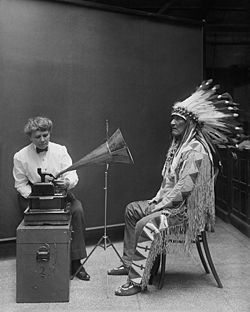
Recorded sound refers to audio captured on-location during filming (production sound) with the primary intention of using it "as is," striving for environmental fidelity. The ideal is to capture a sonic event in its raw form.
- Primary Example: Dialogue recorded on set, the sound of a car engine that is central to a scene, or a specific, unrepeatable environmental sound.
- Theoretical Goal: To anchor the film in a perceived reality, to provide a sonic "actuality" that corresponds directly to the image.
The classic image of ethnographic sound recording captures this ideal perfectly.
However, as we've established, purely recorded sound is rare in the final mix. More often, it serves as the raw material for the next category.
B. Designed Sound
Designed sound encompasses any audio that is created, manipulated, or re-contextualized in post-production to serve a specific narrative purpose, prioritizing rhetorical intelligibility. This is the domain of manufacturing sound.
- Examples:
- ADR (Automated Dialogue Replacement): As noted in the PDF, dialogue is often re-recorded in a studio to achieve clarity, replacing the noisy or poorly captured on-set recording.
- Foley: The art of creating synchronized, everyday sounds (footsteps, cloth movement, doors closing) in a studio to give physical presence and texture to characters and objects.
- Ambiences/Backgrounds: These are rarely a single recording of a location. Sound designers meticulously layer multiple sounds from a library (e.g., distant traffic + specific bird calls + light wind) to construct a soundscape that creates a precise mood and sense of place.
- Sound Effects (SFX): Sounds created from scratch for elements that have no real-world counterpart (like a laser blast) or whose real sound is uncinematic (like a punch).
This is the world of the sound mixing room, where raw elements are transformed into a polished, intentional soundtrack.

The goal of designed sound is not necessarily to be "unrealistic," but to create what sound designer Walter Murch calls "the sound one hears in one's head"—an idealized, hyper-real version of reality that is more emotionally and narratively potent than reality itself. It aims to create "the sound of the image, not that of the world," a concept highlighted in the "Film Sound Theory" resource (LINK).
C. Composed Sound
Composed sound refers primarily to the musical score of the film. This is sound created not to represent a sonic event within the film's world (diegesis), but to comment on it, shape its emotional reception, and provide narrative structure.
- Examples:
- Original Score: Music written specifically for the film by a composer to align with the dramatic arc of the story.
- Adapted/Licensed Music: Pre-existing music chosen by the director or music supervisor and edited to fit a scene. While not "composed" from scratch for the film, its selection and placement is a compositional act.
It's important to distinguish the composed score (typically non-diegetic) from source music (diegetic music, e.g., a song playing on a radio in a scene). Source music often starts as a recording but is then treated as a designed element within the mix.
The composed score is perhaps the most obvious form of sonic authorship. Techniques like the leitmotif—a recurring musical theme associated with a character, object, or idea—are powerful examples of composed sound explicitly guiding the audience's interpretation, as detailed in the "FILM SOUND ANALYSIS FRAMEWORK" reading (LINK).
Synthesis: A Framework for Analysis
These three categories provide a theoretical lens for deconstructing a soundtrack.
| Category | Primary Goal | Key Process | Typical Elements |
|---|---|---|---|
| Recorded | Environmental Fidelity | Capturing | On-set dialogue, "actual" sounds |
| Designed | Rhetorical Intelligibility | Manufacturing / Manipulating | Foley, SFX, ADR, layered ambiences |
| Composed | Emotional/Narrative Guidance | Creating / Arranging | Original score, leitmotifs |
In practice, these lines are often blurred. A piece of dialogue recorded on set might be heavily processed with equalization and reverb (designed) to place it in a large hall. A diegetic song (recorded) might transition into the non-diegetic score (composed).
The value of this framework is not in rigidly categorizing every sound, but in understanding the intention behind the sonic choices. By asking why a filmmaker chose to design a sound effect rather than use a recording, or compose a piece of music rather than let the ambient soundscape play, you begin to uncover the theoretical and authorial work of sound production.
Conclusion
In this lesson, we have established a foundational theoretical distinction between recorded, designed, and composed sound. This framework moves us past the illusion of a "natural" film soundtrack and toward an understanding of it as a deliberately constructed artifact.
Key Takeaways:
- Film sound is rarely a direct recording of reality; it is almost always manufactured to prioritize narrative clarity (rhetorical intelligibility) over pure realism (environmental fidelity).
- Recorded sound is the raw material, captured with the goal of fidelity but often insufficient for the needs of narrative cinema.
- Designed sound is the process of manufacturing the sonic world through techniques like ADR, Foley, and layering, creating an idealized and effective reality.
- Composed sound, primarily the musical score, operates on an expressive and structural level to guide audience emotion and interpretation.
- The distinction between these categories lies in the intent and degree of manipulation applied to the sound to serve the story.
Preview of the Next Lesson:
Now that we have defined these broad categories, our next lesson will delve deeper into the specific techniques of sound design. The learning outcome will be to theorize how professional sound design choices (layering, mixing, editing) construct a film's soundscape, drawing on practical experience. We will explore how these granular, moment-to-moment decisions function as acts of authorship, building the complex sonic tapestry of a film.