Hello! Welcome to the first lesson of our course. Given your background in statistics and your goal to explore the philosophical foundations of probability, we're going to start at the very beginning by asking a question that is often overlooked in technical training: What is probability?
While you're proficient in calculating with probabilities, this lesson delves into what a statement like "the probability of event A is 0.7" actually means. We will distinguish between three major philosophical interpretations: frequentist, propensity, and subjective (Bayesian). For each, we'll examine its core claim and its ontological commitment—that is, what it claims probability is and where it exists (in the world or in the mind).
This exploration lays the groundwork for the entire course, connecting the mathematical tools you already know to the epistemological questions about belief, knowledge, and causation that you're interested in.
The Great Divide: What are We Interpreting?
The mathematical rules of probability, often called the Kolmogorov axioms, are universally accepted. They define a function, , that assigns numbers to events and follows specific rules (e.g., probabilities are between 0 and 1, the probability of a sure event is 1, etc.).
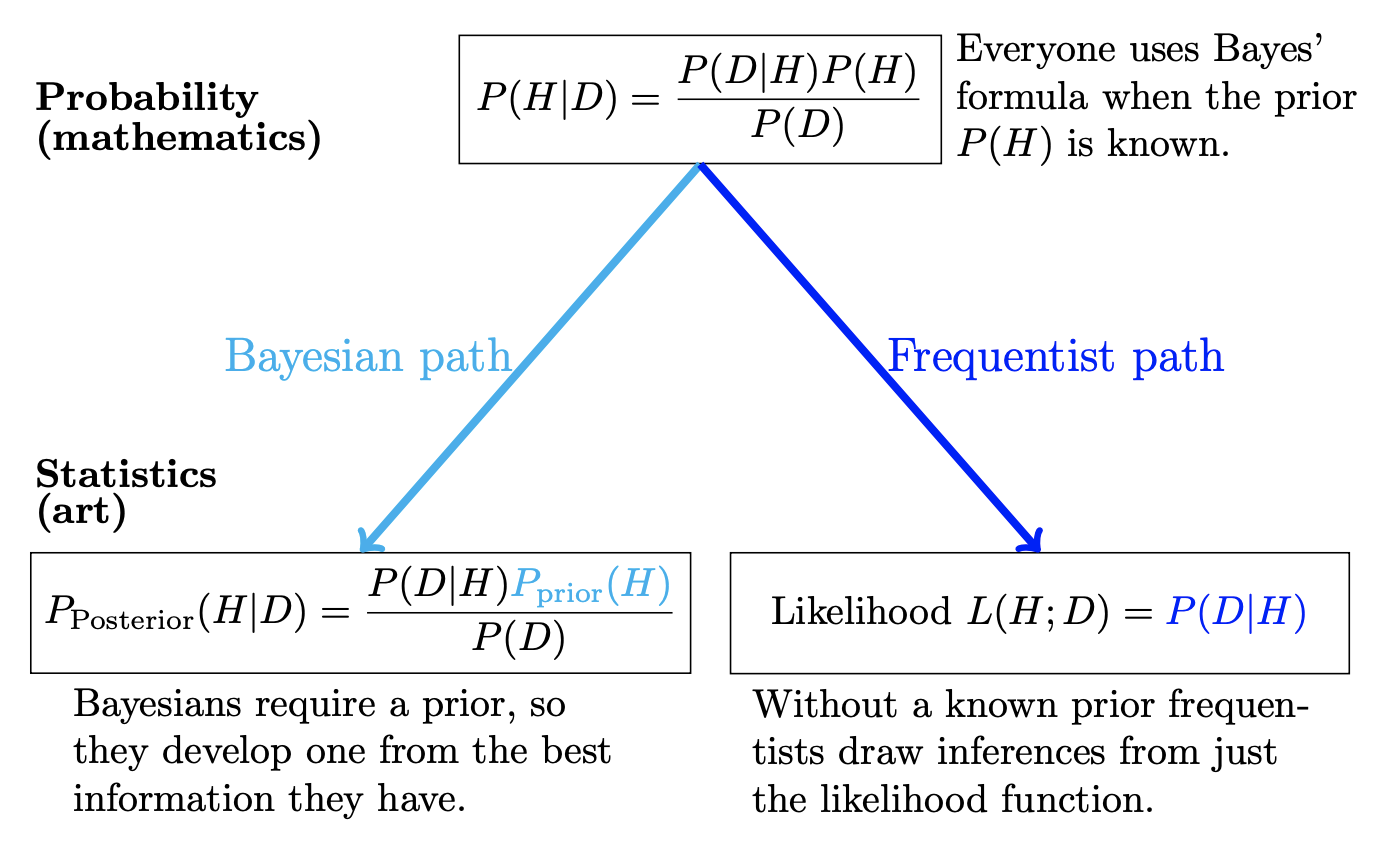
The philosophical debate isn't about these rules, but about what the function represents in the real world. As you've seen in your work, this question leads to different statistical methodologies.
To start, let's watch a brief video that divides interpretations of probability into two broad camps:
- Epistemic probability: Probability is about our state of knowledge or belief.
- Objective (or physical) probability: Probability is a feature of the world itself, independent of us.
The Propensity Interpretation of Probability
This clip from a video by Kevin deLaplante provides a clear overview of the fundamental distinction between 'epistemic' (belief-type) and 'objective' (physical-type) probabilities. This distinction will help frame the three main interpretations we'll discuss.
Watch the segment from 00:11 to 02:46. Focus on how it separates probability concepts that relate to evidence and belief from those that relate to properties of the world.
With this distinction in mind, let's examine the three main interpretations.
1. The Subjective (Bayesian) Interpretation: Probability as Degree of Belief
The subjective interpretation, which is the cornerstone of Bayesianism, falls squarely in the epistemic camp.
Core Idea: Probability is a measure of an individual's personal degree of belief, or credence, in a proposition.
For a subjectivist, your probability for an event is your level of confidence that it will occur. It's a statement about your psychology, informed by your unique evidence and reasoning. If you and I have different evidence about tomorrow's weather, we can rationally have different probabilities for rain, and as long as our beliefs are internally consistent, neither of us is "wrong."
Philosophy of Science 15 - Bayesian Epistemology 1
The following clip from Kane B's lecture on Bayesian Epistemology explains this subjective view. It emphasizes that probability is a matter of psychology and that belief is not an all-or-nothing affair but a spectrum.
Please watch from 03:05 to 07:19. Pay close attention to the definition of probability as a 'subjective degree of belief' and the idea that it's a statement about a person's judgment, not an objective fact in the world.
- Ontological Commitment: Probability is not a feature of the external world. It exists in the mind of an agent. There is no observer-independent "true" probability of a proposition; there is only your degree of belief, my degree of belief, and so on.
A key question for subjectivists is: If probability is just personal belief, why should it follow the mathematical rules of probability? The primary justification is that beliefs which violate these axioms are incoherent and pragmatically self-defeating. The classic argument for this is the Dutch Book argument.
Interpretations of Probability
The Stanford Encyclopedia of Philosophy article on 'Interpretations of Probability' provides a concise summary of the subjective view and its justification via the Dutch Book argument.
Please read the first three subsections of Section 3.3, 'The Subjective Interpretation': 'Probability as degree of belief', 'The betting analysis and the Dutch Book argument', and 'Probabilities and utilities'. These sections formalize the idea of belief-as-probability and introduce the core argument for why those beliefs must be coherent.
The Dutch Book argument shows that if your degrees of belief don't conform to the probability calculus, you are vulnerable to a series of bets that guarantees you a net loss. Rationality, therefore, demands coherence. We will examine this argument in much greater detail in our next lesson.
2. The Frequentist Interpretation: Probability as Long-Run Frequency
In contrast to the subjective view, frequentism is a leading objective interpretation. It's likely the interpretation most implicitly assumed in the classical statistical methods you've encountered.
Core Idea: The probability of an event is its relative frequency in the long run over an infinite number of trials.
For a frequentist, saying "the probability of a coin landing heads is 0.5" means that if you were to toss the coin infinitely many times, the proportion of heads would converge to 0.5. Probability is defined by this limiting frequency.
- Ontological Commitment: Probability is an objective, empirical fact about a collection of events in the world. It is a property of a (hypothetically infinite) reference class, not of a single event.
Interpretations of Probability
Let's turn again to the Stanford Encyclopedia of Philosophy to get a precise definition of frequentism and its main challenges.
Please read Section 3.4, 'Frequency Interpretations'. Focus on the distinction between finite and hypothetical frequentism, and take note of the two major philosophical challenges: the 'problem of the single case' and the 'reference class problem'.
As the reading highlights, frequentism faces significant philosophical hurdles:
- The Problem of the Single Case: What is the probability of a unique event, like the outcome of the next presidential election? Since there's no sequence of trials, frequentism struggles to assign a probability. Von Mises, a prominent frequentist, bluntly stated that for a single case, "probability...has no meaning at all."
- The Reference Class Problem: The probability of an event changes depending on the class you place it in. The probability of a specific person, Alice, surviving the next five years is different if she's in the reference class "30-year-old humans" versus "30-year-old marathon-running, non-smoking humans." Which is the "correct" probability for Alice? Frequentism doesn't provide a clear answer.
3. The Propensity Interpretation: Probability as Physical Disposition
The propensity interpretation is another objective view, developed largely to overcome the weaknesses of frequentism, especially the problem of the single case.
Core Idea: Probability is a physical tendency or disposition of a specific chance setup to produce a particular outcome.
This interpretation treats probability as a property analogous to fragility or solubility. A sugar cube has a disposition to dissolve in water even if it never actually does. Similarly, a biased coin has a physical propensity of, say, 0.75 to land heads on a single toss, a property inherent in its physical makeup and the tossing mechanism.
- Ontological Commitment: Probability is a real, physical property of a system at a given moment. It is objective, mind-independent, and applies to single cases.
The Propensity Interpretation of Probability
This video from Kevin deLaplante introduces Karl Popper's propensity theory as a direct response to the limits of frequentism. It provides an intuitive explanation of probability as a physical tendency.
Please watch from 02:34 to 06:11. Notice how this view attempts to explain why long-run frequencies are what they are, by grounding them in the physical propensities of single-case events. It also connects this idea to probabilities in quantum mechanics.
The propensity view is attractive because it gives an objective, single-case meaning to probability, which seems right for statements like "the probability of this specific atom decaying." However, it faces its own challenges, such as defining what a "propensity" is metaphysically and whether these propensities must obey the probability calculus (the "Humphreys' paradox" mentioned in the SEP article).
Summary and Comparison
Let's consolidate these ideas. The three interpretations offer distinct answers to the question "What is P(A)?".
| Interpretation | The Meaning of P(A) | Ontological Commitment (Where does probability live?) | Key Strength | Key Weakness |
|---|---|---|---|---|
| Subjective (Bayesian) | My degree of belief in A. | In the mind of an agent. | Provides a framework for rational belief and learning for any proposition. | Can feel "too subjective"; what makes one belief better than another? |
| Frequentist | The long-run relative frequency of A in a series of trials. | In the world, as a property of an infinite sequence. | Empirically grounded in observable frequencies. | Cannot handle single-case probabilities; the reference class problem. |
| Propensity | The physical disposition of a system to produce outcome A. | In the world, as a property of a single chance setup. | Objective and applies to single cases. | The metaphysical nature of "propensity" is unclear and hard to test. |
Conclusion
In this lesson, we've moved from the mechanics of probability to its philosophical heart. You can now distinguish between three dominant interpretations:
- Subjectivism (Bayesianism) sees probability as a rational measure of personal belief.
- Frequentism identifies probability with the long-run frequency of an outcome in repeated trials.
- Propensity theory views probability as an objective, physical tendency of a system.
Understanding these distinctions is crucial. Your choice of interpretation determines what you believe probability claims are about—the world or our knowledge of it—and this has profound implications for how you approach data analysis, uncertainty, and decision-making.
In our next lesson, we will dive deeper into the core of Bayesian epistemology. We will explore the Dutch Book argument in detail to understand why subjective degrees of belief must be probabilistically coherent to be considered rational.