Olá! Welcome to our third lesson.
In our last session, we focused on the subjective part of patient assessment: understanding and describing a patient's symptoms and complaints in English. You learned how to use the OPQRST framework to build a clear history of present illness.
Today, we shift from the subjective to the objective. This lesson is dedicated to communicating the concrete, measurable data you gather from a patient. Our learning outcome is to communicate vital signs and basic physical examination findings in English. This is a fundamental skill for any clinical interaction, but it's especially critical in your APH work, where clear and concise handoffs can be life-saving.
We will cover the standard terminology for vital signs, learn how to describe findings from a physical exam, and see how these objective details are communicated in both oral presentations and written reports.
1. The Language of Vital Signs
"Vital signs" are the foundational measurements of a patient's basic body functions. In English, we often refer to them simply as "vitals." Let's start by watching a clinician take and state a patient's vitals.
Checking a Patients Vital Signs OSCE - Clinical Skills - Dr Gill
This video from Dr. James Gill demonstrates the process of checking a patient's vital signs. It provides an excellent model for the language used both when speaking to the patient and when stating the findings.
Watch the video from the beginning (00:00) to 00:19, and then from 00:28 to 03:17. Pay close attention to the names of the vital signs and how Dr. Gill communicates the results, for example, 'your saturations are 99' or 'we've got a normal temperature there'.
As you saw in the video, communicating vital signs involves specific terminology and units. Here is a summary of the core vitals and the common ways to report them.
| Vital Sign | Abbreviation | How to Say It | Example Phrase |
|---|---|---|---|
| Heart Rate | HR / Pulse | "Heart rate is one-ten." / "Pulse is seventy-two." | "The patient's heart rate is 110 beats per minute." |
| Blood Pressure | BP | "BP is one-twenty over eighty." | "Blood pressure is 120 over 80 millimeters of mercury." |
| Respiratory Rate | RR | "Respiratory rate is sixteen." | "His respiratory rate is 16 breaths per minute." |
| Oxygen Saturation | SpO₂ / Sats | "Sats are ninety-eight percent." | "Oxygen saturation is 98% on room air." |
| Temperature | Temp | "Temp is ninety-eight-point-six." (F) / "thirty-seven degrees." (C) | "Her temperature is 37 degrees Celsius." |
"Room air" is a key phrase indicating the patient is breathing without supplemental oxygen.
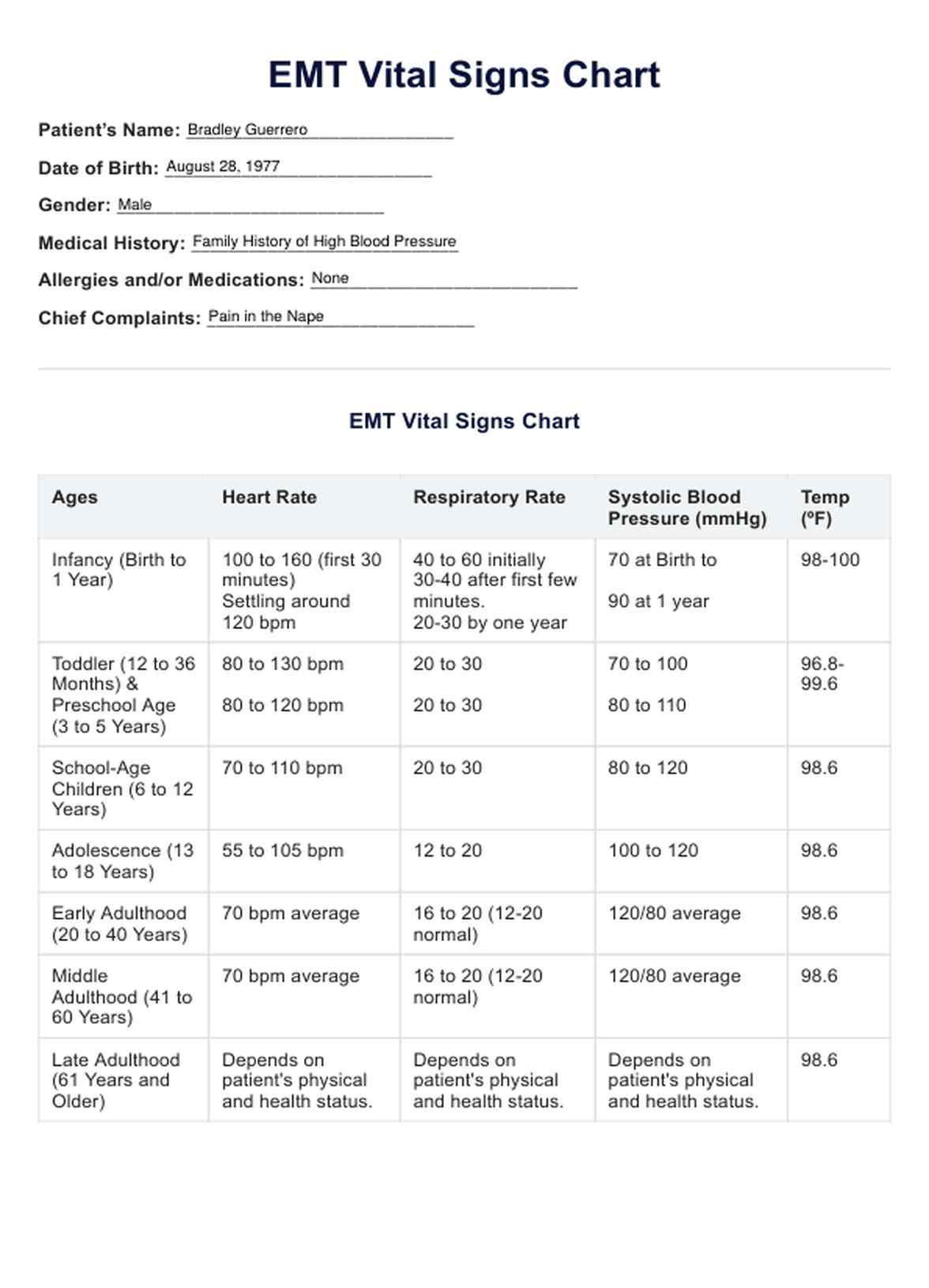
Normal ranges for vital signs vary by age. This chart provides a useful quick reference.
2. The Physical Examination: A Systematic Approach
After vitals, the next step is the physical examination (or "physical exam"). In emergency medicine, a systematic approach is crucial. A common framework is the A-B-C-D-E assessment.

This framework ensures you address the most critical issues first. For a more detailed examination, especially in trauma, you'll perform a head-to-toe assessment. In less critical medical cases, you might conduct a focused assessment on the relevant body system.
To describe your findings, you need a specific vocabulary. Here are some of the most common English terms used in a physical exam, organized by system. These are the "objective" findings, or signs, that you observe.
| System | Normal / Benign Findings | Abnormal / Concerning Findings |
|---|---|---|
| General Appearance | Well-appearing, in no acute distress (NAD) |
Unkempt, cachectic (wasted), diaphoretic (sweating heavily), lethargic |
| Head/Eyes/Ears/Nose/Throat (HEENT) | Pupils equal, round, and reactive to light (PERRL), moist mucous membranes |
Jaundice (yellow skin/eyes), pale conjunctiva, jugular vein distention (JVD) |
| Respiratory | Lungs clear to auscultation bilaterally (CTAB), no respiratory distress |
Wheezing, crackles (or rales), rhonchi, accessory muscle use, tachypnea (fast breathing) |
| Cardiovascular | Regular rate and rhythm (RRR), normal S1, S2, distal pulses 2+ |
Murmur, gallop, rub, tachycardia (fast heart rate), bradycardia (slow heart rate) |
| Abdomen | Soft, non-tender, non-distended (SNTD), bowel sounds active x4 |
Rigid, guarding (tensing muscles), rebound tenderness, distended, absent bowel sounds |
| Extremities / Skin | Warm and dry, no cyanosis, clubbing, or edema (CCE), capillary refill <2 seconds |
Cool, clammy skin, cyanosis (blue skin), pitting edema, rash (erupção cutânea), laceration (laceração) |
Many of these terms are derived from the comprehensive "Principles of Patient Assessment" textbook. When performing a trauma assessment, mnemonics like DCAP-BTLS (Deformities, Contusions, Abrasions, Punctures, Burns, Tenderness, Lacerations, Swelling) are often used to ensure nothing is missed.
3. Communicating Your Findings
Knowing the terms is the first step. The next is to communicate them clearly and concisely. This happens in two primary ways: the oral presentation (e.g., a handoff to hospital staff) and the written report.
Oral Presentation
A good oral presentation is a narrative that tells the patient's story. It should be structured, focusing on the most relevant details.
Patient Presentations in Emergency Medicine
Let's watch an example of an effective patient presentation from the video by the Council of Residency Directors. This presenter concisely integrates the objective findings into the patient's story.
Watch the 'good' presentation example from 08:00 to 09:09. Listen carefully to how the presenter communicates the physical exam and vital sign findings after giving the patient's history.
Did you notice these key phrases from the video?
- "On physical exam, Mr. Ferguson's vital signs were unremarkable." (This is a common way to say the vitals were all within normal limits).
- "He's comfortable and well-appearing."
- "His lungs were clear."
- "His heart exam was with a regular rate and rhythm without any murmurs, gallops, or rubs."
- "His abdominal exam was benign." (Another word for normal/unremarkable).
- "He did have intact and symmetric distal pulses."
This is the standard, professional language you should aim to use.
Written Documentation (Patient Care Report)
In your APH role, you create a Patient Care Report (PCR). Standardized formats like SOAP or CHART are used to ensure all critical information is included. The objective findings we've discussed are a key part of these reports.
EMS Report Template with Examples
This article from S10.AI explains the SOAP and CHART formats and provides excellent examples. It shows exactly where and how to document your objective findings.
First, read the brief description of the SOAP and CHART templates. Then, carefully review the two examples provided. Focus on the 'Objective' section in the SOAP note and the 'Assessment' section in the CHART note. See how the vital signs and physical exam findings are listed.
Let's look at the SOAP note example from the resource:
Objective
- Vital Signs: BP 160/100 mmHg, HR 88 bpm, RR 18, SpO2 96%, Temp 98.7°F.
- Physical Exam: Alert and oriented, diaphoretic, no visible trauma. Heart sounds normal, lungs clear.
This format is direct and data-focused. It presents your objective findings without interpretation, which comes later in the "Assessment" and "Plan" sections. Mastering this structured documentation is a key part of professional medical communication in English.
Conclusion
Excellent work today. We have moved from the patient's story to your objective observations, a critical shift in the assessment process.
Key Takeaways:
- You are now equipped with the standard English vocabulary and phrasing to report a patient's vital signs.
- You can describe findings from a physical examination using professional terminology for each major body system.
- You understand how to integrate these objective findings into a concise oral presentation and a structured written report using formats like SOAP.
Preview of the Next Lesson:
Now that we've covered subjective complaints and objective findings, the next logical step is intervention. In our next lesson, we will focus on the tools of intervention, starting with pharmacology. The learning outcome will be: Identify English names and pronunciations for common medications and drug classes relevant to emergency care.