Introduction
In our last lesson, you armed yourself with scripts to dismantle the two most common "showstopper" objections: "we have internal designers" and "no budget right now." By reframing these conversations around augmentation and ROI, you learned to turn roadblocks into opportunities.
Now, we'll build the offensive weapon that often prevents those objections from ever arising: a powerful, 2-minute verbal pitch. The goal of this lesson is to help you craft and deliver a concise, compelling pitch that immediately establishes your value, demonstrates business acumen, and secures a follow-up meeting with a qualified prospect. This is the script you'll use on discovery calls, in networking situations, or anytime you have a brief window to capture a founder's attention.
1. The Anatomy of a $5k Pitch
A pitch that sells a high-value audit isn't about listing features; it's about telling a concise story of financial impact. It must be structured to grab attention, build credibility, and create urgency in under 120 seconds.
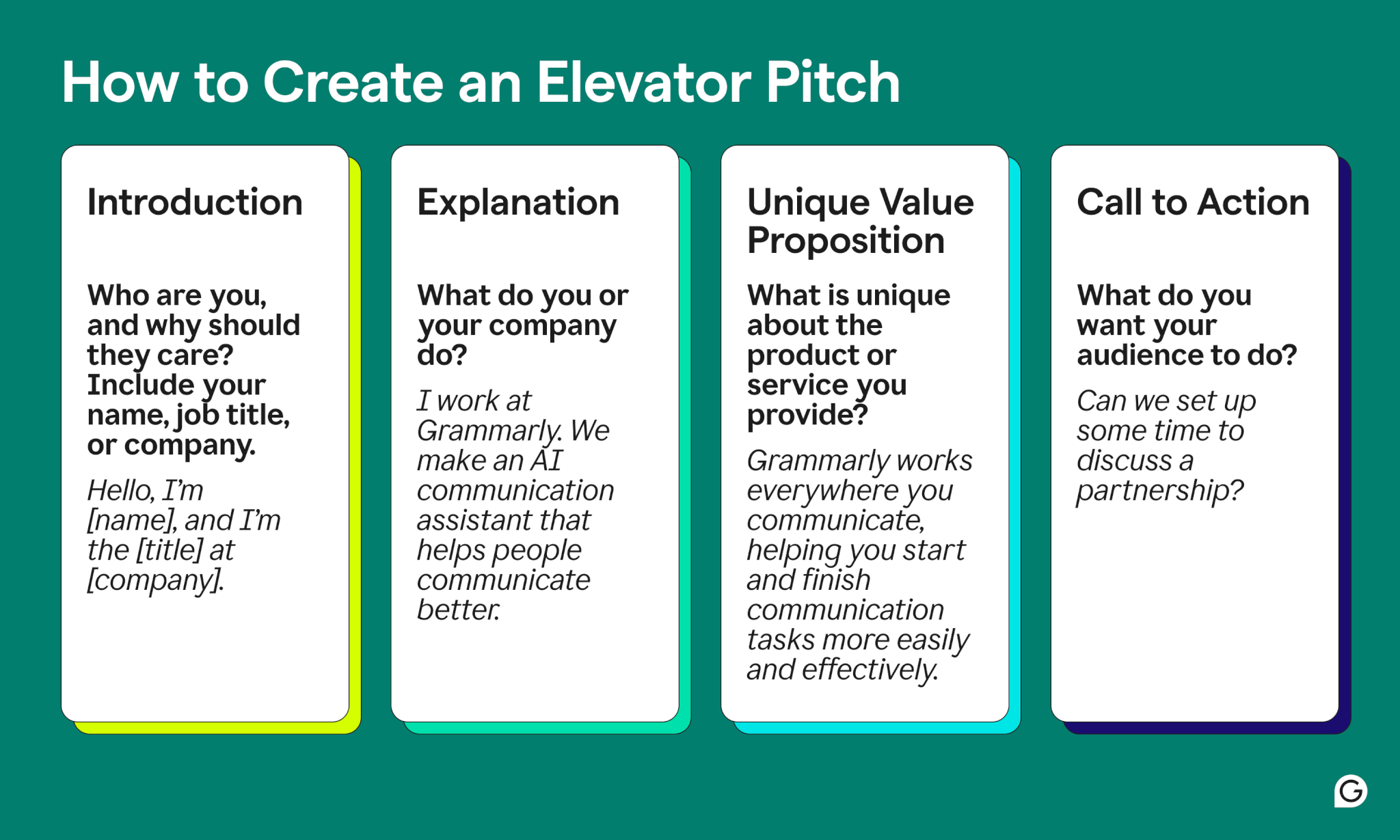
For our purposes, we'll use a battle-tested framework that combines a strong opening hook with a Problem-Solution-Value narrative.
Let's watch a video that breaks down this structure.
The Perfect Elevator Pitch - Best Examples and Templates
Patrick Dang, a sales expert, provides a simple yet powerful formula for crafting an elevator pitch. We'll use his core structure as the foundation for our audit pitch.
Watch the video from the beginning until 07:42, focusing on these three key concepts: The One-Sentence Pitch (00:49 - 01:43): Internalize the I help X achieve Y by doing Z formula. This will be our opening hook. The Story Structure (01:43 - 06:41): Pay close attention to the sequence: Problem -> Solution -> Value. This is the narrative engine of your pitch. The Summary (06:41 - 07:42): The recap reinforces why telling a story is more effective than just listing services. Your pitch is a story about solving a financial problem.
Now, let's build your script, step by step.
2. Building Your 2-Minute Pitch Script
Step 1: The Hook (0-20 seconds) - "I help X achieve Y by doing Z"
Your opening sentence must immediately qualify you and signal that you speak the language of business, not just design.
- X (Your Audience): Be specific. Not "companies," but "B2B SaaS founders" or "Product Managers at Series A fintech companies."
- Y (The Value): Focus on a high-level business outcome. Not "improve the UI," but "increase trial-to-paid conversion rates" or "reduce customer churn."
- Z (Your Method): This is your audit. Frame it as a strategic action. Not "doing a UX audit," but "by performing a rapid, data-driven audit that pinpoints hidden revenue leaks."
Example Script:
"I help B2B SaaS founders increase their trial-to-paid conversion rate by conducting a rapid UX audit that pinpoints exactly where their user onboarding is leaking revenue."
This single sentence tells the client who you help, what financial metric you improve, and how you do it. It's direct and value-focused.
Step 2: The Narrative (20-90 seconds) - Problem, Solution, Value
This is where you tell a micro-story that resonates with a founder's typical challenges.
A. The Problem (Frame the Pain)
Describe a common, costly problem your ideal client faces. Use the language of business and finance.
ROI of UX 2026: CFO Guide to Justifying Design Spend
The article 'ROI of UX 2026' provides the perfect CFO-level language to describe usability problems as business liabilities. We'll borrow this terminology for our pitch.
Scan the sections 'The "Boardroom Pitch"' and 'The Three Pillars of Design ROI'. Pull out phrases that quantify pain, such as 'bleeding efficiency,' 'user debt,' 'operational tax,' and link them to revenue, cost, or risk.
Example Problem Script:
"Most SaaS products I see are sitting on significant 'user debt.' They have friction in their key funnels—like onboarding or checkout—that acts as an invisible tax on their growth. It shows up as high churn, low conversion, and an increasing number of support tickets, which are all symptoms of revenue being left on the table."
B. The Solution (Introduce Your Service as the Fix)
Position your audit not as a "design critique" but as a strategic "performance upgrade" or a "financial diagnostic."
Example Solution Script:
"My service is a 5-day UX audit designed to address this directly. It's not a full, expensive redesign. It’s a fast, surgical diagnostic where I use analytics and heuristic analysis to identify the top 3-5 friction points that are costing you the most money. The deliverable is a clear, prioritized action plan of quick wins your team can implement immediately."
C. The Value (Quantify the Return)
Connect your solution to a tangible financial outcome. Use powerful, reputable statistics to anchor your value. The same 'ROI of UX 2026' article is your source here.
Example Value Script:
"The goal is to generate a massive ROI. By fixing just a few of these critical usability issues, clients can see significant lifts in conversion and retention. For context, Bain & Company found that even a 5% increase in customer retention can boost profitability by 25% to 95%. My audit provides the roadmap to capture that value."
Step 3: The Close (90-120 seconds) - The Call to Action
Your CTA should not be "Do you want to buy an audit?" It should be a low-friction next step to continue the conversation. You are selling the next 15 minutes, not the full $5k project.
Example CTA Script:
"If any of this sounds relevant to what you're seeing at [Client's Company], I'd propose a brief, 15-minute follow-up call. We could use it to dive into one specific area of your product and I could offer a couple of immediate thoughts. Would that be a valuable use of your time next week?"
3. The "Show, Don't Tell" Alternative: The 7-Minute Loom Pitch
For cold outreach or as a follow-up to an initial contact, a verbal pitch isn't always possible. A hyper-tactical alternative is to send a short, personalized video audit. This builds immense trust before you even speak to the prospect.
Replace Discovery Calls with Loom Audits: A 7-Minute Solution
This LinkedIn post outlines a brilliant strategy for replacing generic discovery calls with short, high-value video audits. This is a perfect 'commando-style' tactic for you.
Read the section titled 'The 7-minute structure.' This is a complete script for a video that delivers your pitch and a mini-audit simultaneously.
The 7-minute Loom pitch structure is essentially a compressed, visual version of your verbal pitch:
- 0:00–0:30 (Context): Your one-sentence hook.
- 0:30–5:30 (Narrative): A live demo of their product, showing 3 specific problems (findings) and proposing 3 solutions (quick wins).
- 5:30–6:30 (Value): Briefly connect your proposed fixes to a KPI they care about (e.g., "Fixing this checkout button could reduce cart abandonment by an estimated 10%").
- 6:30–7:00 (Close): A clear CTA to book a focused call if they found the video useful.
This method proves your expertise and value upfront, making the subsequent sales call much warmer.
4. Your Deliverable: Update the Sales Battle Card
It's time to codify these scripts into your primary sales asset.
Task (20 minutes):
- Open your "Sales Battle Card" in Figma.
- Create a new frame titled "PITCH: 2-Minute Verbal Audit Pitch".
- Inside this frame, create text blocks for each of the 4 sections: Hook, Problem, Solution, Value, and CTA.
- Fill in these blocks with the script you've crafted, personalizing the examples provided in this lesson.
- Create a second frame titled "PITCH: 7-Minute Loom Audit Checklist".
- Based on the resource LINK, create a checklist in this frame outlining the 5 key parts of the video audit (Context, 3 Findings, 3 Quick Wins, Impact Math, Next Step).
You now have two powerful, reusable pitching assets ready to be deployed.
Conclusion
You've now moved from a defensive to an offensive sales posture. A well-crafted pitch doesn't just introduce you; it frames the entire conversation around value, ROI, and business impact. It positions you as a strategic partner before the client even has a chance to think about cost.
Key Takeaways:
- A winning pitch follows a Hook -> Problem -> Solution -> Value -> CTA structure.
- Use business language ("user debt," "operational tax") to describe design problems.
- Anchor your value with credible, third-party statistics on the ROI of UX.
- Your immediate goal is to sell the next meeting, not the entire project.
- Use asynchronous video pitches (Loom audits) to demonstrate value and pre-qualify leads before a call.
Preview of the Next Lesson:
A powerful pitch makes claims; a powerful case study proves them. With your sales scripts now complete, we will move to Module 7: Building the Client-Winning Case Study. You will learn how to structure your audit results into a compelling story of business impact—the ultimate asset that validates your pitch and attracts high-value clients automatically.