Hello! Welcome to the next lesson in our exploration of the Theory of Computation.
In our previous lessons, we established the fundamental equivalence between Pushdown Automata (PDAs) and Context-Free Grammars (CFGs). We saw that for any PDA, we can construct a CFG that generates the same language, and vice-versa. A key feature of the PDAs we've worked with so far is their inherent nondeterminism—the ability to have multiple possible moves from a single configuration.
You'll recall from our study of finite automata that nondeterminism didn't add any fundamental power; any language recognized by an NFA could also be recognized by a DFA. A natural question follows: Is the same true for pushdown automata?
Today, we will answer that question. Our learning outcome is to define Deterministic Pushdown Automata (DPDA) and identify languages that require nondeterminism. You will discover that, unlike with finite automata, removing nondeterminism does limit the power of PDAs. Given your experience designing and implementing systems, the distinction between deterministic and nondeterministic processes—and the practical value of the former—will be very familiar.
1. What Makes a PDA Deterministic?
Intuitively, a PDA is deterministic if, at any point during its computation, its next move is uniquely determined. There is never a choice. This means that for any given combination of the current state, the next input symbol (or an ε-transition), and the symbol on top of the stack, there is at most one valid transition.
This intuition is captured by two formal constraints on the PDA's transition function, δ.
Formal Definition of a DPDA
A Pushdown Automaton P = (Q, Σ, Γ, δ, q₀, Z₀, F) is a Deterministic Pushdown Automaton (DPDA) if both of the following conditions are met for every state q ∈ Q and stack symbol X ∈ Γ:
-
No Multiple Moves: For any state
q, inputa ∈ Σ ∪ {ε}, and stack symbolX,δ(q, a, X)can contain at most one element. In other words,|δ(q, a, X)| ≤ 1. This is the most basic condition, ensuring no two transitions exist for the exact same(state, input, stack_top)triplet. -
No
εvs. Input Ambiguity: Ifδ(q, ε, X)is defined (i.e., is not empty), thenδ(q, a, X)must be empty for all input symbolsa ∈ Σ. This is a crucial rule that eliminates a major source of nondeterminism. It states that if the machine can make a move without consuming an input symbol (anε-move), it cannot also have the option to make a move by consuming an actual input symbol for the same state and stack top.
The following resource provides an excellent breakdown of these two restrictions.
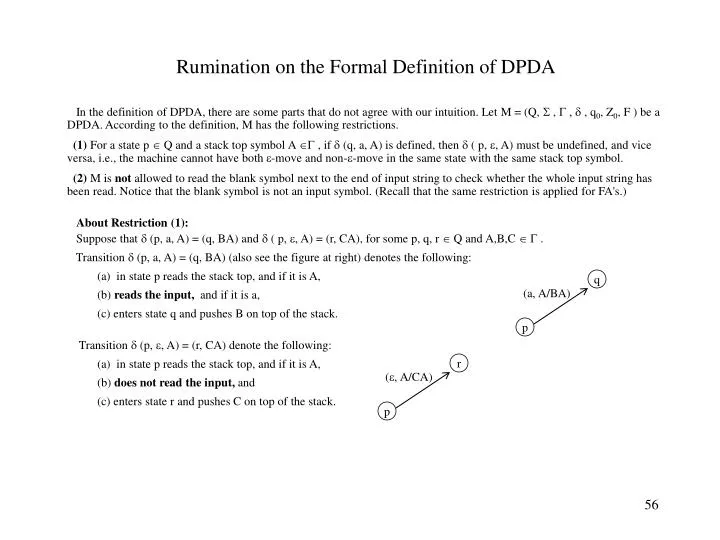
To solidify this definition, let's watch a short video that explains these rules with clear examples.
Deterministic Context-Free Languages (DCFLs), what are they?
This video from Easy Theory provides a clear and concise explanation of the formal definition of a DPDA and the languages they accept, known as Deterministic Context-Free Languages (DCFLs).
Watch the first 4 minutes and 11 seconds of the video. Focus on how the presenter explains the constraints on the transition function and which combinations of transitions are allowed versus disallowed in a DPDA.
2. Deterministic Context-Free Languages (DCFLs)
The set of languages that can be accepted by a Deterministic Pushdown Automaton is called the class of Deterministic Context-Free Languages (DCFLs). Let's explore some examples to understand what kinds of languages fall into this category.
Regular Languages are DCFLs
First, a simple but important point: every regular language is a DCFL. We can construct a DPDA for any regular language by taking the corresponding DFA and adding transitions that simply ignore the stack (e.g., for every transition δ_DFA(q, a) = p, we create a DPDA transition δ_DPDA(q, a, X) = (p, X) for all stack symbols X). Since a DFA is deterministic by definition, this resulting DPDA will also be deterministic.
A Classic DCFL: {aⁿbⁿ | n ≥ 1}
A more interesting example is the language L = {aⁿbⁿ | n ≥ 1}, which we know is context-free but not regular. This language is also deterministic. A DPDA can recognize it with the following logic:
- Start in an initial state. Read
a's from the input and push a corresponding symbol (say,A) onto the stack for eacha. - When the first
bis read, transition to a "popping" state. This is the key deterministic step: the firstbis an unambiguous signal to switch phases. - In the popping state, for each
bread from the input, pop oneAfrom the stack. - If the input ends and the stack is empty (except for the initial stack symbol
Z₀), the string is accepted. - If at any point an
ais seen after ab, or the stack becomes empty whileb's remain, or the input ends while the stack still containsA's, the machine "crashes" (has no valid move) and rejects.
The following video demonstrates the construction of a DPDA for this language.
Deterministic Push Down Automata DPDA || Lesson 73 || Finite Automata || Learning Monkey ||
This video from Learning Monkey walks through the logic for constructing a DPDA for {aⁿbⁿ} and then contrasts it with a language that requires nondeterminism.
Watch the segment from 02:04 to 04:22. Observe how the logic of pushing for 'a's and popping for 'b's is implemented deterministically.
Test your understanding!
Consider the language L = {wcwᴿ | w ∈ {a,b}*}. This is the language of palindromes with a center marker 'c'. Do you think this language is a DCFL? Why or why not?
Show answer
Yes, this language is a DCFL. The logic is very similar to {aⁿbⁿ}. The DPDA can push symbols onto the stack while reading the first part of the string (w). The symbol c serves as an unambiguous, deterministic signal to switch from the "pushing" phase to the "popping" phase. After reading c, the machine can start matching the subsequent input symbols against the symbols popped from the stack.
3. Languages That Require Nondeterminism
Now for the crucial question: are there any context-free languages that are not deterministic? The answer is a definitive yes. This is where PDAs fundamentally differ from finite automata.
Nondeterminism adds power to Pushdown Automata.
A classic example of a language that is context-free but not deterministic is the language of even-length palindromes without a center marker:L_pal = {wwᴿ | w ∈ {a,b}*}
Why does this language require nondeterminism?
A PDA recognizing L_pal must read the first half of the string (w), pushing symbols onto the stack, and then read the second half (wᴿ), popping symbols to match. The problem is that a DPDA has no way to find the middle of the string.
Consider the input string aabbaa.
- After reading
aa, is this the end ofw? Or isw = aab? Or maybew = aabbaa? - A DPDA must make a single, determined choice. If it decides the middle is after
aaand switches to popping, it will fail to acceptaabbaa. If it continues pushing, it might miss the correct middle point.
A nondeterministic PDA, however, can handle this. It essentially "guesses" where the middle is. At every step, it can choose to either:
a) Continue pushing symbols, assuming it's still in the w part.
b) Switch to the popping phase, guessing that it has just reached the middle.
One of these nondeterministic paths will succeed if the string is indeed a palindrome. A DPDA lacks this ability to explore multiple possibilities.
The following document from the University of Waterloo provides a textual explanation for why the palindrome language is not a DCFL.
Read sections 6.62 ("Not all CFLs are accepted by DPDAs") and 6.63 ("Sketch of direct proof..."). These short sections formally state that nondeterminism makes PDAs more powerful and use the palindrome language as the key example, highlighting the problem of identifying the middle of the string.
This leads to a strict hierarchy of language classes:
Regular Languages ⊂ Deterministic Context-Free Languages ⊂ Context-Free Languages
This proper containment shows that DPDAs are less powerful than general, nondeterministic PDAs.
Conclusion
In this lesson, we have separated the concept of context-free languages into two important subclasses: the deterministic and the nondeterministic.
Key Takeaways:
- A Deterministic Pushdown Automaton (DPDA) is a PDA where the next move is always uniquely determined. This is enforced by two formal constraints on the transition function that prevent any ambiguity.
- The class of languages accepted by DPDAs are the Deterministic Context-Free Languages (DCFLs).
- Unlike finite automata, nondeterminism adds computational power to PDAs. The class of all CFLs properly contains the class of DCFLs.
- Languages like
{aⁿbⁿ}are DCFLs because a clear, unambiguous symbol (bappearing for the first time) signals a change in the automaton's behavior. - Languages like
{wwᴿ}are not DCFLs because they require the automaton to "guess" the midpoint of the string, an ability that is inherently nondeterministic.
Preview of the Next Lesson:
We've now seen a limitation within the world of context-free languages. In our next lesson, we will introduce a powerful tool for proving that certain languages are not context-free at all. This tool is the Pumping Lemma for Context-Free Languages, and it will allow us to formally prove that languages like {aⁿbⁿcⁿ} are beyond the reach of any PDA, deterministic or otherwise.