Hello! Welcome to the seventh lesson in our final module on Debugging, Best Practices, and Interview Patterns.
In our previous lesson, we saw a powerful application of the two-pointer technique with Floyd's Tortoise and Hare algorithm to detect cycles in linked lists. That example highlighted how using multiple pointers moving at different rates can solve problems with optimal space complexity.
Today, we will apply this same powerful pattern to arrays. The learning outcome for this lesson is to implement in-place array manipulation algorithms (e.g., reversing, partitioning) using the two-pointer technique. Mastering this pattern is crucial for technical interviews, as it demonstrates your ability to write efficient, memory-conscious code—a skill that is especially valuable given your background in automotive and embedded systems where resource optimization is paramount.
1. The Two-Pointer Technique: A Core Algorithmic Pattern
The "two-pointer" technique is a common strategy for optimizing problems involving arrays or lists. Instead of using nested loops, which often lead to time complexity, this technique uses two pointers that traverse the data structure together to solve the problem in a single pass, typically achieving time and space complexity.
The pointers can move in various ways:
- Converging: Pointers start at opposite ends of the array and move toward each other.
- Parallel (or Sliding Window): Pointers start at or near the beginning and move in the same direction, often maintaining a "window" or specific distance between them.
The following video provides an excellent overview of these strategies.
Two Pointers in 7 minutes | LeetCode Pattern
The video 'Two Pointers in 7 minutes' by AlgoMasterIO gives a concise introduction to the main two-pointer strategies and when to apply them.
Please watch from 00:35 to 03:11. Focus on understanding the three main strategies: converging, parallel, and trigger-based. The converging pointers strategy is the one we will focus on today.
As the video explains, this pattern is particularly effective for problems involving sorted arrays or when you need to process elements from both ends of an array simultaneously.
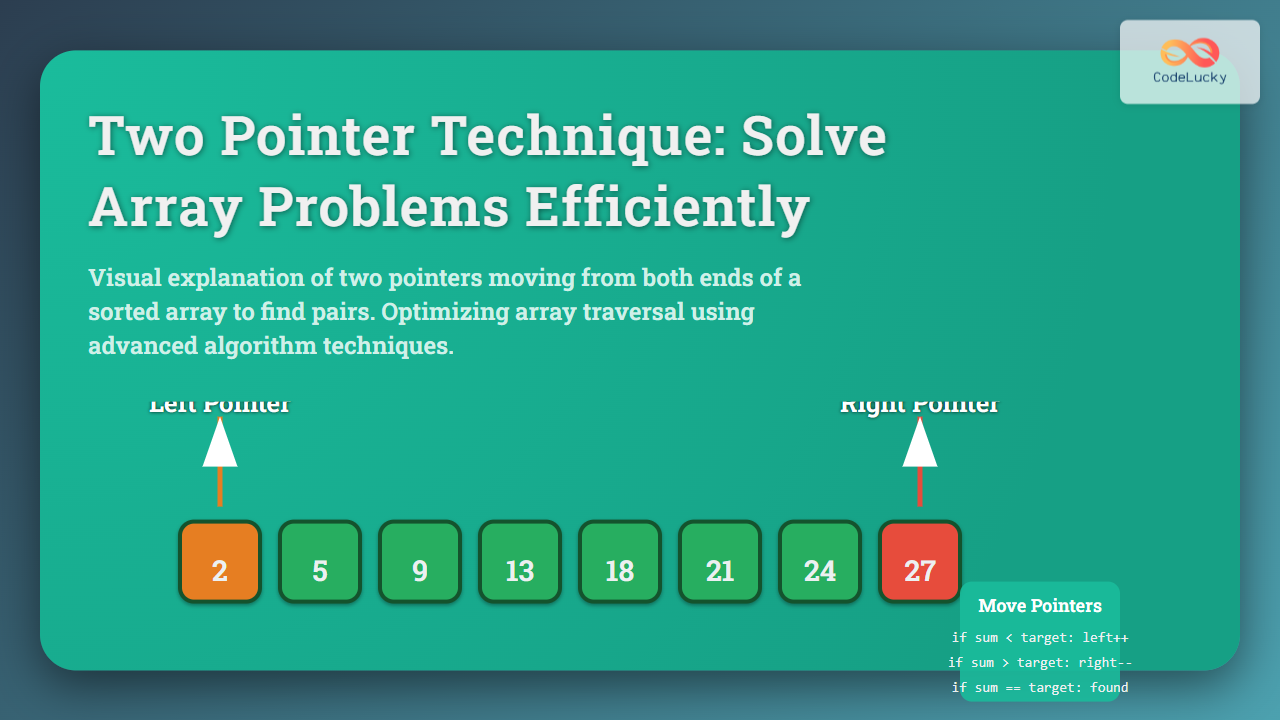
Now, let's apply this pattern to two classic array manipulation problems.
2. Algorithm 1: In-Place Array Reversal
Our first task is to reverse the elements of an array without using any additional arrays. This is a perfect showcase for the converging two-pointer technique.
The Logic:
- Initialize two pointers:
leftat the first element (index 0) andrightat the last element (indexsize - 1). - In a loop, swap the elements at the
leftandrightpointers. - After the swap, move the
leftpointer one step to the right (left++) and therightpointer one step to the left (right--). - Continue this process until the pointers meet or cross each other (
while (left < right)).
This ensures that we only perform swaps, resulting in a complete reversal of the array. The following resource provides a clear walkthrough.
The article 'Reverse a given Array' from takeuforward breaks down this exact approach with excellent diagrams and analysis.
Please read the 'Better Approach' section. Pay attention to the algorithm steps, the visual diagrams showing the pointers moving and swapping, and the complexity analysis.
Here is a C implementation of the algorithm.
#include <stdio.h>

// A utility function to swap two integers
void swap(int* a, int* b) {
    int temp = *a;
    *a = *b;
    *b = temp;
}

// Function to reverse an array in-place using the two-pointer technique
void reverseArray(int arr[], int size) {
    int* left = arr; // Pointer to the first element
    int* right = arr + size - 1; // Pointer to the last element

    while (left < right) {
        // Swap the values pointed to by left and right
        swap(left, right);

        // Move pointers toward the center
        left++;
        right--;
    }
}

int main() {
    int arr[] = {10, 20, 30, 40, 50, 60};
    int n = sizeof(arr) / sizeof(arr[0]);

    printf("Original array: ");
    for (int i = 0; i < n; i++) {
        printf("%d ", arr[i]);
    }
    printf("\n");

    reverseArray(arr, n);

    printf("Reversed array: ");
    for (int i = 0; i < n; i++) {
        printf("%d ", arr[i]);
    }
    printf("\n");

    return 0;
}

// Expected Output:
// Original array: 10 20 30 40 50 60
// Reversed array: 60 50 40 30 20 10
Notice how we use actual pointers (left and right) and pointer arithmetic (arr + size - 1, left++, right--). This is a direct and efficient way to implement this algorithm in C.
3. Algorithm 2: In-Place Array Partitioning
Partitioning involves reorganizing an array's elements based on some property. The two-pointer technique is exceptionally well-suited for this. A famous and practical example is the Dutch National Flag problem.
The Problem: You are given an array containing only 0s, 1s, and 2s. Your task is to sort this array in-place, with all 0s first, followed by all 1s, and finally all 2s.
This problem is a staple in interviews and is an elegant extension of the two-pointer pattern, often using three pointers.

The Logic:
We use three pointers: low, mid, and high.
lowpoints to the boundary where 0s should end.midpoints to the current element being examined.highpoints to the boundary where 2s should begin.
Initially, low and mid are at index 0, and high is at size - 1. We iterate as long as mid <= high.
- If
arr[mid]is 0: Swaparr[low]witharr[mid]. Increment bothlowandmid. - If
arr[mid]is 1: The element is in the correct partition. Just incrementmid. - If
arr[mid]is 2: Swaparr[mid]witharr[high]. Decrementhigh. Do not incrementmidbecause the element you just swapped into themidposition is unknown and needs to be processed.
The following resources provide a deep dive into this algorithm.
Coding Interview Patterns - Two Pointers
Let's watch this segment from the 'Coding Interview Patterns' video by Nikhil Lohia, where he introduces the concept of partitioning 0s and 1s, which leads directly into the Dutch National Flag problem.
Watch from 14:34 to 17:01. This will give you the conceptual foundation for partitioning, starting with two elements and then extending it to three.
Now that you have the concept, let's look at a detailed implementation.
Sort an array of 0s, 1s and 2s - Dutch National Flag Problem
The article 'Sort an array of 0s, 1s and 2s - Dutch National Flag Problem' from GeeksforGeeks provides a superb, detailed explanation and a direct C implementation.
First, read the section under '[Expected Approach] Dutch National Flag Algorithm' for a textual explanation of the three-pointer logic. Then, scroll down to the C code block and study the implementation of the sort012 function. Compare it directly with the logic described.
The C code you just studied is a model of efficiency. It sorts the array in a single pass (O(n)) using only a constant amount of extra memory (O(1)) for the pointers. This is precisely the kind of solution valued in high-performance and resource-constrained programming.
Test your understanding!
In the Dutch National Flag algorithm, when we encounter a 2 at arr[mid] and swap it with arr[high], why is it crucial that we do not increment the mid pointer in the same step?
Show answer
The element that was originally at arr[high] is now at arr[mid]. We have not yet inspected this new element. It could be a 0, a 1, or another 2. By not incrementing mid, we ensure that this newly swapped element is processed in the next iteration of the loop. If we were to increment mid, we would skip over this element, potentially leaving the array unsorted.
Conclusion
In this lesson, we've generalized the two-pointer technique and applied it to solve common array-based problems with optimal efficiency. You've seen how this single pattern can be adapted for both simple reversal and complex multi-way partitioning.
Key Takeaways:
- The two-pointer technique is a powerful pattern for solving array and list problems in time and space.
- Converging pointers, starting from opposite ends, are ideal for tasks like in-place reversal and partitioning.
- For array reversal, we swap elements at
leftandrightpointers and move them inwards until they meet. - The Dutch National Flag problem is a classic partitioning algorithm that uses a
low,mid, andhighpointer to sort three unique elements in a single pass. - In-place algorithms are critical for memory-constrained environments, making this technique highly relevant to your work in embedded systems.
Preview of the Next Lesson
We will continue to hone our pointer skills by applying them to another fundamental C data type. In our next lesson, we will re-implement standard string functions (e.g., strcpy, strstr) using pointer arithmetic. This will reinforce your understanding of C-style strings as null-terminated character arrays and give you more practice with direct memory manipulation.