Hello! Welcome to the sixth lesson in our module on Debugging, Best Practices, and Interview Patterns.
In our last lesson, we mastered the iterative, in-place reversal of a linked list, a fundamental exercise in precise pointer manipulation. We saw how the three-pointer technique allows us to safely re-wire a data structure without losing our place.
Today, we'll dive into another famous pointer-based interview problem that showcases an equally elegant solution: cycle detection. The learning outcome for this lesson is to solve the linked list cycle detection problem using Floyd's Tortoise and Hare algorithm. This algorithm is a brilliant example of how a clever use of pointers can solve a problem with optimal efficiency, a concept highly valued in performance-critical software and technical interviews.
1. The Problem: A Loop in the List
A standard, or "linear," singly linked list terminates when a node's next pointer is NULL. However, due to a bug or by design, a node's next pointer could point to a preceding node in the list. This creates a cycle, or loop.
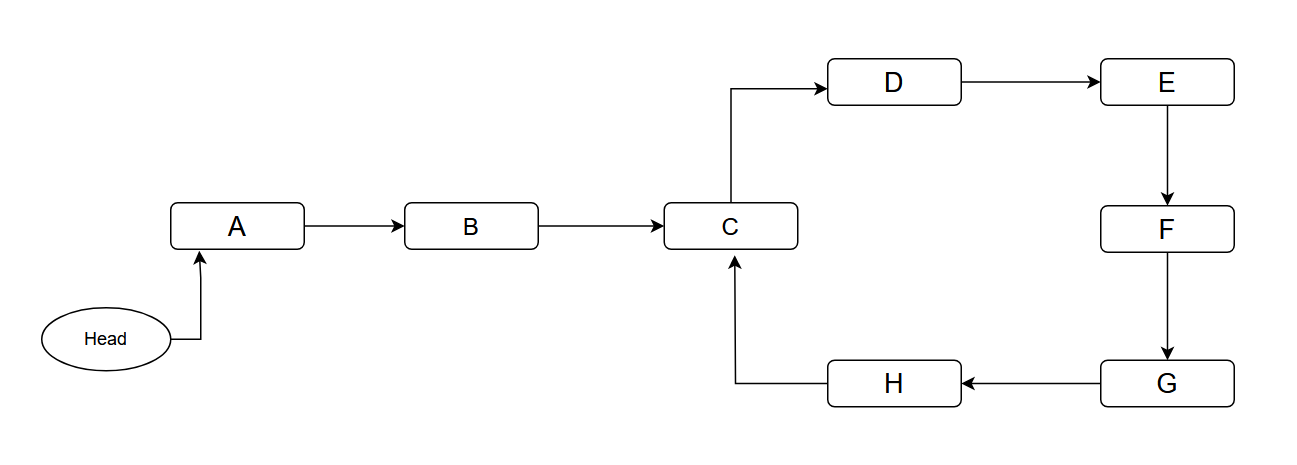
The primary danger of a cycle is that any code attempting a standard traversal (e.g., while (node != NULL)) will fall into an infinite loop, potentially crashing the program or causing it to hang. Your task is to write a function that, given the head of a list, can efficiently determine if such a cycle exists.
2. A First Idea: Hashing Visited Nodes
Before we get to the optimal solution, let's consider a straightforward approach. As we traverse the list, what if we just kept a record of every node we've already visited?
The natural way to do this is with a hash set (or hash map), where we store the memory address of each node we encounter.
The algorithm would be:
- Initialize an empty hash set.
- Start traversing the list from the
head. - For each node, check if its memory address is already in the hash set.
- If yes, we've visited this node before. A cycle exists. Return
true. - If no, add the node's address to the hash set and move to the next node.
- If yes, we've visited this node before. A cycle exists. Return
- If the traversal reaches
NULL, the list is linear. Returnfalse.
Let's watch a brief explanation of this method.
L14. Detect a loop or cycle in LinkedList | With proof and Intuition
The video 'L14. Detect a loop or cycle in LinkedList' from the 'take U forward' channel explains this hash-based approach clearly.
Watch from 01:14 to 07:36. Focus on the logic of using a map to store visited nodes and the analysis of its time and space complexity.
This approach works, but as the video points out, it has a significant drawback:
- Time Complexity: O(n), as we visit each node once.
- Space Complexity: O(n), because in the worst case (a linear list), we store a pointer to every single node in the hash set.
For many applications, and especially in the memory-constrained environments of automotive and embedded systems you're familiar with, an O(n) space requirement is unacceptable. This is what motivates the search for a more optimal, O(1) space solution.
3. The Optimal Solution: Floyd's Tortoise and Hare Algorithm
The optimal solution is a clever two-pointer algorithm named after its inventor, Robert W. Floyd. It's often called the "Tortoise and Hare" algorithm.
The idea is simple:
- Initialize two pointers,
slow(the tortoise) andfast(the hare), both pointing to theheadof the list. - In a loop, advance the pointers at different speeds:
slowmoves one step at a time:slow = slow->next;fastmoves two steps at a time:fast = fast->next->next;
- Evaluate their positions:
- If the list is linear, the
fastpointer will reach the end (NULL) first. If this happens, we know there is no cycle. - If a cycle exists, the
fastpointer will enter the cycle first, followed by theslowpointer. They will then chase each other around the cycle, and becausefastis gaining onslow, they are guaranteed to eventually meet at the same node.
- If the list is linear, the
The moment slow == fast, we have detected a cycle.
This video provides an excellent visualization of the algorithm in action and the intuition behind why it works.
L14. Detect a loop or cycle in LinkedList | With proof and Intuition
Let's continue with the 'take U forward' video. This next segment introduces the Tortoise and Hare algorithm and provides a powerful, intuitive proof for why the pointers are guaranteed to collide.
First, watch from 07:36 to 10:18 to see how the slow and fast pointers move. Then, watch the proof from 13:36 to 18:37. The key insight is that the relative distance between the pointers decreases by exactly one with each step inside the loop.
The core takeaway from the proof is that because the fast pointer moves two steps for every one step of the slow pointer, the distance between them (within the cycle) decreases by one at each iteration. No matter how large the initial distance is, it will inevitably shrink to zero, guaranteeing a collision.
4. C Implementation and Analysis
Now, let's translate this elegant algorithm into C code. Given your background, the implementation should feel straightforward.
The article 'Detect Cycle in Linked List' from GeeksforGeeks provides a clean C implementation that directly matches the algorithm we've just discussed.
Please scroll to the C code block within the article. Study the detectLoop function and pay close attention to the condition in the while loop.
The core of the implementation is the while loop:
int detectLoop(struct Node* head) {
    struct Node *slow = head, *fast = head;

    while (slow && fast && fast->next) {
        slow = slow->next;
        fast = fast->next->next;

        if (slow == fast) {
            return 1; // Cycle detected
        }
    }
    return 0; // No cycle
}
The loop condition while (slow && fast && fast->next) is critical for safety. It ensures we never try to dereference a NULL pointer.
slow: Checks if the slow pointer is valid.fast: Checks if the fast pointer is valid.fast->next: This is the most important check. It ensures that iffastis at the last node of a linear list, we don't try to accessfast->next->next, which would be aNULLpointer dereference.
Complexity Analysis
- Time Complexity: O(n). The slow pointer traverses at most
nnodes. The fast pointer traverses at most2nnodes. The complexity is linear with respect to the number of nodes in the list. - Space Complexity: O(1). We only use two extra pointers (
slowandfast). The memory usage is constant and does not depend on the size of the list. This is a massive improvement over the hashing method.
Test your understanding!
Consider a list where 1 -> 2 -> 3 -> 4 -> 5 -> 3 (node 5 points back to node 3).
The head is node 1.
Where will the slow and fast pointers first meet?
Trace the pointers:
- Start:
slowis at 1,fastis at 1. - Step 1:
slowis at 2,fastis at 3. - Step 2:
slowis at 3,fastis at 5. - Step 3:
slowis at 4,fastis at 4 (fast->nextis 5,fast->next->nextis 4). - ...and so on.
Where do they meet?
Show answer
Let's trace carefully:
- Start:
slow= 1,fast= 1 - Step 1:
slow= 2,fast= 3 - Step 2:
slow= 3,fast= 5 - Step 3:
slow= 4,fast= 4 (5->nextis 3,3->nextis 4)
They meet at node 4.
5. Bonus: Finding the Start of the Cycle
In an interview, a common follow-up question is: "Now that you've detected a cycle, can you find the node where the cycle begins?" Floyd's algorithm can be extended to do this with a second phase.
Algorithm to Find Cycle Start:
- Run the Tortoise and Hare algorithm until
slowandfastmeet. Let's call this themeetingPoint. - Do not move the
fastpointer from themeetingPoint. - Reset the
slowpointer back to theheadof the list. - Now, advance both
slowandfastone step at a time (slow = slow->next;,fast = fast->next;). - The node where they meet again is the starting node of the cycle.
This works because of a neat mathematical property: the distance from the head to the cycle start is equal to the distance from the meetingPoint to the cycle start (modulo the cycle length).
The following video provides a fantastic mathematical proof and code implementation for this second phase.
Floyd's cycle detection algorithm (Tortoise and hare) - Inside code
The video 'Floyd's cycle detection algorithm' from the 'Inside code' channel gives a superb mathematical proof for why this second phase works, followed by a code demonstration.
Please watch from 01:25 to 08:13. The first part (to 03:05) explains the concept. The second part (to 06:38) details the mathematical proof. The final part shows the implementation. Understanding this proof is excellent preparation for a deep technical interview.
Conclusion
You have now analyzed and implemented Floyd's Tortoise and Hare algorithm, a cornerstone of pointer-based problem-solving. It's a testament to how a deep understanding of pointer mechanics can lead to exceptionally efficient and elegant code.
Key Takeaways:
- A cycle in a linked list can cause infinite loops and must be detected.
- A hash set provides a simple but space-inefficient O(n) solution.
- Floyd's Tortoise and Hare algorithm uses a
slowandfastpointer to detect a cycle in O(n) time and O(1) space. - The
while (slow && fast && fast->next)condition is crucial for avoidingNULLpointer dereferences. - If a cycle exists, the pointers are guaranteed to meet.
- The algorithm can be extended to find the starting node of the cycle by resetting one pointer to the
headafter the initial meeting.
Preview of the Next Lesson
Having seen the power of the two-pointer technique in the context of linked lists, we will next explore how this same powerful idea can be applied to a different data structure. In our next lesson, we will implement in-place array manipulation algorithms (e.g., reversing, partitioning) using the two-pointer technique. This will further solidify your ability to solve a wide range of common interview problems efficiently.