Hello! Welcome back to our module on backtracking.
In the previous lesson, we established the theoretical foundation of backtracking, describing it as a methodical exploration of a problem's solution space using a Depth-First Search (DFS) on a conceptual state-space tree. We learned that its efficiency comes from pruning—intelligently discarding entire branches of the search tree that cannot lead to a solution.
Today, we'll move from theory to practice by applying this powerful paradigm to one of the most classic backtracking problems: N-Queens. Our goal is to use the backtracking framework to find all possible ways to place N queens on an N×N chessboard such that no two queens can attack each other. This will solidify your understanding of how to structure a backtracking solution.
1. Understanding the N-Queens Problem
First, let's formally define the problem and its constraints. A queen in chess can attack any piece in the same row, column, or either of the two diagonals. The N-Queens problem asks us to place N queens on an N×N board so that none of them are under attack.
To get a clear picture of the problem, let's start with a short video.
N-queens problem (Backtracking) - Inside code
This video from the "Inside code" channel provides a concise introduction to the N-Queens problem, its rules, and how it generalizes from a standard 8x8 chessboard to an N×N board.
Watch the segment from 00:06 to 02:02. Pay attention to the rules of queen movement and the core objective of the problem.
A brute-force approach might be to try every possible placement of N queens among the squares. The number of combinations would be , which is astronomically large even for a standard 8x8 board. We need a much smarter strategy.
2. Structuring the Problem for Backtracking
As we learned in the last lesson, the key to applying backtracking is to frame the problem in terms of choices that build a solution incrementally. A critical first step is to simplify the search space. We know that any valid solution must have exactly one queen per row. This observation allows us to drastically reduce our choices.
Instead of deciding where to place each of the N queens on the whole board, we can simply decide which column to place a queen in for each row, one row at a time.
This gives us the three components for our backtracking algorithm:
- Choice: For the current row, which column (from 0 to N-1) should we place a queen in?
- Constraints: The chosen column must not be attacked by any queen in a previous row. This means it cannot be in the same column or on the same diagonal as any previously placed queen.
- Goal: We have successfully placed a queen in all N rows.
Let's watch a segment that visualizes this row-by-row placement and backtracking process.
The N Queens Problem using Backtracking/Recursion - Explained
The "Back To Back SWE" channel offers a great way to frame backtracking problems. This video segment explains how to think about the N-Queens problem in terms of choices, constraints, and the goal.
Watch from 02:17 to 05:47. Focus on how the problem is broken down into making a choice (column placement) at each step (row).
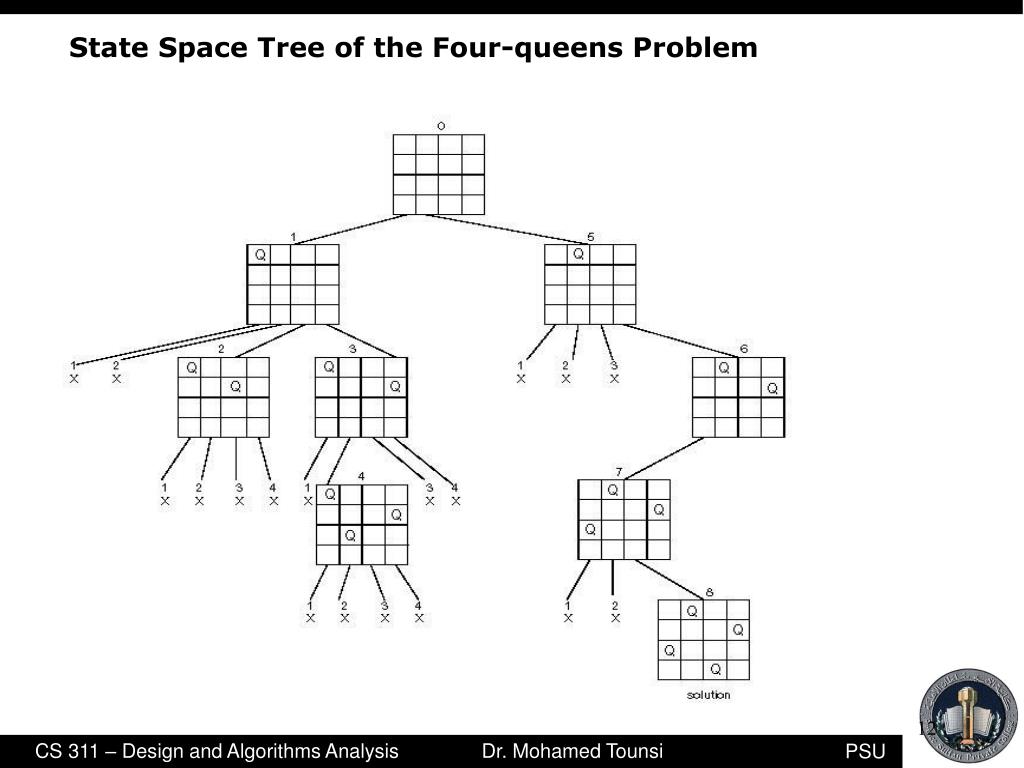
This sequence of choices naturally forms the state-space tree we discussed. The root is the empty board. The nodes at depth k represent partial solutions with k queens placed in the first k rows. When we find that we cannot place a queen in the current row without violating a constraint, we backtrack.
This image shows the state-space tree for the 4-Queens problem. It's a perfect illustration of how our algorithm will explore and prune the search space.
3. The Backtracking Algorithm and the "isSafe" Check
With the problem structured, we can now outline the recursive algorithm. The core pattern is "choose, explore, unchoose".
- Base Case: If we need to place a queen in a row beyond the board (e.g.,
row == N), it means we've successfully placed all N queens. We've found a valid solution. - Recursive Step: For the current
row:- Loop through each
columnfrom 0 to N-1. - Check Constraint: If placing a queen at
(row, column)is safe. - If it is safe:
- Choose: Place the queen on the board at
(row, column). - Explore: Recursively call the function to solve for the next row (
row + 1). - Unchoose: Remove the queen from
(row, column). This is the crucial backtracking step. It restores the state so we can explore placing the queen in the next column of the current row.
- Choose: Place the queen on the board at
- Loop through each
The following resource provides a detailed explanation of this recursive logic and the importance of the backtracking step.
51. N-Queens - Detailed Explanation
This article from Design Gurus provides a clear, detailed breakdown of the backtracking algorithm for N-Queens. We'll focus on the core idea first.
Read the 'Idea' and 'Algorithm' sections under 'Approach 2: Backtracking (DFS with Pruning)'. You can stop before the 'Time Complexity' section for now. This will formalize the recursive structure we just discussed.
The effectiveness of this algorithm hinges on the isSafe() check, which implements our pruning.
Naive isSafe() Check: O(N)
The most straightforward way to implement isSafe(row, col) is to check the three potential attack vectors from previously placed queens (i.e., in rows 0 to row-1):
- Check the column
colupwards. - Check the upper-left diagonal.
- Check the upper-right diagonal.
This requires a loop that runs up to row times, making the check an O(N) operation.
Optimized isSafe() Check: O(1)
We can do much better. By observing the properties of the board's grid, we can perform the safety check in constant time, O(1). This is a significant optimization.
- Columns: We can use a boolean array or a hash set, say
occupied_cols, to track which columns are already in use. Checking if a column is taken is then anO(1)lookup. - Diagonals:
- For any anti-diagonal (top-left to bottom-right), the value of
row - colis constant. - For any main diagonal (top-right to bottom-left), the value of
row + colis constant.
- For any anti-diagonal (top-left to bottom-right), the value of
We can use two more hash sets or boolean arrays (occupied_main_diag and occupied_anti_diag) to track which diagonals are attacked. When we want to check isSafe(row, col), we just look up col, row - col, and row + col in our three tracking structures. All three lookups are O(1).
The Design Gurus article you just looked at explains this trick. Please reread that section, this time focusing on how the sets (cols, main_diag, anti_diag) are used for an O(1) check. The GeeksforGeeks article N Queen Problem also provides an excellent explanation under the section "Optimized Approach".
When you implement the recursive step, you'll perform these actions:
- Choose: Mark
col,row-col, androw+colas occupied. - Explore: Recurse.
- Unchoose: Unmark
col,row-col, androw+col.
4. Advanced Optimization: Bitmasking
For someone with your software engineering background, it's worth knowing about an even more advanced optimization. The sets or boolean arrays for tracking occupied columns and diagonals can be replaced with integers, where each bit acts as a flag. This is called bitmasking.
Instead of array lookups, you perform fast bitwise operations (|, &, ~, <<, >>) to check for safety and update the board state. This doesn't change the overall O(N!) time complexity, but it significantly reduces the constant factors, making the algorithm much faster in practice.
51. N-Queens - Detailed Explanation
Let's return to the Design Gurus article to explore this advanced technique. It's a clever application of low-level operations to solve a high-level algorithmic problem.
Read the section 'Approach 3: Bitmask Optimization'. You don't need to memorize the implementation, but focus on the core idea: using integers as bitmasks to represent the board state and bitwise operations to manipulate it.
Conclusion
In this lesson, we deconstructed the N-Queens problem and built a backtracking solution from the ground up. We saw how a simple observation—one queen per row—dramatically simplifies the problem and defines the choices for our state-space search.
Key Takeaways:
- The N-Queens problem is a classic example of a constraint satisfaction problem perfectly suited for backtracking.
- The state-space tree is built by making a choice at each row: which column to place the queen in.
- The core of the algorithm is a recursive function that follows the "choose, explore, unchoose" pattern.
- The efficiency of the solution heavily depends on the
isSafe()check. We can optimize this from a naiveO(N)loop to anO(1)lookup using arrays or sets to track attacked columns and diagonals. - For ultimate performance, bitmasking can be used to perform these
O(1)checks with highly efficient bitwise operations.
Preview of the Next Lesson:
Now that you've seen backtracking applied to a board-based problem, we'll look at another common application area in the next lesson: combinatorial search problems. We will apply the same fundamental backtracking pattern to solve a Sudoku puzzle, where the constraints are different but the underlying "choose, explore, unchoose" methodology remains the same.