Introduction
In the previous lesson, you mastered the art of synthesizing chaotic discovery call notes into a concise, client-facing Preliminary Scope Summary. By securing client validation on that document, you've established a firm, shared understanding of the project's objectives and boundaries.
Now, we move from informal agreement to formal contract. This lesson is about translating that validated summary into a professional Statement of Work (SOW). Your objective is to translate client requirements into a formal Statement of Work (SOW) with defined deliverables and timelines.
For an engineer, the SOW is not mere paperwork; it is the master technical specification and the binding operational contract for the project. It defines the system's "contractual interface": the inputs (client responsibilities), the outputs (your deliverables), the performance parameters (timeline), and the transaction protocol (payment). A weak SOW invites scope creep, disputes, and financial loss. A strong SOW is your primary tool for project control and professional execution.
The Anatomy of a Bulletproof Statement of Work
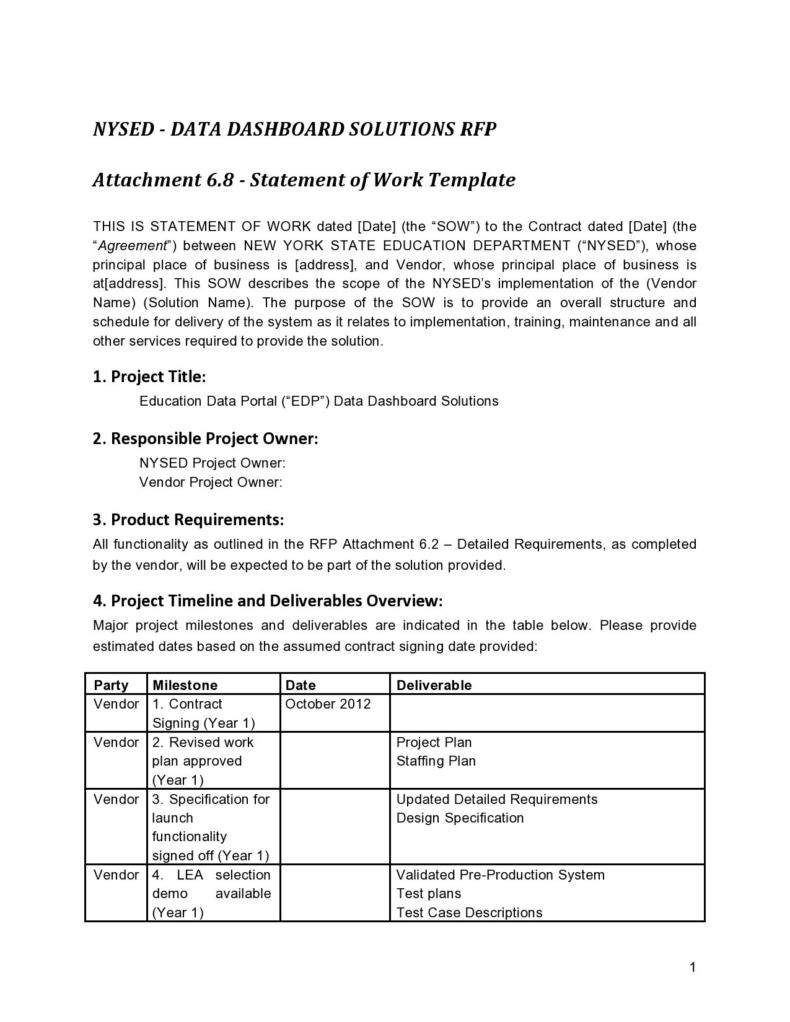
A professional SOW leaves no room for ambiguity. It is a comprehensive document that meticulously details every aspect of the engagement. While formats vary, a robust SOW for an automation project must contain several core sections.
We will review two excellent, professional-grade templates that will form the basis of our structure.
AICP Statement of Work (SOW) Template
First, review this comprehensive SOW template from the Association of Independent Commercial Producers. It is an industry-standard example of a formal, detailed SOW. Pay close attention to the clear separation of responsibilities and the granularity of the deliverables.
Skim through the entire document to get a feel for its structure. Focus specifically on these sections: Description of Services & Project Assignment (Section 2 & 3): Note how it defines what is and is not included. Project Scope with Listed Deliverables (Section 4): See the level of detail used to describe what will be produced. Client Deliverables + Responsibilities (Section 4, Part C): This explicitly lists what the client must provide. Assumptions (Section 5): Understand how these define the ground rules that your timeline and budget rely on. Project Timeline (Section 6) & Fee Schedule (Section 9, Part B): Observe the direct link between project milestones and payments. Budgeting; Adjustments (Section 5 of the Standard Terms): This describes the critical change management process.
The AICP document is dense and legalistic. For a more developer-friendly structure, this GitHub repository provides an excellent template with clear explanations for each section.
Statement Of Work (SOW) example on GitHub
Now, let's examine a more modern, modular SOW template. This example is structured logically and is an excellent framework for freelance developers and automation engineers.
Read through the main sections of the template, from 'Title' down to 'Applicable documents'. Pay particular attention to: Scope: The high-level parameters of the work. Purpose (Objectives, Performance): How it connects the work to measurable business outcomes. Planning (Requirements, Specifications, WBS): The breakdown of what will be done and how it will be measured. Change management procedures: The process for handling scope changes.
Synthesizing these examples, here are the non-negotiable components of your SOW:
- Parties & Project Summary: Who the agreement is between, the project title, and a high-level abstract.
- Purpose & Objectives: The "why" behind the project. What business goal will be achieved?
- Scope of Work:
- In-Scope Deliverables: A detailed, itemized list of everything you will create and deliver.
- Out-of-Scope: An explicit list of related items that are not included. This is your primary defense against scope creep.
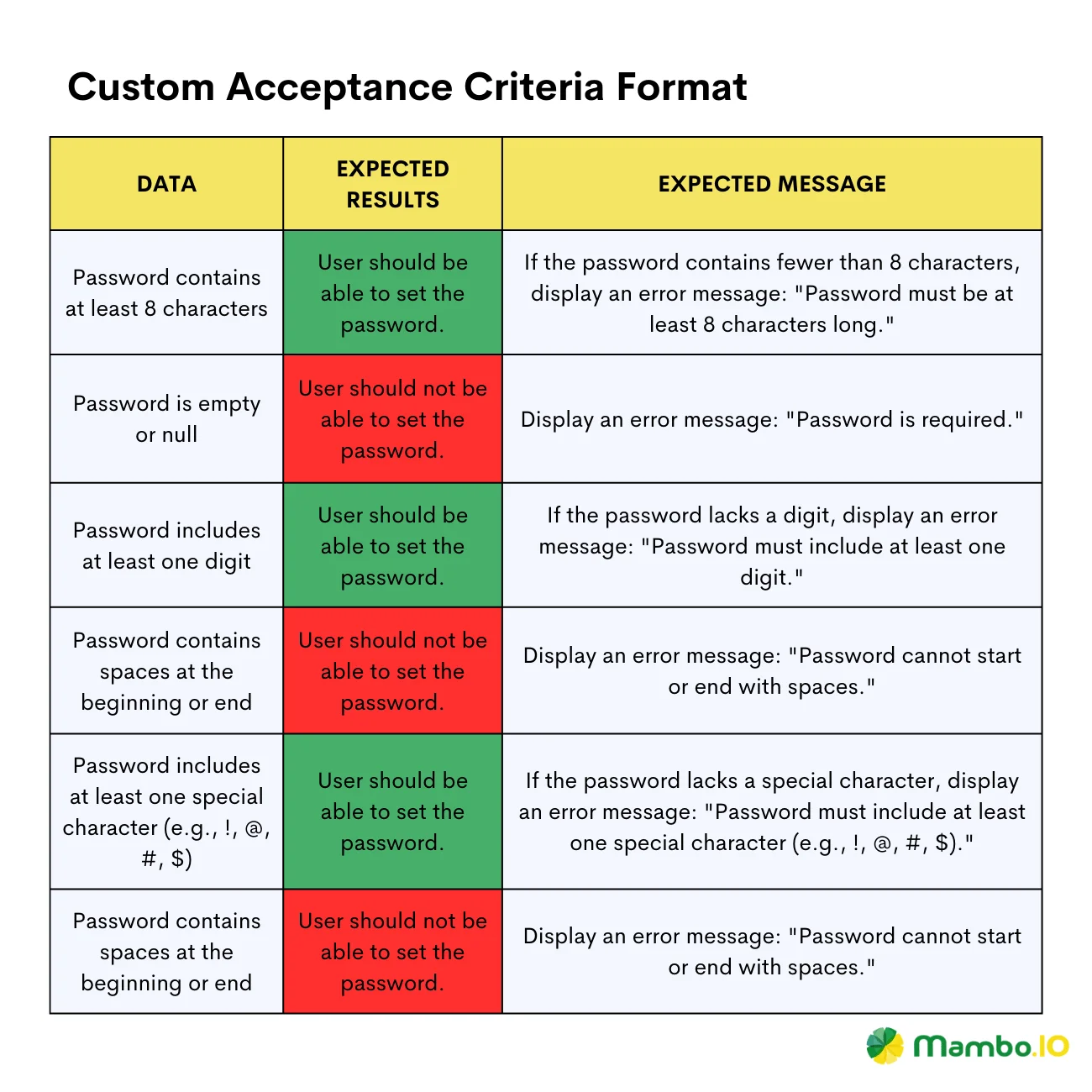
- Acceptance Criteria: For each major deliverable, define the objective, testable conditions that must be met for it to be considered "complete."
- Client Responsibilities: A list of all actions, information, and assets the client must provide for the project to succeed.
- Project Timeline & Milestones: Key dates for major phases and deliverables. This timeline should be tied directly to payments.
- Fees & Payment Schedule: The total cost and a schedule of payments triggered by specific dates or milestone completions.
- Assumptions: Foundational beliefs upon which the schedule and budget are based (e.g., "Client has an active Google Workspace Business plan").
- Change Management Process: The formal procedure for requesting, evaluating, and approving changes to the scope, timeline, or budget.
Defining "Done": The Power of Acceptance Criteria
A common point of failure in projects is a differing opinion on whether a task is "done." A client might have unstated expectations. You must eliminate this ambiguity by defining explicit, testable Acceptance Criteria.
This concept should be familiar from your engineering background; it's analogous to writing unit tests or defining pass/fail conditions for a system validation test.
- Bad (Vague): "The system will send a welcome email."
- Good (Specific & Testable): "Upon a new row being added to the 'Clients' Google Sheet, the system will trigger an email within 5 minutes. The email will be sent from
onboarding@client.comto the email address in column G. The subject line will be 'Welcome to [Client Name from Column B]' and the body will use the 'Welcome Email Template v2' Google Doc."
Practical Task: Draft the SOW for 'GrowthMarketers'
In the last lesson, you created a Preliminary Scope Summary for Alex at 'GrowthMarketers' and received his approval. Now, it's time to formalize that agreement.
Your task is to create a complete Statement of Work based on your validated scope summary and the raw notes from the 'GrowthMarketers' project.
Client Scenario Recap:
- Project: Automate the chaotic client onboarding process for GrowthMarketers.
- Goal: Reduce manual onboarding time from ~8 hours to <1 hour per client.
- Core Features:
- Triggered by Alex closing a deal.
- Automated welcome email with a link to a comprehensive intake form.
- Intake form collects client info, credentials, and assets.
- Upon form submission:
- Create a templated Google Drive folder structure.
- Create a templated Trello project board.
- Invite client and internal team to Drive/Trello.
- Send a Slack notification to the
#new-clientschannel. - Automatically send a Calendly link to book the kickoff call.
- Out of Scope: Stripe integration for payments.
- Tool Stack: Google Workspace, Trello, Slack, Calendly.
Instructions
- Create a new document (e.g., Google Doc, Word Doc).
- Using the structures from the
AICP SOWandGitHub SOWresources, build a formal Statement of Work for the 'GrowthMarketers' project. - Translate the points from the scope summary and raw notes into the appropriate sections of the SOW.
- Invent realistic but specific details where necessary:
- Timeline: Assume a 3-week project duration. Create specific milestone dates.
- Payment: Assume a total project fee of $2,500. Structure it as a 50% upfront payment and 50% upon completion.
- Crucially, you must write at least two distinct and highly specific Acceptance Criteria for two different deliverables (e.g., one for the automated folder creation, one for the Slack notification). Use the format shown in the "Custom Acceptance Criteria Format" image as inspiration.
Deliverable
A complete, professional Statement of Work document ready to be sent to 'GrowthMarketers' for signature.
Evaluation Criteria
- Structural Integrity: Does the SOW contain all 9 essential components outlined in the lesson?
- Specificity and Precision: Are deliverables, timelines, responsibilities, and exclusions defined without ambiguity?
- Actionable Acceptance Criteria: Are the acceptance criteria objective, measurable, and testable?
- Commercial Soundness: Do the payment terms and change management process protect you as the freelancer?
- Professionalism: Is the document well-formatted, clearly written, and does it project confidence and authority?
Conclusion
You have now moved from architect to lead contractor. The Statement of Work is the foundational document upon which a successful project is built. It is your primary instrument for managing expectations, controlling scope, and ensuring you are compensated for your work. By mastering its creation, you elevate yourself from a "doer" to a professional systems engineer who can reliably deliver complex projects.
Key Takeaways:
- The SOW is the single source of truth for the project's scope, timeline, and budget.
- A strong SOW is built on specificity. Clearly define what is in-scope, what is out-of-scope, and what the client is responsible for.
- Define "done" for every major deliverable with objective, testable acceptance criteria.
- Link payments directly to milestones to ensure healthy cash flow and incentivize progress.
- A formal change management process is non-negotiable for protecting against scope creep.
Preview of the Next Lesson:
With the SOW signed, the project begins. However, the SOW is a living document's foundation, not a static artifact. The most contested part of any SOW is the scope definition itself. In our next lesson, "Write precise scope definitions that establish clear boundaries and protect against scope creep," we will perform a deep dive into the art and science of crafting bulletproof scope clauses that serve as your primary defense during project execution.