Introduction
With our last lesson, we concluded our journey through the four rounds of All India Quota (AIQ) counseling, from the initial "Free Exit" to the high-stakes Stray Vacancy round. You now have a complete map of the AIQ process flow. However, within this system, there's a specific category of institutions that requires special attention, especially given your sister's preference for affordable government colleges: Deemed Universities.
This lesson focuses on a critical risk management aspect of AIQ counseling: identifying the high fee structures of Deemed Universities to prevent their accidental selection during choice filling. Mistakenly choosing one of these institutions can have significant financial consequences. We will dissect what makes these universities different, analyze their fee structures in detail, and outline a clear strategy to avoid this common pitfall.
What are Deemed Universities?
First, let's clarify what a Deemed University is. These are institutions that have been granted the status of a university by the University Grants Commission (UGC) due to their high standards. This gives them academic autonomy to design their own courses and curriculum. While many are centres of excellence, they are fundamentally different from government and state private colleges in two key areas for counseling: governance and fees.
All admissions to Deemed Universities for MBBS are conducted centrally by the Medical Counselling Committee (MCC), the same body that handles the 15% AIQ for government colleges. This is the crucial point of intersection and potential confusion.
From your perspective as a developer, you can think of the MCC portal as a unified API gateway. It serves data and processes requests for different underlying services:
AIQ_Government_SeatsCentral_University_SeatsAIIMS_JIPMER_SeatsDeemed_University_Seats
When your sister fills her choices, she is essentially constructing a single, ordered request payload (a list of preferences) that can contain calls to any of these services. The system will process her request and try to fulfill it with the highest-ranked preference her NEET rank allows, regardless of which "service" it comes from.
The Fee Structure Chasm: Government vs. Deemed
The most significant difference lies in the cost. While government colleges are heavily subsidized, Deemed Universities are self-financed and operate like private entities, resulting in vastly different fee structures.
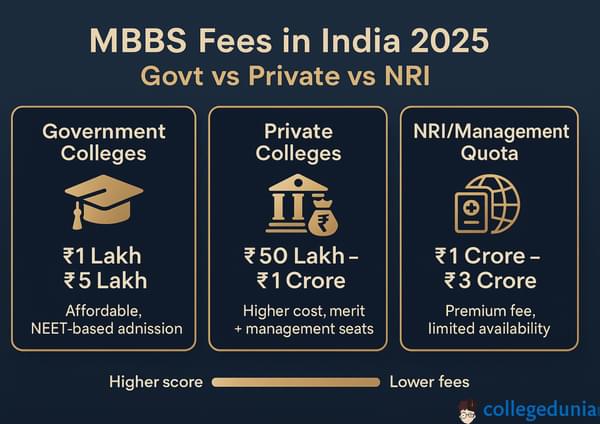
As the chart shows, the entire 5.5-year MBBS course at a government college might cost between ₹1 Lakh and ₹5 Lakhs. In contrast, Deemed Universities typically charge between ₹15 Lakhs and ₹25 Lakhs per year. This can lead to a total course cost exceeding ₹1 Crore.
To understand this better, let's examine the specifics of Deemed University admissions.
Deemed Universities MBBS Admission 2026 – Top Colleges, Fees, Cutoff & Seats | Future Education
This guide from Future Education provides an excellent overview of Deemed Universities, their admission process, and fee structures.
First, read the introduction to understand what they are. Next, review the "Key facts" table to get a quick summary of the fee range and note the absence of domicile or category reservations. Finally, scroll down to the section "Deemed vs Private vs Government Colleges" and carefully study the comparison table. Pay close attention to the rows for "Annual Fee," "Admission via," and "Reservation" to solidify your understanding of the key differences.
Unpacking the Total Cost: Beyond the Tuition Fee
A common mistake is to only look at the advertised annual tuition fee. The total financial outflow is often much higher due to various other components. The video below provides an excellent, detailed breakdown of the total estimated cost for nearly every Deemed University in India.
How Much Does an MBBS Really Cost? All Deemed University Fees & Cutoffs 2025
The presenter from the Just Get MBBS channel has compiled an exhaustive list of Deemed Universities, calculating their approximate total cost over 5.5 years, including tuition, hostel, and other fees. This is precisely the kind of data you need.
Watch the video starting from the introduction at the explanation of the video's purpose. Then, focus on these two key segments: Colleges under ₹1 Crore: This section covers the "more affordable" Deemed Universities. Note the costs and corresponding NEET scores. Colleges over ₹1 Crore: Pay close attention here, especially to the many colleges listed from Tamil Nadu and Pondicherry (e.g., Sri Lalithambigai, Meenakshi, Vels, SRM, Chettinad, Sri Ramachandra). The presenter explicitly breaks down the costs, which often range from ₹1.1 Crore to over ₹1.6 Crore. This data will give you a concrete list of high-fee colleges to be extremely cautious about during choice filling.
As the video highlights, several factors can inflate the total cost:
- Annual Fee Increments: Some universities increase their tuition fees by 5-15% every year. A college that looks cheaper in year one may become more expensive over the full term.
- Miscellaneous Charges: Be aware of additional fees like Development Fees, University Fees, Library Fees, and high hostel/mess charges.
- 5-Year Tuition: Some colleges charge tuition for a full 5 years, not the standard 4.5 years of the MBBS curriculum.
Medical College To Avoid During Choice Filling Or College Selection - MBBSCouncil
This article from MBBSCouncil points out several red flags to watch for, including tricky fee structures.
Read the section titled "3. Medical Colleges That Charge 5 Years Tuition Fees or Increment Fees Every Year." Focus on the warning to look for the total budget rather than just the annual tuition fee.
How Accidental Selection Can Happen
The risk of accidental selection arises because of the unified choice-filling system. Since government colleges and Deemed Universities appear in the same interface, it's easy to add a high-fee college to the list without realizing the financial implications.
Separate choice filling for AIQ and Deemed Universities?
This video directly addresses the core mechanism behind accidental selection.
Watch the entire clip from the explanation. The key takeaways are: It is a single, combined list where you can mix government, AIIMS, and Deemed University choices in any order. The system allots you the best possible seat from your list that your rank allows and then stops. It does not give you multiple options to choose from.
Imagine your sister's choice list looks like this:
- Madras Medical College (Govt)
- Stanley Medical College (Govt)
- Sri Ramachandra Medical College, Chennai (Deemed)
- Kilpauk Medical College (Govt)
If her rank is not high enough for MMC or Stanley, but it is sufficient for Sri Ramachandra, the system will allot her that seat in Round 2. The process then stops. She is now faced with a choice:
- Accept the seat and pay the fee of ~₹25 lakhs/year.
- Decline the seat, which in Round 2 means forfeiting the security deposit.
Critically, the security deposit for participating in Deemed University counseling is ₹2,00,000, compared to just ₹10,000 for government colleges only. A simple mistake in the choice list can lead to a ₹2 lakh penalty.
Strategy to Avoid This Pitfall
Given your sister's goal, the strategy is straightforward: active prevention.
-
Segregate During Registration: The MCC registration process itself helps. You must choose which quota you are applying for. To be eligible for Deemed Universities, you must select that option and pay the refundable security deposit of ₹2,00,000 + a non-refundable fee of ₹5,000. If your sister is certain she only wants government seats, she should only select the AIQ/Central University option, for which the deposit is much lower. This acts as a primary firewall.
-
Verify Every Choice: Before adding any college to the preference list, manually verify its type (Government or Deemed) and its latest fee structure from the official MCC seat matrix or the college's own website.
-
Create a "Safe List": Prepare the choice list in a separate document. For each college, include its name, location, type, and annual fee. This ensures there are no surprises when filling the choices on the portal.
-
Strict Prioritization: If, for any strategic reason, a "lower-cost" Deemed University is considered an absolute last-resort backup, it must be placed at the very bottom of the preference list, after every single affordable government and state quota private college has been listed.
Conclusion
We have now examined one of the most significant financial risks in the AIQ counseling process. For a candidate focused on securing a low-fee MBBS seat, Deemed Universities present a high-cost alternative that must be handled with extreme care.
Here are the essential takeaways from this lesson:
- Deemed Universities are academically autonomous institutions whose admissions are handled by the MCC, but their fees are drastically higher than government colleges, often exceeding ₹1 Crore for the entire course.
- The unified choice-filling list creates a risk of accidentally selecting a high-fee Deemed University, as they can be mixed in with government college choices.
- The total cost is more than just the annual tuition; you must account for hostel fees, miscellaneous charges, and potential annual fee hikes.
- The best defense is proactive verification: know which colleges are Deemed, check their fees before choice filling, and use the registration process itself as a filter by selecting the correct counseling scheme.
This lesson concludes our deep dive into the All India Quota system. We are now fully prepared to shift our focus to the pathway that holds the most seats for your sister: the Tamil Nadu State Quota. In our next lesson, we will begin Module 4 by detailing the online registration and application process on the Tamil Nadu Medical Selection portal.