In our previous lesson, we established the critical distinction between 'wanting' (incentive salience) and 'liking' (hedonic impact), revealing that the dopamine system drives the former, while separate opioid circuits mediate the latter. Today, we delve into how this 'wanting' system can be powerfully manipulated, not by the size of a reward, but by its predictability.
Your learning objective for this lesson is to explain how variable-ratio reinforcement schedules can dysregulate dopamine signaling. We will explore the neurochemical mechanisms that make unpredictable rewards so compelling and examine the behavioral consequences of this powerful effect. Understanding this principle is key to decoding the addictive potential of everything from slot machines and social media to certain dynamics in personal relationships.
The Brain as a Prediction Engine
Before we can understand the power of unpredictability, we must first establish how the dopamine system reacts to predictable events. The prevailing modern view is that dopamine doesn't signal reward itself, but rather reward prediction error (RPE). As a statistician, the concept of an "error" or "residual" as the difference between an observed and an expected value should be quite familiar. In this context:
A groundbreaking series of experiments by neuroscientist Wolfram Schultz in the 1990s laid the foundation for this understanding. The following video provides a clear summary of his findings.
CCN Course 2020, Motor 8: Dopamine is reward prediction error
This video from Randall O'Reilly's computational neuroscience course explains the core experiments that defined dopamine's role in signaling reward prediction error.
Please watch the following segments: Unexpected Reward: Notice how dopamine neurons fire robustly when a monkey receives a reward it wasn't expecting. Predicted Reward: This is the critical finding. Once a cue (a tone) reliably predicts the reward, the dopamine firing at the time of the reward disappears. The firing now occurs in response to the predictive cue. The system has learned, and there is no more "error" to report. Withheld Reward: Observe what happens when the monkey hears the predictive cue but the expected reward is not delivered. The dopamine neurons show a dip in firing below their baseline rate. This is a negative prediction error, signaling that reality was worse than expected.
These three conditions reveal the fundamental operating principle of the dopamine system: it is a learning signal that fires in response to surprise. When an outcome is better than expected, it fires. When an outcome is worse than expected, it quiets down. And, crucially, when an outcome is exactly as expected, it does nothing out of the ordinary. The system effectively says, "This is old news, nothing new to learn here."
Hijacking the Prediction Engine: Variable-Ratio Reinforcement
Now, what if we could design a system where the reward is never fully predictable? This is precisely what a variable-ratio reinforcement schedule accomplishes.
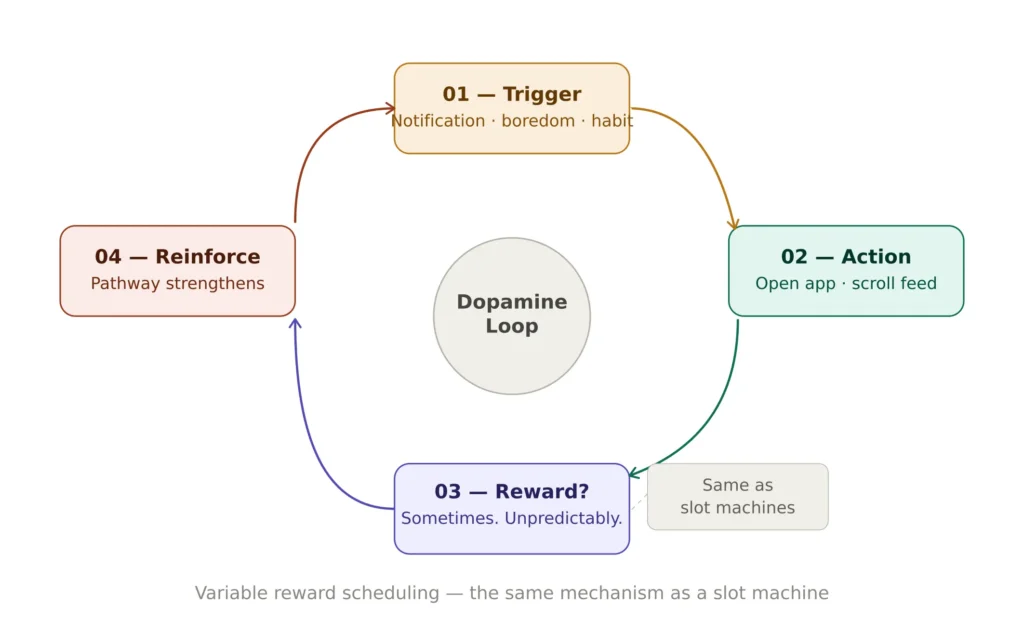
A variable-ratio (VR) schedule is a system where a reward is delivered after an unpredictable number of responses. The "ratio" refers to the average number of responses needed for a reward (e.g., a VR-10 schedule means a reward is given, on average, for every 10 responses), but the exact moment of reward is random. This is the core mechanism of a slot machine. You might win after 3 pulls, then 50, then 12. You never know when the reward will come.
This unpredictability is the key that unlocks the dopamine system and holds it in a state of chronic activation. The following video explains why this is so potent.
How to Increase Motivation & Drive | Huberman Lab Essentials
In this clip, Andrew Huberman discusses why intermittent reinforcement, as seen in gambling, is the most powerful schedule for driving behavior.
Watch the segment from 28:42 to 30:05. He highlights that gambling leverages dopamine through hope and anticipation, because "the next time really could be the thing that changes everything." This perpetual uncertainty prevents the dopamine system from ever fully habituating or predicting the outcome.
Because the reward is never fully predicted, every pull of the lever or scroll of the feed carries the potential for a positive prediction error. The brain never settles into a state of "knowing what's coming," so the 'wanting' system remains highly engaged, constantly anticipating the next potential reward.
This process is so fundamental to modern technology that it's often visualized as a "Dopamine Loop."
Dysregulation in Action: Evidence from the Lab
This powerful effect is not just theoretical; it's been robustly demonstrated in controlled laboratory experiments. A recent study (which is a preprint and has not yet undergone peer review) provides an excellent example of how to design an experiment to test this principle.
[PDF] Uncertain, intermittent access to reward promotes ... - bioRxiv
This research paper compares the effects of predictable versus unpredictable reward access on motivation and seeking-behavior in rats. It provides a clear experimental demonstration of the concepts we're discussing.
Please review the following parts of the paper: Read the section of the introduction that explains how reward uncertainty can sensitize reward pathways. In the Methods section, familiarize yourself with the experimental design, particularly the description of the Uncertain intermittent access (UIntA) group. This is their implementation of a variable-ratio schedule. Scan the Results to see how the UIntA group differed from the predictable-access groups. Note the finding that rats with intermittent access responded at higher rates. Examine the results of the Progressive Ratio test, where the cost of the reward increases over time. Note that UIntA rats worked harder for the reward. Finally, look at the Extinction and Reinstatement tests. Observe that UIntA rats showed a slower rate of extinction and more robust reinstatement of seeking behavior when presented with a cue.
The results of this study perfectly illustrate what "dopamine dysregulation" means in behavioral terms. The rats exposed to the variable-ratio schedule showed:
- Greater Motivation: They worked harder to get the reward.
- Greater Persistence: They kept trying for longer even after the reward was removed.
- Greater Cue-Reactivity: The power of a reward-associated cue to trigger seeking behavior was significantly enhanced.
This is the behavioral signature of a 'wanting' system that has been sensitized by unpredictable rewards. It's a system that has learned to overvalue the reward and its associated cues, driving behavior that is disproportionate to the actual hedonic value of the outcome.
The Downside of the Loop: The Pleasure-Pain Balance
This dysregulation comes at a cost to our baseline well-being. The dopamine system operates on an opponent-process principle: every peak in pleasure or motivation is followed by a corresponding dip below baseline.
How to Increase Motivation & Drive | Huberman Lab Essentials
Let's return to the Huberman video to understand the long-term consequence of repeatedly spiking dopamine.
Watch from 10:00 to 12:44. He explains that for every bit of pleasure, there is a "mirror image experience of pain." With repeated exposure, the pleasure response diminishes, while the pain/craving response gets stronger and lasts longer.
When a variable-ratio schedule constantly spikes our dopamine with small, unpredictable rewards, we are also experiencing a series of small dips. Over time, the net effect is a lowering of our baseline state. We start to feel less motivated and less happy in general, and we need to engage in the behavior simply to feel normal again. This is the insidious trap of dopamine dysregulation: the 'wanting' becomes less about achieving pleasure and more about escaping the pain of craving.
Conclusion
Today, we've dissected the mechanism that makes unpredictable rewards so captivating. By exploiting the dopamine system's function as a prediction error detector, variable-ratio schedules can create a state of chronic 'wanting' that is detached from 'liking' and can degrade our baseline well-being.
Key Takeaways:
- Dopamine primarily signals reward prediction error—the difference between what you expect and what you get. It fires for surprises.
- Variable-ratio reinforcement schedules deliver rewards unpredictably, ensuring that the brain is always surprised and the dopamine system remains highly activated.
- This constant activation dysregulates the 'wanting' system, leading to behaviors like increased motivation, persistence, and cue-reactivity, as seen in gambling and social media use.
- Repeatedly engaging these loops lowers your baseline dopamine levels through the pleasure-pain balance, fostering a cycle of craving where you seek the reward just to feel normal, not to feel pleasure.
Formula for Your Cheat Sheet:
Unpredictable Rewards (Variable Ratio) → Perpetual Surprise (Prediction Error) → Chronic Dopamine Firing → Sensitized 'Wanting' (Dysregulation) → Degraded Baseline (Pleasure-Pain Imbalance)
In our next lesson, we will shift our focus from how motivation is generated to how it's applied. We'll explore the role of dopamine in effort-based decision-making, investigating how the brain calculates whether a potential reward is "worth the effort" and what this means for your personal productivity.