In our last lesson, we established that the mesolimbic pathway, powered by dopamine, is the engine of 'wanting'—the motivational drive to pursue goals. We dismantled the old "pleasure molecule" myth, repositioning dopamine as the key player in pursuit, not pleasure itself. Today, we will explore this distinction in much greater depth. The separation between 'wanting' and 'liking' is not merely a semantic nuance; it is one of the most critical insights in the modern neuroscience of motivation and reward.
Your objective for this lesson is to distinguish between 'wanting' (incentive salience) and 'liking' (hedonic impact) in reward processing. We will investigate their separate neurobiological foundations and examine the compelling evidence that shows they can operate independently. Understanding this dissociation is fundamental to mastering your own motivational landscape, as it explains everything from everyday cravings to the powerful grip of addiction.
The Great Divide: Defining 'Wanting' and 'Liking'
In everyday language, we treat 'wanting' and 'liking' as two sides of the same coin. We assume we want things because we like them. While this is often true, the brain treats these two experiences as fundamentally different jobs, handled by different neural systems.
To ground our discussion, let's establish the precise scientific definitions. The following article, co-authored by Professor Kent Berridge who pioneered this research, provides a clear and concise summary.
[PDF] Current perspectives on incentive salience and applications to ...
This review from Current Opinion in Behavioral Sciences provides the foundational definitions and highlights the separability of these two components of reward.
Please read the introductory paragraphs. Pay close attention to how the authors define ‘Liking’ and ‘Wanting’, and the immediate assertion that these two components are dissociable and mediated by different brain systems.
As the paper clarifies:
- 'Liking' refers to the hedonic impact of a reward. It is the core pleasure or enjoyment you get from an experience. This can even be an unconscious process, measured objectively by things like the facial expressions of a baby tasting something sweet.
- 'Wanting' refers to incentive salience. It is the motivational process that makes a reward, or its associated cues, seem attractive, attention-grabbing, and desirable. It’s the "motivational magnet" that pulls you toward a goal.
The fact that these are dissociable means that one can exist without the other, a concept that is difficult to grasp intuitively but is clearly demonstrated by neurological evidence. The reason they can be dissociated is that they are generated by entirely different brain circuits.
Two Processes, Two Neural Systems
Let's look at the underlying machinery. As we've established, 'wanting' is the domain of the large, powerful mesolimbic dopamine system. But what about 'liking'?
The experience of pleasure is not generated by dopamine. Instead, it arises from a much smaller, more specific network of "hedonic hotspots." These are small islands of tissue within larger brain structures that are uniquely capable of amplifying pleasure. They are neurochemically distinct from the 'wanting' system, relying primarily on opioid and endocannabinoid neurotransmitters (the brain's natural versions of morphine and cannabis compounds, respectively).
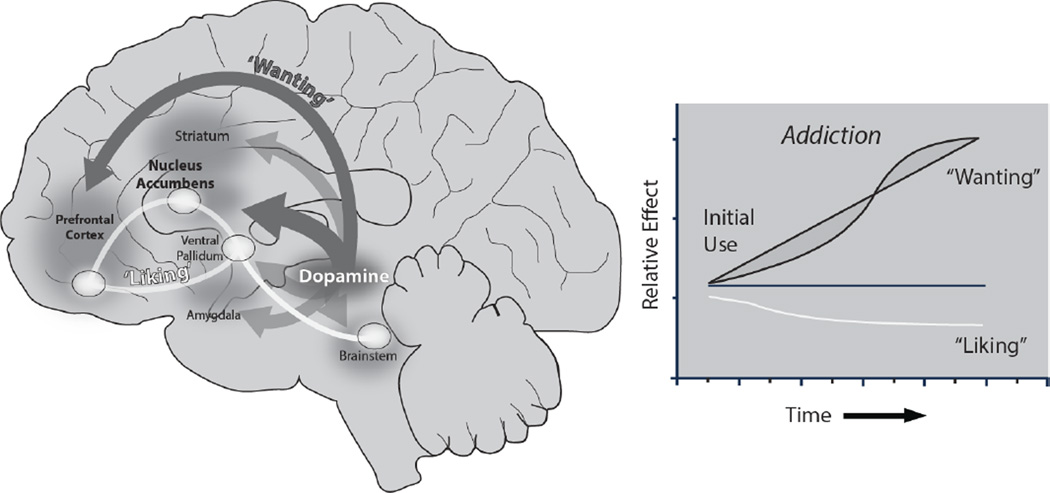
The following diagram, from Berridge's lab, provides a powerful visual for this distinction.
Now, let's hear Professor Berridge explain these hedonic hotspots and the neurotransmitters involved.
Kent Berridge: Neuroscience of Pleasure, Reward, Liking, Wanting, Motivation, Addiction & Emotion
In this segment from the Mind & Matter Podcast, Professor Berridge describes the discovery and function of the brain's hedonic hotspots.
Please watch from 20:53 to 25:27. Note the specific brain regions mentioned, such as the nucleus accumbens and ventral pallidum, and the key neurotransmitters—opioids and endocannabinoids—that enhance 'liking'. He makes a crucial point: direct dopamine stimulation in these hotspots never enhances 'liking'.
This is the central biological fact:
- 'Wanting' system: Large, robust, dopamine-driven.
- 'Liking' system: Small, fragile, opioid/endocannabinoid-driven.
This structural and chemical separation is what makes it possible for the intensity of your motivation for something to become completely untethered from the pleasure you actually get from it.
Evidence of the Dissociation in Humans
The idea that 'wanting' can diverge from 'liking' is not just a finding from animal models. It has been demonstrated clearly in human studies and explains several well-known clinical conditions.
1. Addiction: The Ultimate Case of Wanting Without Liking
Addiction is the most dramatic real-world example of this dissociation. With repeated use of an addictive substance, the dopamine-driven 'wanting' system becomes sensitized, meaning it gets hyper-reactive to the drug and its cues. This leads to intense, escalating cravings.
Meanwhile, the 'liking' system often shows tolerance. The actual pleasure derived from taking the drug either stays the same or, more commonly, decreases over time. The result is a tragic spiral: an individual 'wants' the drug more and more, while 'liking' it less and less. The graph in the image above perfectly illustrates this divergence.
This next video explains how addictive drugs hijack the dopamine system to create this massive, artificial 'wanting' signal that is completely disconnected from hedonic experience.
Misunderstanding dopamine: Why the language of addiction matters | Cyrus McCandless | TEDxPortsmouth
In this TEDx talk, Cyrus McCandless explains why the language we use around addiction matters, focusing on the neuroscience of dopamine.
Watch the segment from 05:52 to 09:47. The speaker explains how drugs create a "huge surprise success signal" that continuously tells the brain to focus on getting more, "whether you enjoyed it or not." This is the essence of incentive sensitization.
2. Experimental Evidence: The Cocaine Study
The dissociation can also be shown in controlled experiments. One elegant study gave cocaine to human volunteers. In one condition, participants' dopamine systems were chemically suppressed beforehand.
From your statistics background, you can appreciate the power of this experimental design. By manipulating the independent variable (dopamine availability) and measuring the dependent variables ('liking' and 'wanting' ratings), researchers could draw causal conclusions.
Let's hear Professor Berridge describe the results of this landmark human study.
Kent Berridge: Neuroscience of Pleasure, Reward, Liking, Wanting, Motivation, Addiction & Emotion
Professor Berridge discusses the human studies that finally provided converging evidence for the wanting/liking distinction.
Watch from 01:03:34 to 01:05:13. He describes a study by Marco Leyton where participants' subjective ratings of pleasure ('liking') for cocaine were unaffected by dopamine suppression, but their ratings of desire for more cocaine ('wanting') were significantly reduced.
The result was unambiguous: blocking dopamine didn't reduce the pleasure of the drug, but it dramatically reduced the motivation to get more. It surgically separated 'liking' from 'wanting'.
3. Motivational Deficits: The "Anhedonia Paradox"
The flip side of addiction is also illustrative. Many clinical conditions, like depression and Parkinson's disease, are characterized by what is often called "anhedonia"—the inability to feel pleasure. However, modern research suggests this is often a misnomer.
Many of these patients, when directly presented with a pleasant stimulus (like their favorite ice cream), report normal levels of 'liking'. Their pleasure circuits are intact. The problem is a deficit in the dopamine system, leading to avolition: a catastrophic loss of 'wanting' or motivation. They lack the drive to seek out rewards, even ones they would enjoy. This is sometimes called the "anhedonia paradox." This distinction is critical for developing effective treatments, as a drug that boosts 'liking' would be useless for a patient whose core problem is a lack of 'wanting'.
Conclusion
Today we've moved beyond the initial introduction of 'wanting' to a detailed examination of its counterpart, 'liking'. You now understand that these are not just different words but represent distinct psychological and neurobiological processes.
Key Takeaways:
- 'Liking' (hedonic impact) and 'Wanting' (incentive salience) are separate components of reward, handled by different brain systems.
- 'Liking' is generated by small, discrete hedonic hotspots that are rich in opioid and endocannabinoid receptors.
- 'Wanting' is driven by the large-scale mesolimbic dopamine system.
- This separation allows these two processes to become dissociated, as seen dramatically in addiction (excessive 'wanting', diminished 'liking') and avolition (intact 'liking', diminished 'wanting').
Recognizing that the drive to pursue something is neurologically separate from the pleasure of obtaining it is a profound insight. In our next lesson, we will explore one of the most powerful mechanisms for manipulating the dopamine-driven 'wanting' system: variable-ratio reinforcement schedules. We'll examine how the unpredictability of rewards can hijack this system, driving compulsive behavior in everything from social media use to gambling.