Welcome to the final lesson of our course on personal performance. Over the past several weeks, we have journeyed from the fundamental neuroscience of attention and motivation to the practical construction of daily routines. You have built an evidence-based morning routine to synchronize your circadian clock and an evening routine to facilitate recovery. Now, it is time to assemble these components into a unified, resilient system.
This lesson addresses our final learning outcome: to consolidate all principles into a cohesive weekly schedule with contingency plans for challenging days. We will move beyond daily tactics to weekly strategy. The goal is not to create a rigid, unbreakable schedule, but rather a flexible and robust framework that adapts to the predictable unpredictability of life, ensuring you can maintain high performance and well-being consistently.
The Daily Blueprint: An Integrated Example
Before architecting the week, let's review a holistic model of a single, optimized day. The principles we've discussed—from light exposure to meal timing and focused work—don't exist in isolation. They form an interconnected system where each element supports the others. Neuroscientist Andrew Huberman provides an excellent walkthrough of how these scientific protocols can be woven into the fabric of a day.
Maximize Productivity, Physical & Mental Health With Daily Tools | Huberman Lab Essentials
The video "Maximize Productivity, Physical & Mental Health With Daily Tools" by Andrew Huberman serves as a powerful case study, integrating many of the concepts we've covered throughout this course.
Watch this video from the start up to the main daily protocols. As you watch, don't focus on adopting his exact schedule. Instead, observe how the different tools are sequenced and why. Notice the biological rationale he provides for: Morning: Sunlight, hydration, delayed caffeine, and fasting to promote an alert, focused state. Work: 90-minute ultradian cycles and optimizing the workspace for alertness. Exercise: The blend of resistance and endurance training, timed appropriately. Nutrition: Macronutrient timing (low-carb lunch, starchy-carb dinner) to manage alertness and prepare for sleep. Evening: Afternoon light exposure, leveraging temperature for sleep, and specific supplementation. This video serves as a concrete example of moving from individual habits to an integrated daily protocol. Architecting Your Week: The Three-Phase Framework With a daily blueprint in mind, we can now zoom out to the weekly level. A powerful way to structure each day within your week is to align your activities with your natural neurochemical state. Your brain and body are not static throughout the day; they move through predictable phases of readiness for different types of tasks. Dr. Huberman articulates a simple yet profound framework that divides the 24-hour day into three distinct neurochemical phases. Understanding this allows you to place the right activities in the right phase, reducing friction and leveraging your biology instead of fighting it.
This video serves as a concrete example of moving from individual habits to an integrated daily protocol.
Architecting Your Week: The Three-Phase Framework
With a daily blueprint in mind, we can now zoom out to the weekly level. A powerful way to structure each day within your week is to align your activities with your natural neurochemical state. Your brain and body are not static throughout the day; they move through predictable phases of readiness for different types of tasks.
Dr. Huberman articulates a simple yet profound framework that divides the 24-hour day into three distinct neurochemical phases. Understanding this allows you to place the right activities in the right phase, reducing friction and leveraging your biology instead of fighting it.
The Science of Making & Breaking Habits
This video offers a simple yet powerful system for installing and testing new habits or systems, like the weekly schedule we've just designed.
Watch the segments on the 21-day system and how it meshes with the phase-based plan. The key idea is a 21-day implementation period followed by a 21-day assessment period to see which parts of the system have become automatic and which require adjustment.
By categorizing your weekly tasks and mapping them to these three phases, you create a schedule that is biologically informed.
The Master Tool: Implementation Intentions
Knowing what to do and when is the first step. The second, more crucial step is ensuring you actually do it. The most robust tool for closing this "intention-behavior gap" is the implementation intention, a concept we've touched on before. Now, we will explore its neuroscientific basis.
Implementation intentions are more than a simple planning hack; they are a method for pre-loading a decision, effectively delegating control of your behavior to a specific environmental cue. This shifts the required mental processing from effortful, top-down executive control to more automatic, bottom-up stimulus response.
A comprehensive review paper delves into the physiological evidence for why this works. Given your background, you will find the depth of this evidence particularly compelling.
Promoting the translation of intentions into action by implementation ...
This paper by Wieber et al. (2015) reviews the physiological correlates of planning. It provides the "why" behind the effectiveness of the if-then plans we are about to construct.
First, read the introduction and background to understand the intention-behavior gap and the formal definition of implementation intentions. Next, focus on the section on processes, which explains the two key mechanisms: heightened accessibility of the cue and the strong cue-action link. Then, skim the section on automaticity to see how these plans reduce the need for conscious effort. Finally, and most importantly for our purposes, review the section on physiological measures. This is the core of the scientific evidence. Note the findings from: EEG studies: How if-then plans affect brain waves like the P100 and P300, indicating changes in early perception and decision-making, often within 120-300 milliseconds of a cue. fMRI studies: How implementation intentions shift brain activity from lateral prefrontal regions (associated with effortful, top-down control) to more medial regions (associated with stimulus-driven, automatic processing).
In essence, forming an if-then plan is like writing a small piece of code for your brain. When the "if" condition (the cue) is met, the "then" subroutine (the action) is executed with greater speed, efficiency, and less conscious effort.
Building Your Resilient Schedule
Now, let's translate this science into a practical system. We will use a step-by-step framework to build both your core schedule and its essential backup systems.
The article "How to Actually Follow Through on Goals" provides an excellent, pragmatic guide for this process.
How to Actually Follow Through on Goals (Framework for Quitters)
This article provides a structured process for applying the principles we've just discussed. It's the practical "how-to" manual for building your schedule.
Read the section from Step 1 to Step 6. This will walk you through creating your core implementation intentions for your desired weekly behaviors. Then, pay special attention to the "Hour 3: Contingency Planning" subsection within Step 6. This is the key to making your schedule resilient.
Let's apply this framework.
Step 1: Define Core Weekly Behaviors
List the non-negotiable activities for your week based on your goals and our course content.
- Deep Work Block (e.g., 4x per week)
- Powerlifting Session (e.g., 3x per week)
- Daily Walk
- Daily Meditation/Breathwork
- Weekly Planning/Review
Step 2: Create Implementation Intentions for Core Behaviors
Map these behaviors to the three-phase framework.
- Phase 1 (High Friction):
- If it is Monday/Tuesday/Thursday/Friday at 9:00 AM, then I will turn off my phone, open my research file, and begin my 90-minute deep work block.
- If it is Monday/Wednesday/Friday at 6:30 AM, then I will put on my lifting gear and go to the gym.
- Phase 2 (Low Friction):
- If it is a weekday at 1:00 PM after lunch, then I will go for my 30-minute walk.
- If I have just finished my final work task for the day, then I will begin my 20-minute meditation session.
- General:
- If it is Sunday at 5:00 PM, then I will open my calendar and plan my schedule for the upcoming week.
Step 3: Engineer Contingency Plans
This is what separates a fragile schedule from an antifragile one. Anticipate common disruptions and create if-then plans for them.
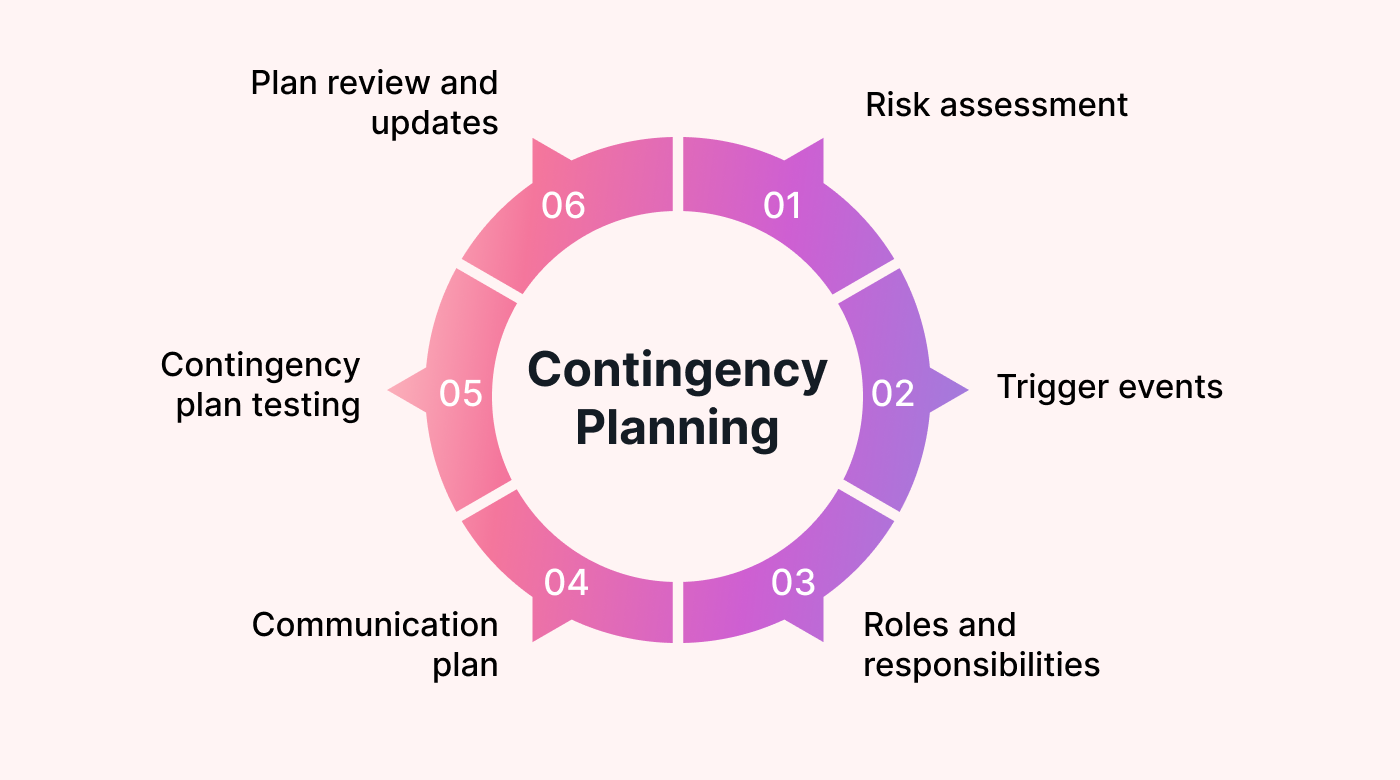
This diagram shows the key stages of contingency planning: risk assessment, identifying triggers, defining roles, communication, testing, and review. For our purposes, 'risk assessment' is identifying what might derail your week, and 'triggers' are the specific events like travel or illness.
Here are some examples based on the "Common Mistakes" section of the LINK article:
- Trigger: Unexpectedly busy day / Lack of time
- If a meeting runs long and my deep work block is cut to under 45 minutes, then I will use the time to organize my notes and plan the next deep work session instead of trying to force a short, fragmented one.
- If I don't have time for a full powerlifting session, then I will perform a 15-minute kettlebell circuit at home.
- Trigger: Illness / Low energy
- If I feel sick and cannot train, then I will do a 10-minute gentle stretching routine and a 20-minute NSDR script instead.
- If I am mentally exhausted after work, then I will do a 5-minute cyclic sighing protocol instead of a full meditation.
- Trigger: Travel
- If I am traveling for work, then my morning routine will be simplified to a 10-minute walk outside the hotel and my evening routine will focus only on a hot shower and avoiding screens before bed.
These contingency plans are not "get out of jail free" cards. They are modified, lower-dose versions of your desired behaviors that maintain momentum and identity ("I am someone who moves my body daily") even when the ideal plan is not possible.
Your Schedule as an Ongoing Experiment
Finally, it is critical to view your weekly schedule not as a static document, but as a living hypothesis that you are continuously testing and refining. Your background in statistics makes you uniquely equipped to embrace the "N-of-1" experimental approach to personal development.
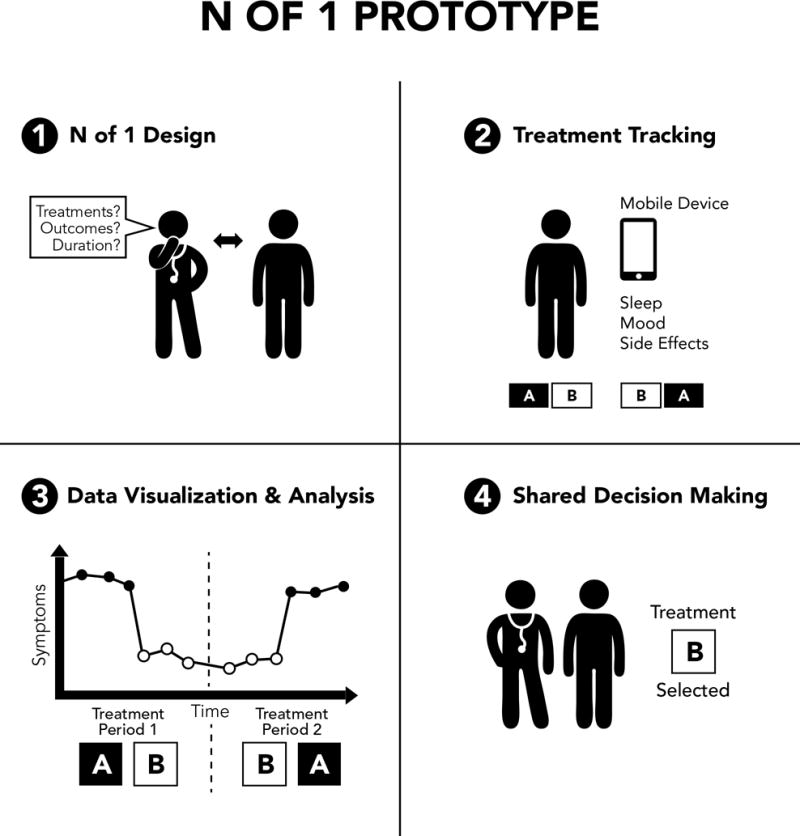
This diagram illustrates the N-of-1 experimental cycle: 1) Design the intervention (your weekly schedule), 2) Track treatments and outcomes, 3) Visualize and analyze the data, and 4) Make a shared decision (with yourself) to select, reject, or modify the protocol.
You can formalize this with a structured testing period.
The Science of Making & Breaking Habits
This video offers a simple yet powerful system for installing and testing new habits or systems, like the weekly schedule we've just designed.
Watch the segments on the 21-day system and how it meshes with the phase-based plan. The key idea is a 21-day implementation period followed by a 21-day assessment period to see which parts of the system have become automatic and which require adjustment.
Your N-of-1 Experiment:
- Hypothesis: Adhering to a three-phase weekly schedule with pre-defined contingency plans will lead to more consistent deep work completion and higher subjective well-being compared to my previous, less structured approach.
- Intervention: Implement your new weekly schedule for 21 days.
- Outcome Measures:
- Objective: Number of deep work blocks completed per week; number of training sessions completed.
- Physiological: Morning HRV (as a measure of cumulative stress/recovery).
- Subjective: Daily ratings (1-10) for focus during work, energy levels, and quality of evening relaxation.
- Analysis: After 21 days, review your data. Which implementation intentions worked seamlessly? Which ones were frequently overridden? Which contingency plans were most useful? Use this analysis to refine your system for the next cycle.
Conclusion: Your Personal Performance Formula
Congratulations on completing this course. You have systematically built a comprehensive toolkit grounded in neuroscience and psychology. You now have not only a set of individual habits but a complete operating system for managing your focus, energy, and recovery.
Key Takeaways:
- Structure Your Day in Three Phases: Align your tasks with your neurochemical state. Place high-friction work in Phase 1 (morning), low-friction work in Phase 2 (afternoon), and prioritize recovery in Phase 3 (evening).
- Use
If-ThenPlans for Everything: Translate your goals into specific, cued behaviors using implementation intentions. This offloads cognitive effort and makes execution more automatic. - Engineer for Failure with Contingency Plans: The strength of your schedule is not in its perfection, but in its resilience. Design specific, "minimum dose" alternatives for when your ideal plan is disrupted.
- Be the Scientist and the Subject: Treat your schedule as a dynamic experiment. Use N-of-1 principles to systematically test, track, and refine your personal performance system over time.
This journey was designed to empower you with both the scientific understanding and the practical tools to achieve your goals. The frameworks we've built are not meant to be restrictive, but liberating—freeing up your mental energy from the daily battle of willpower so you can direct it toward the pursuits that matter most to you. I encourage you to continue this process of curious self-experimentation, building a life of high performance that is not just effective, but also sustainable and fulfilling.