Hello! Welcome to the first lesson in our course on Algorithmic Game Theory.
Given your goal of understanding the proof of the minimax theorem via linear programming duality for your upcoming assignment, we need to move quickly and build a solid theoretical foundation. This first lesson is the essential starting point.
Our learning outcome for today is to: Define normal-form games (players, strategies, payoffs) and compute expected payoffs for mixed strategies.
We'll break this down into three parts:
- We'll formally define a "game" in the way game theorists see it, using the concept of a normal-form game.
- We'll distinguish between "pure" strategies (a single choice) and "mixed" strategies (a probabilistic choice).
- We'll learn how to calculate a player's expected payoff when they or their opponents use mixed strategies. Your background in probabilistic modeling will be helpful here.
Let's begin.
1. What is a Normal-Form Game?
In game theory, we need a precise way to describe a strategic situation. The most fundamental representation is the normal-form game. It specifies three core components: the players, the possible actions for each player, and the outcomes or payoffs for every combination of actions.
To get a conceptual overview, let's start with a short video.
(AGT1E1) [Game Theory] Strategic (normal) Form Games: Definitions
This video, from the YouTube channel selcuk ozyurt, introduces the core ideas behind strategic (or normal-form) games. It distinguishes them from sequential games and then lays out the three essential ingredients.
Please watch from the beginning of the clip until 06:40. Focus on the definitions of the three key components: the set of players (N), the strategy space for each player (S_i), and the payoff function (u_i).
The video provides a good intuitive foundation. Now, let's formalize this. As a computer science student, you'll find that these formal definitions are what allow us to reason about games algorithmically.
[PDF] Algorithmic game theory (NDMI098) Lecture notes
These lecture notes on Algorithmic Game Theory by Balko et al. provide the precise mathematical definitions we need. We'll focus on the formal definition of a normal-form game.
Please read the section '2.1 Games in normal form', starting from 'Definition 2.1 (Normal-form game)' and stopping just before 'Example 2.2 (Rock-Paper-Scissors)'. This will give you the formal triple (P, A, u) that constitutes a game.
To summarize, a normal-form game is defined by a tuple (P, A, u):
- P (or N): A set of players, e.g.,
{1, 2}. - A: A set of action profiles. This is the Cartesian product of each player's individual action set, . An action profile
a = (a_1, a_2, ..., a_n)is a specific combination of one action from each player. In this context of one-shot, simultaneous-move games, "actions" and "pure strategies" are used interchangeably. - u: A tuple of utility or payoff functions,
u = (u_1, u_2, ..., u_n). Each function maps an action profile to a real number, representing the payoff for player .
For two-player games, this structure is almost always represented by a payoff matrix. The first player (Player 1) is the "row player" and the second (Player 2) is the "column player". Each cell in the matrix corresponds to an action profile, and contains the payoffs as a tuple (u_1, u_2).
2. Pure vs. Mixed Strategies
So far, we've implicitly assumed that a player chooses a single, definite action. This is called a pure strategy. For example, in Rock-Paper-Scissors, always choosing "Rock" is a pure strategy.
However, players can also randomize their choices. A mixed strategy is a probability distribution over a player's set of pure strategies. Instead of committing to one action, the player commits to a set of probabilities for choosing each action.
Let's return to the lecture notes for the formal definition.
[PDF] Algorithmic game theory (NDMI098) Lecture notes
We'll now read the definitions for mixed strategies and, most importantly, the expected payoff when players use them.
In the same PDF, please read from 'Definition 2.4 (Mixed strategy)' up to (but not including) the worked example for Rock-Paper-Scissors. Pay close attention to Definition 2.5, which gives the formula for expected payoff.
The key takeaway is the formula for the expected payoff for player given a mixed-strategy profile :
Let's break this down:
- is a pure-strategy (action) profile.
- is the payoff to player if that specific profile is played.
- is the probability that player chooses action according to their mixed strategy .
- is the probability of the pure-strategy profile occurring, assuming players choose their actions independently.
The formula is the standard definition of mathematical expectation: a weighted average of all possible payoff values, where each weight is the probability of that payoff occurring.
3. Calculating Expected Payoffs
Knowing the formula is one thing; applying it is another. Let's watch a clear, practical demonstration of how to compute these payoffs in a 2x2 game.
Game Theory 101 (#11): Calculating Payoffs
This video from William Spaniel's 'Game Theory 101' series provides a simple 3-step algorithm for calculating expected payoffs and walks through it with the 'Battle of the Sexes' game.
Please watch the entire video (it's under 5 minutes). The key part is the three-step algorithm he introduces at 01:17: Find the probability of each outcome. Multiply that probability by a player's payoff for that outcome. Sum the results.
This method is a direct application of the formula we just saw. Let's work through another example to solidify this. Consider the game of Matching Pennies. Player 1 wins if the pennies match (H,H or T,T), and Player 2 wins if they don't (H,T or T,H). The payoff matrix looks like this:
| Player 2: Head (prob q) | Player 2: Tail (prob 1-q) | |
|---|---|---|
| Player 1: Head | (1, -1) | (-1, 1) |
| Player 1: Tail | (-1, 1) | (1, -1) |
Suppose Player 2 adopts a mixed strategy of playing Head with probability and Tail with probability . What is Player 1's expected payoff if they play the pure strategy Head?
We calculate the expectation over Player 2's choices:
- Player 2 plays Head (with prob ), outcome is (H,H), P1's payoff is 1.
- Player 2 plays Tail (with prob ), outcome is (H,T), P1's payoff is -1.
So, Player 1's expected payoff for playing Head, given Player 2's strategy , is:
This is exactly what the following image illustrates.
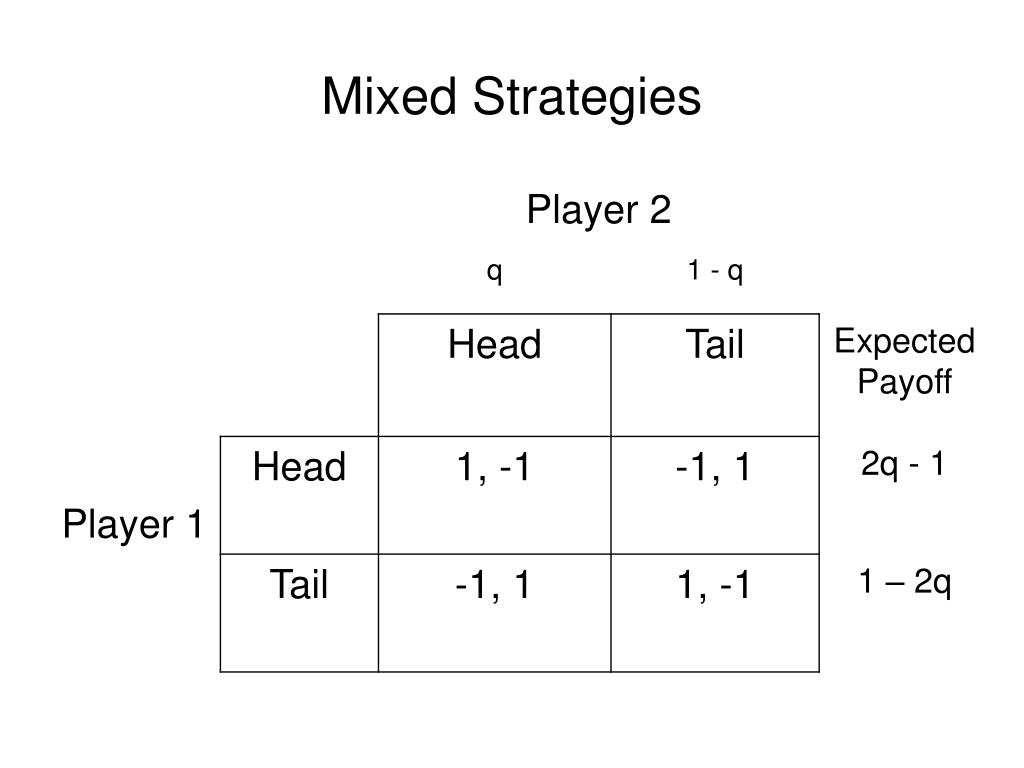
Similarly, let's calculate Player 1's expected payoff for playing the pure strategy Tail, given Player 2's same strategy :
Now, what if Player 1 also plays a mixed strategy, , choosing Head with probability and Tail with probability ?
The overall expected payoff for Player 1, , is the weighted average of the expected payoffs of their pure strategies:
This calculation is fundamental. Being able to compute a player's expected payoff given their opponents' strategies is a prerequisite for finding optimal strategies and game equilibria.
Conclusion
In this lesson, we have established the essential vocabulary and mechanics for analyzing games.
Key Takeaways:
- A normal-form game is formally defined by a set of players, a set of action profiles, and a set of payoff functions
(P, A, u). - A pure strategy is a deterministic choice of an action, while a mixed strategy is a probability distribution over the set of pure strategies.
- The expected payoff of a mixed-strategy profile is the sum of the payoffs of all possible pure-strategy outcomes, each weighted by its probability of occurring. We can calculate this systematically by considering each player's strategy.
This foundation is crucial. You can't determine the "best" way to play a game without first being able to evaluate the outcome of playing it in a certain way.
Preview of the next lesson:
In the next lesson, we will build directly on this by asking: given an opponent's strategy, what is my best response? This will lead us to the concepts of best response and dominated strategies, which are the first tools we use to start "solving" games by eliminating irrational choices.