Welcome back! In our first lesson, we established the formal language of game theory, defining normal-form games and learning how to calculate the expected payoff of any given strategy profile. This was about evaluating outcomes.
Today, we move from evaluation to decision-making. We'll explore how a rational player can compare their available strategies to find the best ones and discard the worst. This will give us our first tool for "solving" games.
Our learning outcome for this lesson is to: Define best response and dominated strategies, and apply iterated elimination of strictly dominated strategies.
We will cover:
- Best Response: How to determine the optimal strategy for a player, given their beliefs about what their opponents will do.
- Dominated Strategies: Identifying and formally defining strategies that are unambiguously bad choices.
- Iterated Elimination of Strictly Dominated Strategies (IESDS): A powerful method for simplifying and sometimes solving games by systematically removing these bad choices.
Let's get started.
1. Best Response
In the previous lesson, we calculated player 1's expected payoff in Matching Pennies for playing "Head" or "Tail", given that player 2 plays "Head" with probability . We found:
A rational player, aiming to maximize their payoff, would simply compare these two values.
- If (which simplifies to ), Player 1 should play "Head".
- If (i.e., ), Player 1 should play "Tail".
- If (i.e., ), Player 1 is indifferent and gets the same payoff from "Head" or "Tail" (or any mix of them).
This simple comparison is the core idea of a best response.
Definition: Best Response
A strategy for player is a best response to an opponent strategy profile if it maximizes player 's payoff. That is, for any other strategy available to player :
The following video provides a detailed walkthrough of how to formalize this concept and derive a player's best response function, which specifies their best response for every possible strategy of the opponent.
(IME2) Chapter 5 - Video 6: Calculating Best Response Functions and Mixed Strategy Nash Equilibrium.
This video from selcuk ozyurt builds directly on our previous work with expected payoffs. It demonstrates how to find a player's best response by comparing the expected payoffs of their different actions and considering all possible opponent strategies.
Please watch from 01:17 to 09:49. The video will: Formally set up the best response problem (01:17 - 02:18). Calculate Player 1's best response by comparing the expected payoffs for 'Left' vs. 'Right' based on Player 2's mixed strategy 'Q' (02:18 - 07:27). Plot the resulting best response function on a graph, showing how the optimal choice changes (07:27 - 09:49).
Understanding how to find a player's best response to a given strategy is a fundamental skill. It is the building block for the central solution concept in game theory, Nash Equilibrium, which we will discuss in the next lesson.
2. Strictly Dominated Strategies
While "best response" identifies what to do in a specific situation, the concept of dominance helps us identify strategies that a player should never use, regardless of the situation.
Let's look at the classic Prisoner's Dilemma:
| Player 2: Cooperate | Player 2: Defect | |
|---|---|---|
| Player 1: Cooperate | (2, 2) | (0, 3) |
| Player 1: Defect | (3, 0) | (1, 1) |
Consider Player 1's choices:
- If Player 2 Cooperates, Player 1 gets a payoff of 3 from Defecting vs. 2 from Cooperating. Defect is better.
- If Player 2 Defects, Player 1 gets a payoff of 1 from Defecting vs. 0 from Cooperating. Defect is better.
No matter what Player 2 does, Player 1 gets a strictly higher payoff by choosing Defect. In this case, we say that Player 1's strategy "Cooperate" is strictly dominated by "Defect". A rational player would never play a strictly dominated strategy.
Here is the formal definition.
Definition: Strictly Dominated Strategy
A strategy is strictly dominated by another strategy if for every possible combination of the other players' strategies , the payoff from playing is strictly greater than the payoff from playing .
Note that a pure strategy can also be dominated by a mixed strategy.
3. Iterated Elimination of Strictly Dominated Strategies (IESDS)
The power of dominance comes from applying it iteratively. The logic rests on the assumption of common knowledge of rationality:
- All players are rational (so they won't play a strictly dominated strategy).
- All players know that all other players are rational (so they know others won't play their dominated strategies).
- All players know that all players know... and so on.
This allows us to perform Iterated Elimination of Strictly Dominated Strategies (IESDS):
- Identify and remove all strictly dominated strategies for all players from the game.
- In the new, smaller game, some strategies that were not dominated before might become dominated now.
- Repeat this process—identifying and removing newly dominated strategies—until no more strategies can be eliminated.
The strategies that remain are the prediction of the game's outcome.
The following video provides an excellent walkthrough of this process.
GTO-3-02: Strictly Dominated Strategies and Iterative Removal
This video from Game Theory Online demonstrates the IESDS process with a clear 3x3 example. Pay close attention to how eliminating a strategy for one player can suddenly make a strategy for another player dominated in the next step.
Please watch from 02:24 to 08:52, and then from 12:49 to 14:10. Formal Definition (02:24 - 04:50): The video first gives the formal definition of a strictly dominated strategy, which will be a good reinforcement. Worked Example (04:50 - 08:52): Follow the step-by-step elimination process for the 3x3 game. Notice how the game matrix shrinks at each iteration. Key Property (12:49 - 14:10): This final segment discusses a crucial property of IESDS: for strictly dominated strategies, the order of elimination does not affect the final outcome. This is a key theoretical result.
A crucial connection exists between these two concepts: a strategy is strictly dominated if and only if it is never a best response. That is, for a strictly dominated strategy, there is no belief you could hold about your opponents' play that would make it the optimal choice. The proof for this theorem is a classic result in game theory, and it formally cements the intuition that dominated strategies are ones you should never play.
4. Practice with IESDS
Now it's your turn to apply the IESDS process. Consider the following game matrix.
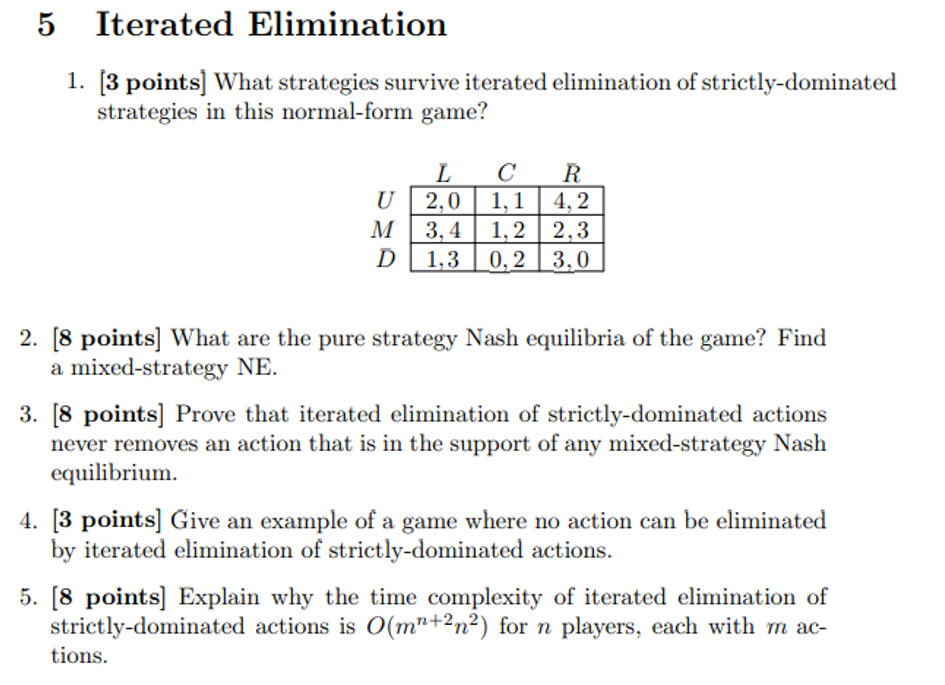
Let's focus on Problem 1. Apply the IESDS algorithm to the game shown. For each step, identify which strategy is strictly dominated and by what.
Click here to see the step-by-step solution.
Game:
| L | C | R | |
|---|---|---|---|
| U | (2, 0) | (1, 1) | (4, 5) |
| M | (3, 5) | (1, 2) | (5, 4) |
| D | (1, 6) | (0, 4) | (3, 5) |
Step 1:
- Player 1 (Row): Compare U, M, D.
- U vs M: M is better if P2 plays L (3>2), but U is better if P2 plays R (4>5 is false). No dominance.
- U vs D: U is better if P2 plays L (2>1) and C (1>0), but D is better if P2 plays R (3>4 is false). No dominance.
- M vs D: M is better if P2 plays L, C, R (3>1, 1>0, 5>3). So, M strictly dominates D. We eliminate strategy D.
Reduced Game:
| L | C | R | |
|---|---|---|---|
| U | (2, 0) | (1, 1) | (4, 5) |
| M | (3, 5) | (1, 2) | (5, 4) |
Step 2:
- Player 2 (Column): Now we re-examine Player 2's strategies in the smaller game.
- L vs C: C is better if P1 plays U (1>0), but L is better if P1 plays M (5>2). No dominance.
- L vs R: R is better if P1 plays U (5>0), but L is better if P1 plays M (5>4). No dominance.
- C vs R: R is better if P1 plays U (5>1) and if P1 plays M (4>2). So, R strictly dominates C. We eliminate strategy C.
Reduced Game:
| L | R | |
|---|---|---|
| U | (2, 0) | (4, 5) |
| M | (3, 5) | (5, 4) |
Step 3:
- Player 1 (Row): Back to Player 1 in this 2x2 game.
- U vs M: M is better if P2 plays L (3>2), but U is better if P2 plays R (4>5 is false). Wait, my comparison for U vs M was wrong earlier. Let's re-check my notes. U payoff vs M payoff: (2 vs 3), (4 vs 5). U is never strictly better than M. Let's check M vs U. M is better if P2 plays L (3>2) and R (5>4). Ah! M strictly dominates U. We eliminate strategy U.
Reduced Game:
| L | R | |
|---|---|---|
| M | (3, 5) | (5, 4) |
Step 4:
- Player 2 (Column): In this final 1x2 game, Player 2 only has one choice to make, assuming Player 1 will play M. Player 2 compares the payoff of 5 from playing L to 4 from playing R. Clearly, L is the better choice.
Conclusion:
The IESDS process reduces the game to a single strategy profile: (M, L). This is the unique prediction for this game under the assumption of common knowledge of rationality.
Conclusion
In this lesson, we have developed our first set of tools for analyzing and solving games. By moving from simply calculating payoffs to comparing them, we can make concrete predictions about player behavior.
Key Takeaways:
- A best response is a strategy that yields the highest possible payoff, given what the other players are doing.
- A strategy is strictly dominated if there is another available strategy that always yields a strictly higher payoff, no matter what the opponents do. Rational players never play such strategies.
- Iterated Elimination of Strictly Dominated Strategies (IESDS) is a process that leverages common knowledge of rationality to simplify or solve a game by removing dominated strategies in rounds. For strict dominance, the order of removal does not matter.
Preview of the next lesson:
IESDS is a powerful tool, but in many games, no strategies are strictly dominated, or the process stops before reaching a unique outcome. We need a more general solution concept. In the next lesson, we will introduce Nash Equilibrium, a state where every player's strategy is a best response to the strategies of all other players. This concept is the cornerstone of modern game theory.