Introduction
Welcome to the "Foundations of Machine Learning" module. This is a significant milestone in your journey. Having built foundational skills in Python programming and statistics, you are now ready to dive into the core principles of Artificial Intelligence. This module bridges the gap between understanding data and building systems that can think and learn from it.
In our last lesson, you learned how to use Python to generate random data and compute summary statistics. You saw how a sample provides a snapshot of a larger population. We were describing data. Now, we will begin to learn how to make the computer learn from that data on its own.
Today's lesson directly addresses the learning outcome: to define machine learning and distinguish it from traditional programming. This is the bedrock concept for everything that follows. For your ambition to build transformative technologies, understanding this fundamental paradigm shift is crucial. It's the difference between creating a simple calculator and creating a system like JARVIS, which learns, adapts, and makes intelligent decisions without being explicitly told how to handle every possible scenario.
1. What is Machine Learning?
At its heart, machine learning is a subfield of Artificial Intelligence (AI) that focuses on building systems that can learn from data, identify patterns, and make decisions with minimal human intervention.
Think of it this way:
- Traditional Programming is like giving a chef a detailed, step-by-step recipe. You provide explicit instructions (the code) and ingredients (the data), and the chef produces a dish (the output).
- Machine Learning is like showing the chef thousands of pictures of a perfect dish and telling them which ingredients were used. The chef's job is to experiment and figure out the recipe (the model) on their own.
Let's ground this in a more formal definition. A classic, widely-cited definition comes from computer scientist Tom M. Mitchell:
"A computer program is said to learn from experience E with respect to some class of tasks T and performance measure P, if its performance at tasks in T, as measured by P, improves with experience E."
Let's break this down with a practical example: building an email spam filter.
- Task (T): To classify emails as either "spam" or "not spam."
- Experience (E): A massive dataset of emails, where each one has already been labeled by humans as spam or not spam.
- Performance (P): The percentage of emails the program correctly classifies.
According to Mitchell's definition, our program has "learned" if its classification accuracy (P) gets better as it processes more and more labeled emails (E). It's not learning from new code we write, but from the data it sees.
To explore this further, let's look at an excellent article that uses this very example.
Chapter 1: Introduction to Machine Learning and Deep ...
The following reading from 'Introduction to Machine Learning and Deep Learning' by Sebastian Raschka provides a clear definition of machine learning by contrasting it with the traditional programming approach for a task like spam filtering.
Please read the section '1.1.1 Automating the Traditional Programming Paradigm'. As you read, focus on how the author illustrates the limitations of a rule-based approach for spam filtering and how machine learning offers a more effective alternative.
2. The Core Distinction: Traditional Programming vs. Machine Learning
The fundamental difference lies in how a system generates its logic.
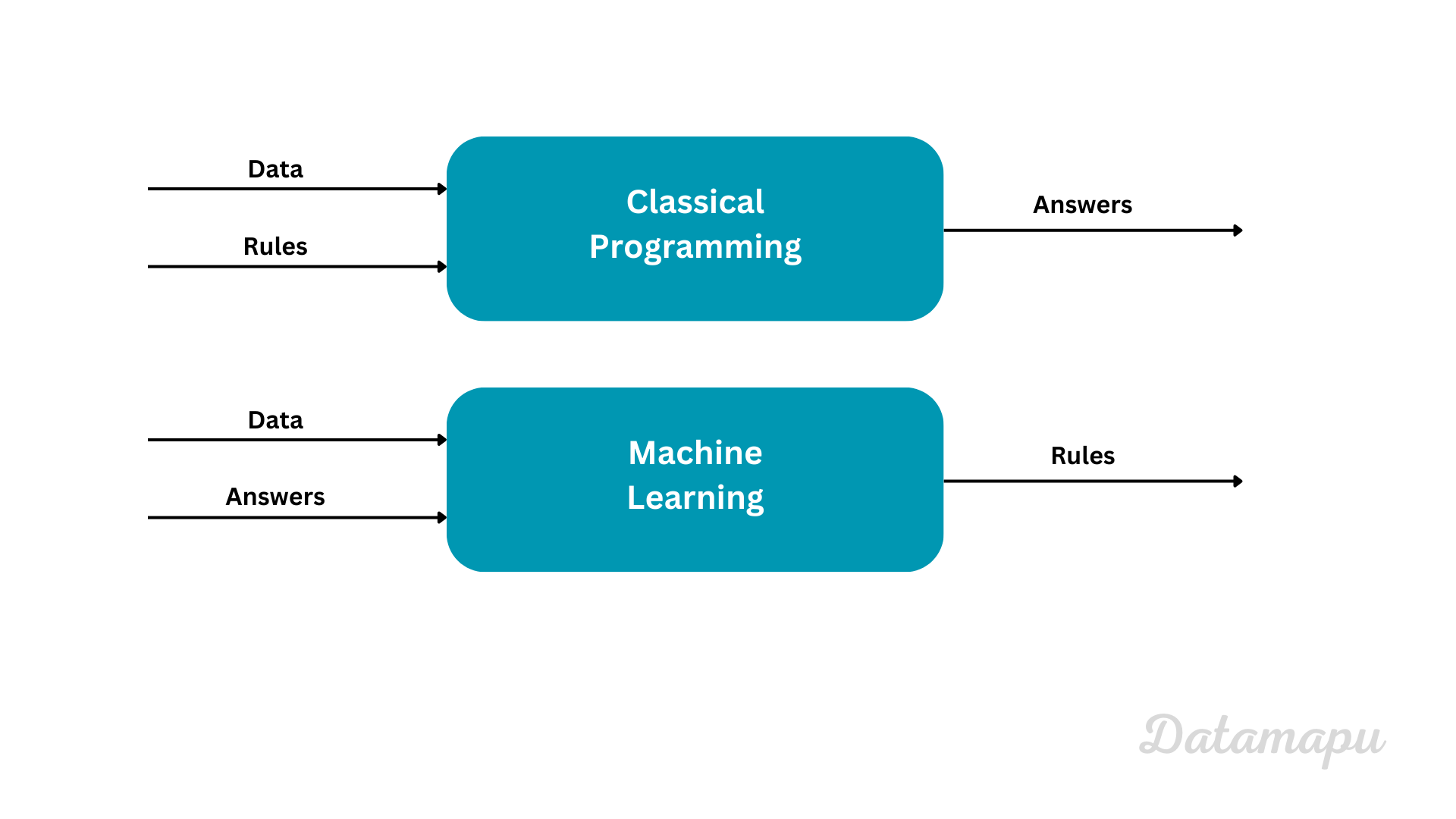
In traditional programming, a developer analyzes a problem and writes explicit, step-by-step rules for the computer to follow. The program's logic is static unless a human rewrites the code.
In machine learning, the developer does not write the rules for making a specific decision. Instead, they choose a suitable learning algorithm and provide it with data. The algorithm processes the data and generates a "model," which is effectively the set of rules or patterns the system will use to make future decisions.
The following videos offer a dynamic explanation of this contrast.
AI Systems vs Traditional Coding
First, let's watch a video from IBM Technology that gives a high-level overview of the differences, including aspects like stability, scalability, and control.
Watch the two segments from 03:08 to 04:06 (explaining traditional programming) and then from 00:00 to 00:52 (introducing the 'black box' nature of AI). Notice the emphasis on traditional programming being deterministic and requiring rules for 'every possible scenario'.
How is Artificial Intelligence different from Traditional Programming?
Next, this video from AI For Beginners provides a very concrete example involving salary prediction, making the abstract concepts easier to grasp.
Watch from 00:47 to the end at 03:32. Pay close attention to how it contrasts a task with known rules (Fahrenheit conversion) versus a task with unknown rules (predicting salary from grades), which is where machine learning excels.
To consolidate these ideas, here is a summary table contrasting the two approaches:
| Feature | Traditional Programming | Machine Learning |
|---|---|---|
| Core Logic | Logic is explicitly coded by a human programmer (e.g., if-else statements). |
Logic is learned from patterns in data by an algorithm. |
| Paradigm | Rules + Data → Answers | Data + Answers → Rules |
| Human Role | Write the detailed, step-by-step instructions. | Provide data, select a model, and define how to measure success. |
| Adaptability | Rigid. To change behavior, a programmer must update the code. | Adaptive. The model can improve and change its behavior as it is exposed to new data. |
| Use Cases | Well-suited for tasks with clear, definable, and stable rules (e.g., calculating taxes, processing a transaction). | Best for complex problems where rules are not easily defined (e.g., recognizing faces, translating languages, predicting stock prices). |
| Output | Deterministic. Given the same input, it will always produce the same output. | Probabilistic. The output is a prediction, which may vary and has an associated confidence level. |
| Transparency | High. A programmer can trace the execution step-by-step to debug issues ("white box"). | Can be low. Complex models may be difficult to interpret ("black box"), though this is an active area of research. |
3. The Bigger Picture: AI, ML, and Deep Learning
It's helpful to understand where machine learning fits within the broader landscape of Artificial Intelligence. These terms are often used interchangeably, but they have distinct meanings.
- Artificial Intelligence (AI): This is the broadest concept. It is the entire field dedicated to creating non-biological systems that exhibit human-like intelligence. This includes not just machine learning but also other approaches like expert systems, which rely on complex, hand-coded rules.
- Machine Learning (ML): This is a subfield of AI. It represents the most successful modern approach to achieving AI, focusing specifically on algorithms that learn from data.
- Deep Learning (DL): This is a subfield of machine learning. It uses a specific type of model architecture called a "deep neural network" and has been responsible for the most significant breakthroughs in recent years, particularly in areas like computer vision and natural language processing.
The relationship is hierarchical, like nesting dolls.
Chapter 1: Introduction to Machine Learning and Deep ...
Let's return to Sebastian Raschka's article, which provides a concise explanation of how these three fields are related.
Please read section '1.1.2 The Connection between Machine Learning, Deep Learning, and AI'. Focus on Figure 2 and the accompanying text that describes AI as the overall quest, ML as a path to achieve it, and DL as a modern technique within ML.
Conclusion
In this lesson, you have taken your first and most important step into the world of AI. You now understand the fundamental paradigm that separates machine learning from every other type of programming you might have encountered.
Key Takeaways:
- Traditional Programming relies on humans to write explicit rules that a computer then executes on data.
- Machine Learning flips this: it uses data and desired outcomes to allow a computer to learn the rules for itself.
- The paradigm shifts from Rules + Data → Answers to Data + Answers → Rules.
- Machine learning is ideal for complex problems where the rules are unknown or too numerous to write by hand, such as image recognition or natural language understanding.
- Machine Learning (ML) is the dominant approach within the broader field of Artificial Intelligence (AI), and Deep Learning (DL) is a powerful subfield of ML.
Preview of the Next Lesson:
Now that you can define what machine learning is, the next logical question is: how many ways are there for a machine to learn? In our next lesson, we will explore the three main categories of machine learning: supervised, unsupervised, and reinforcement learning. You will learn to distinguish between these approaches and identify the types of problems each one is designed to solve.