Introduction
In our last lesson, you successfully trained your first neural network using model.fit() and learned how to monitor its performance by plotting loss and accuracy. We used fixed values for epochs and batch_size, which raises a crucial question: were those the best choices? The answer is almost certainly no.
Welcome to the art and science of hyperparameter tuning. While a model's parameters (its weights and biases) are learned from data, its hyperparameters are the settings you, the architect, must define before training begins. They are the dials and knobs that control the entire learning process.
Today, your goal is to learn how to tune key hyperparameters (learning rate, epochs, and batch size) to improve model performance. We will explore:
- What these hyperparameters are and the profound impact they have on training.
- How to find good values for them, moving from manual adjustments to systematic, automated search strategies.
Mastering this skill is a significant step toward your goal of building high-impact AI. It's the difference between building a model that simply "works" and engineering one that performs at its peak potential—a key discipline for anyone aiming to operate at the "Tony Stark" level of innovation.
Part 1: The Core Hyperparameters
Let's begin with the theory, focusing on the three most influential hyperparameters for any neural network.
The Ultimate Guide to Deep Learning Hyperparameter Tuning
First, let's solidify the distinction between parameters and hyperparameters and understand why tuning is so critical. This article from the 'Ultimate Guide to Deep Learning Hyperparameter Tuning' provides a concise overview.
Read the sections 'Hyperparameters in Neural Networks' and 'Why Tune Hyperparameters in Deep Learning?'. Focus on the definitions and the examples of how adjusting learning rate, batch size, and epochs affects the model.
Now, let's dive into each one individually.
1. Learning Rate
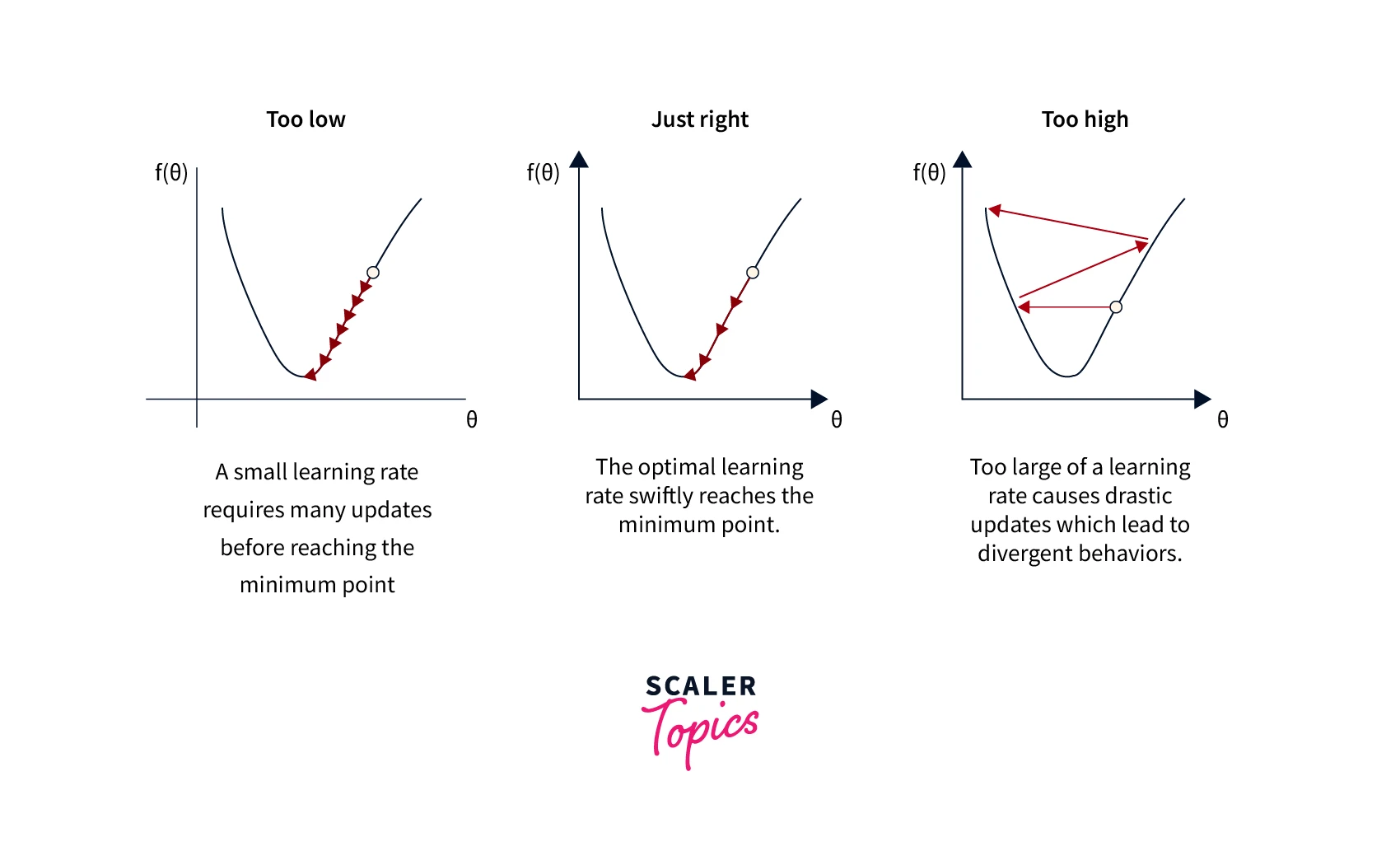
The learning rate is arguably the single most important hyperparameter. It controls the size of the steps the optimizer takes to update the model's weights during backpropagation.
- A high learning rate can cause the training to become unstable, overshooting the optimal solution and causing the loss to fluctuate wildly or even increase.
- A low learning rate results in very slow training. While more stable, it can take an impractically long time to converge and may get stuck in a suboptimal solution.
Finding the "just right" learning rate is crucial for efficient and effective training.
To deepen your understanding, let's review two excellent explanations that use helpful analogies.
AI Basics: Accuracy, Epochs, Learning Rate, Batch Size and Loss
In our previous lesson, we watched Prof. Ryan Ahmed's video on epochs and batch size. Now, let's watch his explanation of the learning rate, where he uses the analogy of teaching a child to walk.
Watch the segment on 'Learning Rate' from 05:51 to 09:14. Pay attention to the visual of the error surface and how different step sizes navigate it.
Fine-tuning Hyperparameters: exploring Epochs, Batch Size, and...
This article provides another perspective, describing the learning rate as the 'stride length' in your walk towards a solution. It clearly explains the consequences of getting it wrong.
Read the section 'Learning Rate: Controlling the Pace of Learning'. This will reinforce the concepts of stability, convergence speed, and the common practice of using learning rate schedules.
2. Number of Epochs and Early Stopping
We've already defined an epoch as one full pass over the training data. The key question is: how many passes are enough?
- Too few epochs leads to underfitting. The model hasn't had enough time to learn the underlying patterns in the data.
- Too many epochs leads to overfitting. The model starts to memorize the training data, including its noise, and loses its ability to generalize to new, unseen data.

So, how do we find the sweet spot? Instead of guessing the perfect number of epochs, a common and effective technique is Early Stopping. You train the model for a potentially large number of epochs but monitor the validation loss. If the validation loss stops improving (or starts getting worse) for a certain number of consecutive epochs (a parameter called patience), you stop the training automatically. This prevents overfitting and saves computational resources.
Fine-tuning Hyperparameters: exploring Epochs, Batch Size, and...
The following article explains this trade-off clearly and introduces the practical strategy of Early Stopping.
Read the section 'Epoch Count: Navigating the Training Iterations'. Focus on the connection between epochs, the loss curve, and the concept of early stopping as a solution to prevent overfitting.
3. Batch Size
Batch size determines how many training samples are processed before the model's weights are updated. This choice involves a trade-off between computational efficiency and the learning dynamics.
- Large batch sizes are computationally efficient as they leverage parallel processing on GPUs. The gradient calculation is more stable because it's averaged over more samples. However, this can sometimes lead the model to converge to sharp, less generalizable minima.
- Small batch sizes introduce more noise into the gradient updates. This "noise" can be beneficial, helping the optimizer escape poor local minima and potentially find a better, more generalizable solution. The downside is that training can be slower and less stable.
The choice of batch size is often constrained by your GPU's memory. A common practice is to use batch sizes that are powers of two (e.g., 16, 32, 64, 128) as this can optimize memory usage.
Epochs, Iterations and Batch Size | Deep Learning Basics
This video offers a great discussion on batch size, contrasting it with other training methods and giving practical advice.
Watch the sections on 'Batch Size' (03:04 - 06:42) and the 'Concluding Remarks' (06:42 - 07:17). Focus on the comparison between full-batch, stochastic, and mini-batch gradient descent, and the practical recommendation for choosing a batch size.
Part 2: Strategies for Tuning
Now that you understand what to tune, let's move on to how to tune. Finding the optimal hyperparameters is an empirical search process—there's no magic formula.
Manual vs. Automated Tuning
The simplest approach is manual tuning: you pick a set of values, train the model, observe the results, and use your intuition to decide what to try next. This is a good way to build an intuition, but it can be slow and unsystematic.
A more robust approach is automated tuning, where you define a search space for your hyperparameters and let an algorithm explore it for you. Common strategies include:
- Grid Search: Exhaustively tries every possible combination of a predefined set of hyperparameter values. It's thorough but computationally very expensive.
- Random Search: Randomly samples combinations from the search space. It's often more efficient than grid search because it explores a wider range of values for each hyperparameter.
- Bayesian Optimization: A "smarter" search method. It builds a probabilistic model of how hyperparameters relate to performance and uses it to choose the most promising combinations to try next. It balances exploring new areas with exploiting known good areas.
The Ultimate Guide to Deep Learning Hyperparameter Tuning
This article section provides an excellent overview of these automated tuning techniques.
Read the section 'Techniques for Tuning Hyperparameters'. Understand the conceptual difference between Grid Search, Random Search, and Bayesian Optimization.
Practical Application with Keras Tuner
Manually implementing these search strategies can be complex. Fortunately, there are libraries that do the heavy lifting for you. Keras Tuner is a library that integrates directly with TensorFlow/Keras to make hyperparameter tuning simple.
The general workflow is:
- Create a model-building function: This function defines your model architecture, but instead of using fixed values for hyperparameters, you define a search space for them (e.g.,
hp.Int('units', min_value=32, max_value=512, step=32)). - Instantiate a tuner: You choose a tuning algorithm (like
RandomSearchorHyperband) and point it to your model-building function. - Run the search: You call the tuner's
search()method, which is similar tomodel.fit(). The tuner will then automatically train and evaluate multiple versions of your model to find the best hyperparameter combination.
The Ultimate Guide to Deep Learning Hyperparameter Tuning
Let's see how this is done in practice. The following resource demonstrates how to use Keras Tuner to apply Random Search, Bayesian Optimization, and another technique called Hyperband.
First, read the brief section on 'Python Tuning Frameworks' to get familiar with the names Keras Tuner, Optuna, etc. Then, carefully study the code examples in the section 'Tuning the model with various hyperparameter tuning techniques'. You don't need to run the code right now, but focus on understanding the structure: The model_builder(hp) function and how hp.Int() and hp.Float() define the search space. How to initialize a tuner, like kt.RandomSearch(...). How the tuner.search(...) call kicks off the process.
Conclusion
You have now moved beyond just training a model to optimizing it. This is a fundamental skill in applied AI. By thoughtfully selecting and tuning hyperparameters, you directly control the efficiency and ultimate performance of your models.
Key Takeaways:
- Hyperparameters like learning rate, epochs, and batch size are settings you define to control the training process.
- Learning Rate controls the step size of optimization; it must be carefully balanced to ensure stable and efficient convergence.
- The Number of Epochs determines the amount of training; using Early Stopping is a crucial technique to prevent overfitting.
- Batch Size involves a trade-off between computational speed and the stability of gradient updates.
- Tuning can be done manually to build intuition or through automated strategies like Random Search and Bayesian Optimization for more systematic and efficient exploration.
- Libraries like Keras Tuner provide practical tools to implement these automated strategies.
Preview of the Next Lesson:
With a solid grasp of how to build, compile, fit, and now tune a fundamental neural network, you are ready to explore more specialized and powerful architectures. In our next lesson, we will dive into Convolutional Neural Networks (CNNs). These models revolutionized the field of computer vision and are the technology behind image recognition, self-driving cars, and medical imaging analysis. We will explore the unique layers that allow them to "see" and understand patterns in images.