Welcome to the final lesson of our first module. In our previous lessons, we've explored ways to build new vector spaces from existing ones by combining them, culminating in the concept of the direct sum which guarantees unique decomposition. Today, we will investigate a complementary and equally powerful construction: creating a new vector space not by combining, but by simplifying. We will learn how to take a vector space and "collapse" a chosen subspace into the zero vector, forming a new structure called the quotient space, denoted .
This idea of "modding out" by a certain structure is a recurring theme in advanced mathematics and physics. For instance, in gauge theories, different field configurations that are related by a gauge transformation are considered physically equivalent. The space of physically distinct configurations is, in essence, a quotient space. Similarly, in group theory, which you are currently studying, one forms a quotient group by identifying elements related by a normal subgroup . The construction we will study today is the direct analogue for vector spaces.
Our goal is to formally define the quotient space , prove it is a vector space in its own right, and then describe its defining characteristic: the universal property of the canonical projection map. This abstract property is what makes the quotient space a fundamental tool in linear algebra.
1. The Intuition: Collapsing a Subspace
Before diving into the formal definitions, let's build some geometric intuition. Imagine the vector space and a subspace which is a plane passing through the origin (e.g., the xy-plane). To form the quotient space , we essentially decide to treat the entire subspace as a single point—the new zero vector.
What happens to vectors not in ? A vector is now considered "the same" as any other vector if their difference, , lies within the subspace we've collapsed. Geometrically, this means all vectors ending in a plane parallel to are grouped together and treated as a single element in our new space. The quotient space is therefore the set of all such parallel planes.
The following video from Sheldon Axler introduces this idea using the language of "affine subsets," which is a formal term for these translated subspaces like lines or planes that do not necessarily pass through the origin.
This video provides the geometric motivation for quotient spaces by defining them as sets of parallel affine subsets.
Watch the segment from the definition and examples. Pay close attention to the examples in \mathbb{R}^2 and \mathbb{R}^3, which illustrate how the quotient space consists of lines parallel to a given line, or planes parallel to a given plane.
2. Formal Construction: Cosets and Equivalence Classes
To make this construction rigorous, we use the concept of an equivalence relation.
Let be a vector space and be a subspace. We define a relation on by declaring that for ,
This is called "congruence modulo ". It's a straightforward exercise to show this is an equivalence relation (it is reflexive, symmetric, and transitive). An equivalence relation partitions the set into disjoint equivalence classes. The equivalence class of a vector is the set of all vectors equivalent to it:
This set is denoted and is called a coset of in . The quotient space is defined as the set of all such cosets:
The following resources formalize this definition and provide further visual examples.
[PDF] Quotient Spaces - Cornell University
This document provides a concise and rigorous introduction to quotient spaces.
Please read the first page, from the beginning up to the definition of a coset. This text formally defines the congruence relation and shows why the equivalence class of a vector \mathbf{v} is precisely the set \mathbf{v}+W. (Note: The resource uses W for the subspace, which we are calling U).
Advanced Linear Algebra, Lecture 1.4: Quotient spaces
This video from Professor Macauley gives a very clear lecture-style explanation of the equivalence relation and the geometric meaning of cosets.
Watch from the beginning to the geometric examples. The explanation of why the equivalence class is written as x + Y and the subsequent visualizations in \mathbb{R}^3 are particularly helpful for cementing the concept.
3. Defining a Vector Space Structure
So far, is just a set. To make it a vector space, we must define addition and scalar multiplication for its elements (the cosets). The natural definitions are:
- Addition:
- Scalar Multiplication:
However, there is a subtle but crucial issue here. The definitions depend on the choice of representatives and from their respective cosets. A coset can have many representatives (any vector in that affine subset will do). For these operations to be valid, we must show they are well-defined—that is, the result is independent of the choice of representative.
The next video gives an excellent explanation of why this is necessary and what it means.
Advanced Linear Algebra, Lecture 1.4: Quotient spaces
This segment of the video explains the critical concept of "well-defined" operations.
Watch the section from "well-defined". The analogy of two people picking different "favorite" elements from the same families (cosets) and needing to arrive at the same resulting family is a powerful way to understand this abstract requirement.
Now that you appreciate the need for this check, let's see the formal proof that these operations are indeed well-defined.
[PDF] Quotient Spaces - Cornell University
This section of the Cornell PDF provides the formal verification that addition and scalar multiplication on cosets are well-defined.
Read the section titled "We now make this set into a vector space". The proof shows that if you start with different representatives for the same cosets, the resulting coset under addition or scalar multiplication is identical.
With well-defined operations, it can be shown that satisfies all the vector space axioms. The zero vector is the coset , and the additive inverse of is .
4. The Universal Property of Quotient Spaces
We have constructed a new vector space, . Associated with it is a natural map, the canonical projection (or quotient map) , defined by:
This map simply sends each vector to the coset it belongs to. The way we defined the operations on ensures that is a linear map. Notice two key properties:
- is surjective (by definition of ).
- The kernel of is precisely , since if and only if .
The true power of the quotient space is revealed by an abstract characterization known as the Universal Mapping Property (UMP). It states that is the "most general" vector space you can get from if you demand that every vector in is mapped to zero.
Theorem (Universal Mapping Property): Let be a subspace of . For any vector space and any linear map that satisfies , there exists a unique linear map such that .
This property is best visualized with a commutative diagram.
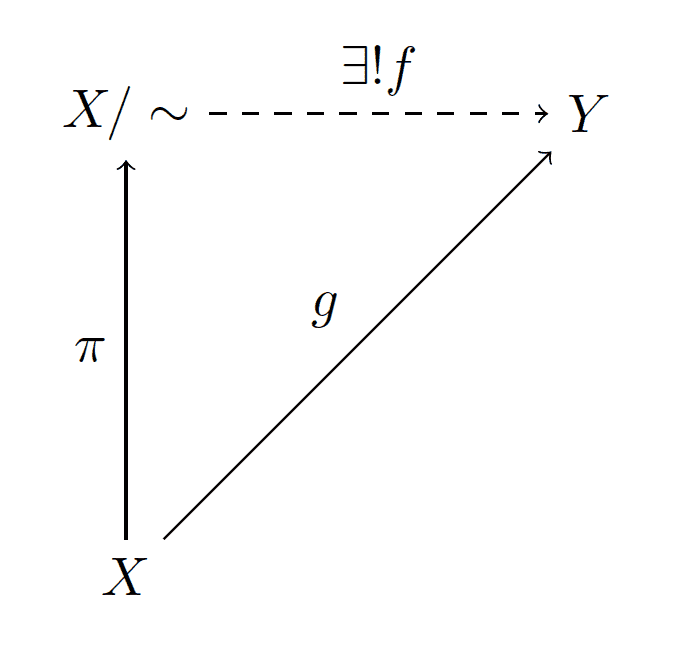
The UMP tells us that any map from that "kills" can be uniquely factored through the quotient space. In essence, instead of mapping directly from to , you can first go to via and then to via , and the result is the same.
The following reading breaks down the UMP and its proof.
[PDF] Quotient Spaces - Cornell University
This part of the document defines the canonical projection map, states the Universal Mapping Property, and provides a full proof.
First, read the section that defines the canonical projection map (denoted p) and lists its properties. Next, read the statement of the theorem for the Universal Mapping Property. Finally, study the proof, which is broken into three parts: Uniqueness, Existence, and Properties. This proof is a classic example of how UMP arguments are structured and is worth understanding thoroughly.
This universal property pattern is not unique to vector spaces. As mentioned, it's fundamental in group theory. To solidify your understanding, it is highly instructive to see the exact same logical structure applied to quotient groups.
universal mapping properties - Keith Conrad
This document by Keith Conrad discusses universal mapping properties across different algebraic structures. This section focuses on modules, which are a generalization of vector spaces.
Read the short section titled "Quotient modules". A vector space is a module over a field, so this theorem is a direct statement of the UMP for vector spaces. Notice the identical structure: a map f: M \to P that vanishes on a submodule N induces a unique map \bar{f}: M/N \to P. This reinforces that the UMP is a deep, structural principle.
Conclusion
In this lesson, we have moved from combining subspaces to the more abstract idea of collapsing them. This has led us to the construction of the quotient space, a concept that will be instrumental in our future studies.
Key Takeaways:
- The quotient space is the set of cosets , where vectors are grouped together if their difference lies in the subspace .
- Addition and scalar multiplication on are defined via representatives from the cosets. This requires proving that the operations are well-defined.
- The canonical projection is a surjective linear map whose kernel is precisely the subspace that was "quotiented out".
- The Universal Mapping Property is the defining feature of the quotient space. It guarantees that any linear map that sends to zero can be uniquely "factored through" the quotient space .
The construction of the quotient space completes our foundational toolkit for manipulating vector spaces. In the next module, we will shift our focus from constructing new spaces to analyzing the internal structure of a single vector space. We will begin by defining the concepts of span and linear independence, which are the building blocks for understanding bases and the crucial notion of dimension. As a preview, the quotient space gives us a powerful tool to relate the dimensions of these spaces, leading to the fundamental formula , which we will prove in a later lesson.