In our last lesson, we defined the sum of subspaces, , and proved it is the smallest subspace containing each of the . This construction allows us to build larger spaces from smaller ones. A vector in a sum can be written as for some and . This raises a fundamental question: is this decomposition unique?
As you know from many areas of physics, from decomposing forces into orthogonal components to expressing quantum states in a basis, the uniqueness of a representation is often as important as its existence. This lesson introduces the special case where this uniqueness is guaranteed. We will define the internal direct sum, denoted by the symbol, and prove several equivalent characterizations that provide powerful tools for identifying and working with such sums.
1. The Direct Sum and Unique Decomposition
The concept of a direct sum elevates the notion of a sum of subspaces by adding the crucial constraint of unique representation.
Definition: Let be subspaces of a vector space . The sum is called a direct sum if every vector in the sum can be written in only one way as a sum , where each .
When a sum is direct, we denote it by .
[PDF] Subspaces - Linear Algebra Done Right
This excerpt from Sheldon Axler's Linear Algebra Done Right provides the formal definition of a direct sum.
Please read the part under the heading "Direct Sums", specifically the formal definition and the explanation of the \oplus notation.
Geometrically, you can visualize this in . The entire space can be formed by summing a plane through the origin (a 2D subspace) and a line through the origin not contained in that plane (a 1D subspace). Any vector in can be uniquely decomposed into a component lying in the plane and a component along the line.
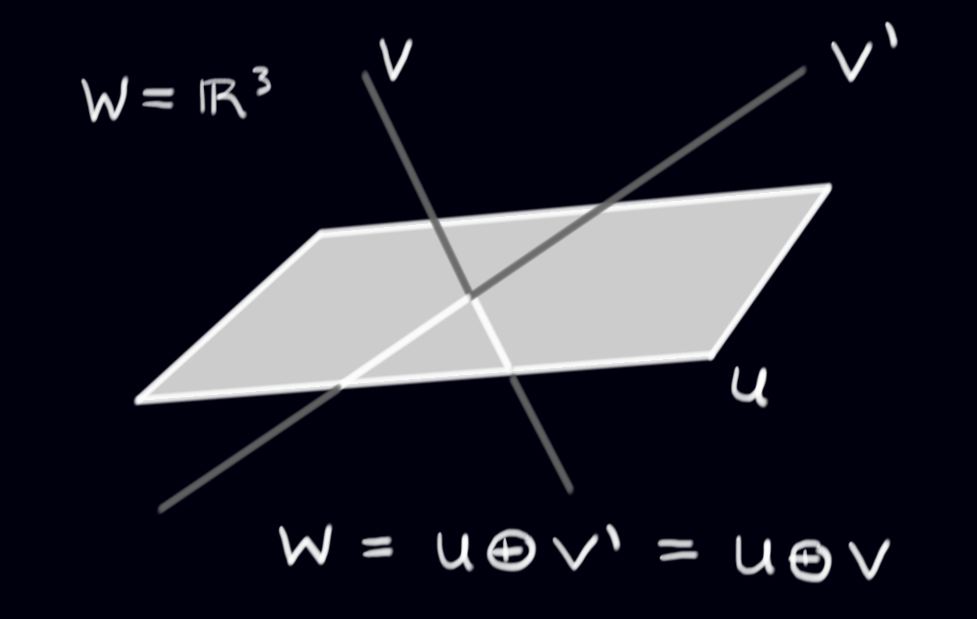
2. Equivalent Characterizations of a Direct Sum
Checking uniqueness for every vector in a sum can be cumbersome. Fortunately, there are more practical, equivalent conditions. The first simplifies the problem by focusing only on the zero vector.
A. The "Zero Test"
Theorem: The sum of subspaces is a direct sum if and only if the only way to write the zero vector as a sum (with ) is by taking every .
Let's quickly prove this, as it's fundamental.
- () If the sum is direct, then by definition every vector has a unique representation. The zero vector is no exception. We know one representation is , where each . Since this representation must be unique, it is the only one.
- () Assume the only representation of is the trivial one. Now, suppose a vector has two representations:
where . Rearranging gives:
Since each is a subspace, . We now have a representation of as a sum of vectors from the . By our assumption, each term must be zero: , which implies for all . Thus, the representation is unique.
This theorem is formally stated in the Axler text.
[PDF] Subspaces - Linear Algebra Done Right
This part of the text states and proves the theorem we just discussed.
Read the theorem under the heading "Condition for a direct sum". The proof in the text is essentially identical to the one outlined above.
B. The Intersection Test for Two Subspaces
The "zero test" is a significant improvement, but for the common case of two subspaces, we can derive an even simpler and more geometric condition.
Theorem: Let and be subspaces of . The sum is a direct sum if and only if their intersection is trivial, i.e., .
This is a powerful result. To check if a sum is direct, we only need to inspect the intersection of the subspaces. The following video provides a rigorous proof of this equivalence.
Oxford Linear Algebra: Direct Sum of Vector Spaces
The presenter in this video from the "Oxford Linear Algebra" series clearly states the two common definitions for a direct sum of two subspaces (the sum with trivial intersection, and unique decomposition) and then proves their equivalence.
Watch the segment from the definitions and proof. The presenter first assumes the intersection is trivial and proves uniqueness. He then proves the converse (which we won't detail here, but it follows similar logic).
Let's recap the core of the proof for the direction:
- Assume .
- We use the "zero test": suppose for some and .
- This implies .
- Since and is a subspace, .
- Therefore, is in both and , so .
- By our assumption, this means .
- Consequently, .
- Since the only representation of is , the sum is direct by our first theorem.
3. Examples in Practice
Let's see this theorem in action. Checking the intersection is a standard procedure when determining if a sum is direct. The next video provides excellent worked examples in .
Oxford Linear Algebra: Direct Sum of Vector Spaces
This video continues with concrete examples, applying the intersection test to determine if certain sums in \mathbb{R}^3 are direct.
First, watch the example from the first example, where two subspaces of \mathbb{R}^3 are defined. The presenter shows that their intersection is a line, not just the origin. Since the intersection is non-trivial, the sum is not direct. Next, watch the more involved example from the second example. Here, the intersection of the two new subspaces is shown to be only the zero vector. This satisfies the condition for a direct sum. The presenter then goes further to show that their sum is indeed all of \mathbb{R}^3, confirming that \mathbb{R}^3 = U \oplus W. This part of the analysis involves finding bases and solving a system of equations, which is a valuable exercise to observe.
4. A Cautionary Tale: Generalizing to Multiple Subspaces
Given the elegance of the condition , one might be tempted to generalize it to multiple subspaces by stating that is direct if and only if the subspaces are pairwise disjoint (i.e., for all ).
This is incorrect.
Pairwise trivial intersection is a necessary condition, but it is not sufficient. A simple counterexample makes this clear.
In this video, Dr. Peyam explains why the naive generalization for direct sums fails and provides the classic counterexample.
Watch the segment from the counterexample. The presenter considers three lines through the origin in \mathbb{R}^2: the x-axis (W_1), the y-axis (W_2), and the line y=x (W_3). Any pair has a trivial intersection, but their sum is not direct. For instance, (1,-1) = (1,0) + (0,-1) + (0,0) and (1,-1) = (0,0) + (0,0) + (1,-1) are two valid non-unique decompositions.
The correct characterization for multiple subspaces is a stronger version of the intersection property.
Theorem: The sum is a direct sum if and only if for each ,
In words, each subspace must have a trivial intersection with the sum of all the other subspaces.
Conclusion
In this lesson, we have added the crucial condition of uniqueness to the sum of subspaces, leading us to the definition of the internal direct sum.
Key Takeaways:
- A sum of subspaces is direct if every vector in the sum has a unique decomposition into components from each subspace.
- This is equivalent to the condition that the only way to represent the zero vector is with zero vectors from each subspace.
- For the special case of two subspaces and , their sum is direct if and only if their intersection is trivial: .
- For more than two subspaces, the condition is stronger: each subspace must have a trivial intersection with the sum of the others.
The concept of decomposing a vector space into a direct sum of subspaces is one of the most powerful ideas in linear algebra. It is the foundation for understanding diagonalizability (decomposing a space into eigenspaces) and the structure of linear operators, concepts with profound implications in quantum mechanics, classical mechanics, and field theory. Direct sums are intimately related to projection operators, which project vectors onto the constituent subspaces. This connection is something we will explore more deeply later in the course.
In the next lesson, we will conclude our first module by introducing a completely different way of constructing a new vector space from an old one: the quotient space.