Hello! Welcome to your seventh lesson.
In our last session, you mastered the two-pointer technique, particularly the "opposite ends" pattern, which is a fantastic way to optimize problems on sorted data. Today, we'll explore a closely related and equally powerful pattern: the Sliding Window Technique.
While it also uses two pointers, they typically move in the same direction to define a "window" or a contiguous sub-section of an array or string. This technique is a cornerstone of efficient algorithm design, especially for interview problems that ask you to find the "best" subarray or substring. Today, you will learn to implement both fixed-size and variable-size sliding windows in Java, transforming potential O(n^2) brute-force solutions into sleek O(n) ones.
1. From Brute Force to an Efficient "Window"
Imagine you're asked to find the maximum sum of any three consecutive elements in an array. The brute-force way would be to calculate the sum of arr[0], arr[1], arr[2], then arr[1], arr[2], arr[3], and so on. Notice the repetitive calculations? The sum of arr[1] and arr[2] is computed in both steps.
The sliding window technique eliminates this redundancy. Instead of recalculating the sum for each new window, we simply "slide" the window one step to the right by:
- Adding the new element that enters the window.
- Subtracting the old element that leaves the window.
This single pass approach is what gives the sliding window its linear time efficiency.
To get a solid conceptual overview, let's watch a video that explains what this technique is, why it's so much better than brute-force, and how to start recognizing problems where it can be applied.
Sliding Window Technique - Algorithmic Mental Models
The video 'Sliding Window Technique - Algorithmic Mental Models' by Ryan Schachte provides a great introduction to this pattern. We'll focus on the core concepts first.
Please watch from the beginning to 06:52. Pay close attention to: The goal of recognizing a 'mental model' rather than memorizing solutions. The distinction between a fixed-size window and a dynamically resizing window (the 'caterpillar' analogy). The comparison of time complexity between the brute-force O(n^2) approach and the sliding window's O(n) approach.
As the video explained, sliding window problems generally fall into two categories, which we'll explore next.
2. Type 1: Fixed-Size Sliding Window
This is the most straightforward variant, used when the problem specifies a fixed window size, k.
Problem: Given an array of integers arr and a number k, find the maximum sum of any contiguous subarray of size k.
The Logic
- Calculate the sum of the first
kelements. This is our initialwindowSumand our initialmaxSum. - Iterate from the
k-th element to the end of the array. - In each step, "slide" the window:
- Add the current element to
windowSum. - Subtract the element that just fell out of the window's left side (i.e.,
arr[i-k]).
- Add the current element to
- Update
maxSumwith the newwindowSumif it's larger.
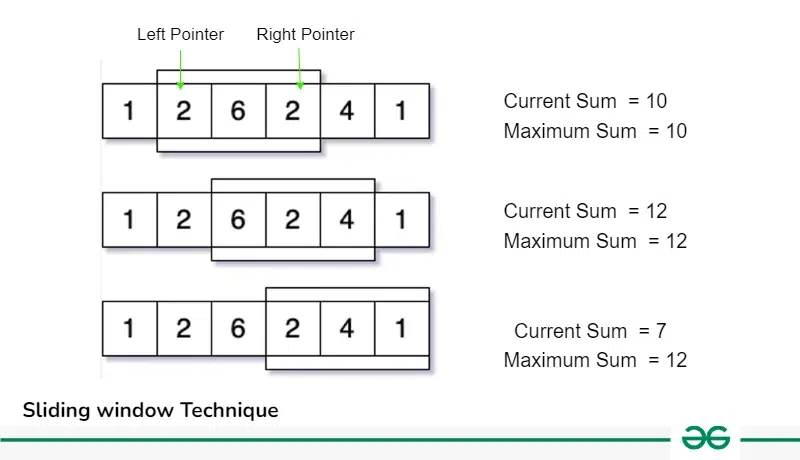
Java Implementation
Let's look at a concise implementation of this logic. The key is the line windowSum += arr[i] - arr[i - k], which performs the slide in a single, efficient operation.
A Complete Beginner-Friendly Guide (with Java Examples)
The article 'A Complete Beginner-Friendly Guide' provides a clean Java implementation for the fixed-size window problem. We'll focus on that code snippet.
Find the section 'Type 1: Fixed-Size Sliding Window'. Read the explanation and study the associated 'Java Code (Fixed-Size Window)' by reviewing the fixed-size pattern. Notice how it first builds the initial window sum and then slides it across the rest of the array.
Here is the code from the article for your reference:
public int maxSumSubarray(int[] arr, int k) {
    int windowSum = 0;

    // Sum of the first k elements (initial window)
    for (int i = 0; i < k; i++) {
        windowSum += arr[i];
    }

    int maxSum = windowSum;

    // Slide the window from k to the end of the array
    for (int i = k; i < arr.length; i++) {
        // Add the new element and remove the old one
        windowSum += arr[i] - arr[i - k];
        maxSum = Math.max(maxSum, windowSum);
    }

    return maxSum;
}
Test your understanding!
How would you modify the maxSumSubarray function to find the subarray of size k with the maximum average instead of the maximum sum?
Show answer
You actually don't need to change the core logic at all! Since the window size k is constant, the subarray with the maximum sum will also have the maximum average. You would find the maxSum exactly as before and then simply return (double)maxSum / k at the end of the function.
3. Type 2: Variable-Size Sliding Window
This variant is more dynamic and powerful. The window expands and shrinks based on a condition. It doesn't have a fixed size k. Instead, you're usually looking for the longest or shortest subarray that satisfies a property.
Problem: Given an array of positive integers arr and a target integer S, find the length of the smallest contiguous subarray whose sum is greater than or equal to S.
The Logic
We use two pointers, left and right, to define the window's boundaries.
- Initialize
left = 0,windowSum = 0, andminLength = infinity. - Expand the window by moving the
rightpointer forward, addingarr[right]towindowSum. - Once
windowSum >= S, we have a potential answer!- Record its length (
right - left + 1). - Now, try to get a better (smaller) answer. Shrink the window from the left by subtracting
arr[left]fromwindowSumand incrementingleft. - Keep shrinking as long as
windowSumis still>= S.
- Record its length (
- Repeat until
rightreaches the end of the array.
Java Implementation
This pattern typically involves a for loop for the right pointer (to expand) and a nested while loop for the left pointer (to shrink).
A Complete Beginner-Friendly Guide (with Java Examples)
Let's return to the 'A Complete Beginner-Friendly Guide' to see the Java code for a variable-size window.
Locate the section 'Type 2: Variable-Size Sliding Window'. Read and analyze the variable window approach, including the 'Java Code (Variable Window)'. Focus on how the for loop expands the window and the while loop shrinks it once the condition is met.
The code demonstrates this expand-and-shrink logic perfectly:
public int smallestSubarrayWithSum(int[] arr, int target) {
    int left = 0, windowSum = 0, minLength = Integer.MAX_VALUE;

    for (int right = 0; right < arr.length; right++) {
        // Expand the window to the right
        windowSum += arr[right];

        // While the condition is satisfied, shrink the window from the left
        while (windowSum >= target) {
            minLength = Math.min(minLength, right - left + 1);
            windowSum -= arr[left];
            left++;
        }
    }

    return minLength == Integer.MAX_VALUE ? 0 : minLength;
}
4. Sliding Windows with Auxiliary Data Structures
For more complex problems, you might need to track more than just a sum. A common scenario involves tracking the frequency of elements or the number of unique elements within the window. This is where you can combine the sliding window pattern with a HashMap or a HashSet.
Problem: Given a string s and an integer k, find the length of the longest substring with at most k distinct characters.
The logic is similar to the variable-size window, but our condition for shrinking is based on the size of a HashMap that stores character frequencies.
A Complete Beginner-Friendly Guide (with Java Examples)
The same guide provides an excellent example of this advanced pattern.
Read the section 'Sliding Window with Frequency Map' and review its explanation and Java code. Observe how the HashMap is used to track distinct characters and how the window shrinks when freq.size() > k.
This pattern is extremely common in interviews for problems involving strings and character counts.
5. How to Spot Sliding Window Problems
Since your goal is to excel in technical interviews, recognizing when to apply a pattern is as important as knowing how to implement it.
A Complete Beginner-Friendly Guide (with Java Examples)
To wrap up, let's focus on the 'interview mindset'. The article we've been using has a fantastic section dedicated to the thought process you should follow.
Please read the section titled 'How to Think During Interviews'. This checklist is a powerful tool for quickly identifying sliding window problems under pressure.
Key Heuristics:
- Input: The problem involves an array or string.
- Contiguous: It asks for a subarray or substring (implying elements are next to each other).
- Optimization: It asks for a
min,max,longest,shortest, orcountof something. - Brute-Force Hint: Your initial thought involves nested loops, which would be
O(n^2)or worse.
Conclusion
You've now added another essential algorithmic pattern to your arsenal. The sliding window technique is a powerful optimization that elegantly solves a wide range of problems involving contiguous data. By understanding its fixed and variable-size forms, you are well-equipped to tackle many common questions in competitive programming and technical interviews.
Key Takeaways:
- The Sliding Window Technique optimizes problems on contiguous subarrays/substrings from a brute-force
O(n^2)to an efficientO(n). - Fixed-Size Windows are used when the subarray length
kis given. The window is updated by adding the new element and subtracting the old one. - Variable-Size Windows are used to find the longest/shortest subarray that meets a condition. They expand from the right and shrink from the left when the condition is met (or violated).
- Auxiliary data structures like a HashMap can be used within the window to track complex states, such as character frequencies.
Preview of the next lesson:
In our next lesson, we will step back from algorithmic patterns slightly to cover a practical and essential topic for any Java programmer in a competitive context: using Java's built-in sorting methods like Arrays.sort() and Collections.sort(). We'll discuss how they work under the hood (their time complexity) and when to use them for maximum efficiency.