Hello! Welcome to the first lesson of our new module on Stacks, Queues, and Deques.
In the last module, you mastered linked lists, right up to advanced manipulation using dummy nodes. Those skills, particularly your comfort with Node objects and pointer manipulation, will be very useful today.
This lesson kicks off our exploration of abstract data types that are fundamental to countless algorithms. We'll start with the stack. Your learning outcome is to implement a stack using both an array and a linked list. This is a classic interview task that tests your understanding of data structures from first principles. We'll build both versions from scratch, analyze their trade-offs, and set the stage for using stacks to solve problems.
1. The Stack: A Last-In, First-Out (LIFO) Data Structure
A stack is an Abstract Data Type (ADT) that follows a simple but powerful principle: Last-In, First-Out (LIFO). Think of a stack of plates: the last plate you place on top is the first one you take off.

The core operations of a stack are:
push(item): Adds an item to the top of the stack.pop(): Removes and returns the item from the top of the stack.peek()(ortop()): Returns the top item without removing it.isEmpty(): Checks if the stack contains any elements.size(): Returns the number of elements in the stack.
To formalize this, let's look at how a Stack interface can be defined in Java. It's good practice to use generics (<T>) to make our stack type-safe, allowing it to hold any type of object without messy casting.
The lecture notes 'Lists, Stacks, and Queues' from Harvard University provide a formal definition of the Stack ADT and introduce a generic interface in Java. This sets a clear contract for what our implementations must provide.
Read the sections 'Stack ADT' and 'Limiting a Stack to Objects of a Given Type'. Focus on understanding the purpose of each operation in the Stack<T> interface. This defines the 'what' before we dive into the 'how'.
2. Implementation 1: Using an Array
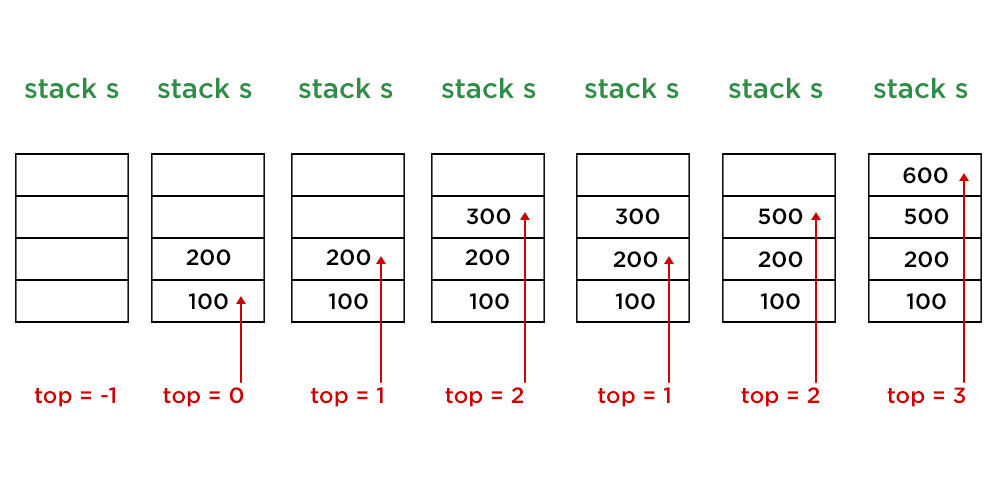
Our first implementation will use an array. The idea is to use an array to store the elements and an integer variable, let's call it top, to keep track of the index of the most recently added element.
Here's the logic:
- Initialization: We create an array of a certain capacity and initialize
top = -1to signify that the stack is empty. - Push: To push an element, we increment
topand then place the new element atarray[top]. We must first check if the stack is full (i.e., iftopis already at the last index). This is known as a stack overflow condition. - Pop: To pop an element, we retrieve the element at
array[top]and then decrementtop. We must first check if the stack is empty (i.e., iftop == -1). Attempting to pop from an empty stack is a stack underflow condition.
The following video provides an excellent visual demonstration of this process.
Implementation of Stack using Arrays
The video 'Implementation of Stack using Arrays' by take U forward clearly visualizes how the top index moves during push and pop operations.
Watch from 01:53 to 04:27. Pay close attention to how the top variable is initialized to -1 and how it changes with each push and pop operation.
Java Implementation (Array-based)
Here is a complete, generic implementation in Java based on the principles we've discussed.
import java.util.EmptyStackException;

public class ArrayStack<T> {
    private T[] arr;
    private int top;
    private static final int DEFAULT_CAPACITY = 10;

    @SuppressWarnings("unchecked")
    public ArrayStack(int capacity) {
        // Java doesn't allow direct creation of generic arrays.
        // This is a standard workaround.
        arr = (T[]) new Object[capacity];
        top = -1;
    }

    public ArrayStack() {
        this(DEFAULT_CAPACITY);
    }

    // Pushes an element onto the top of the stack. O(1)
    public void push(T element) {
        if (top == arr.length - 1) {
            // In a real-world scenario, you might resize the array here.
            // For this implementation, we'll consider it a fixed-capacity stack.
            throw new StackOverflowError("Stack is full");
        }
        top++;
        arr[top] = element;
    }

    // Removes and returns the element at the top of the stack. O(1)
    public T pop() {
        if (isEmpty()) {
            throw new EmptyStackException();
        }
        T element = arr[top];
        arr[top] = null; // Help garbage collection
        top--;
        return element;
    }

    // Returns the element at the top of the stack without removing it. O(1)
    public T peek() {
        if (isEmpty()) {
            throw new EmptyStackException();
        }
        return arr[top];
    }

    // Returns true if the stack is empty. O(1)
    public boolean isEmpty() {
        return top == -1;
    }

    // Returns the number of elements in the stack. O(1)
    public int size() {
        return top + 1;
    }
}
The key advantage of the array implementation is its efficiency. All operations (push, pop, peek, isEmpty, size) are constant time, O(1). The main disadvantage is its fixed size. If you fill the array, you either get an overflow or have to perform a costly resize operation (creating a new, larger array and copying all elements, which is O(n)).
3. Implementation 2: Using a Linked List
Now, let's address the fixed-size limitation by using a linked list. This should feel familiar after your work in the previous module. The head of our linked list will serve as the top of our stack.
Here's the logic:
- Initialization: We have a single reference,
top, which initially points tonull. - Push: To push a new element, we create a new
Node. We set this new node'snextpointer to the currenttopnode, and then we updatetopto be this new node. This is identical to adding an element to the front of a singly linked list. - Pop: To pop, we simply move the
toppointer to the next node in the list (top = top.next). The oldtopnode is now disconnected and will be garbage collected. We must handle the underflow case wheretopisnull.
Let's watch a video that walks through this implementation.
Stack Implementation - Linked List
The video 'Stack Implementation - Linked List' by Blue Tree Code provides a concise explanation and code walkthrough for building a stack with a linked list.
Watch from 00:49 to 05:40. This covers the visual logic of push/pop, the Node and Stack class structure, and the Java code for each core operation.
Test your understanding!
When implementing a stack with a linked list, why is it more efficient to use the head of the list as the top of the stack, rather than the tail?
Show answer
Operations on the head of a singly linked list (insertion and deletion) are O(1) because we only need to update the head reference.
If we used the tail as the top of the stack:
- Push (add to tail): Would require traversing the entire list to find the last node, making it an O(n) operation unless we also maintained a separate
tailpointer. - Pop (remove from tail): Would require traversing the list to find the node before the tail to update its
nextpointer, which is also an O(n) operation.
Using the head ensures all core stack operations remain O(1).
Java Implementation (Linked List-based)
Here is a complete, generic implementation using a linked list. Notice how it naturally handles dynamic sizing.
import java.util.EmptyStackException;

public class LinkedListStack<T> {

    private class Node {
        T data;
        Node next;

        Node(T data) {
            this.data = data;
        }
    }

    private Node top;
    private int size;

    public LinkedListStack() {
        top = null;
        size = 0;
    }

    // Pushes an element onto the top of the stack. O(1)
    public void push(T element) {
        Node newNode = new Node(element);
        newNode.next = top;
        top = newNode;
        size++;
    }

    // Removes and returns the element at the top of the stack. O(1)
    public T pop() {
        if (isEmpty()) {
            throw new EmptyStackException();
        }
        T element = top.data;
        top = top.next;
        size--;
        return element;
    }

    // Returns the element at the top of the stack without removing it. O(1)
    public T peek() {
        if (isEmpty()) {
            throw new EmptyStackException();
        }
        return top.data;
    }

    // Returns true if the stack is empty. O(1)
    public boolean isEmpty() {
        return top == null;
    }

    // Returns the number of elements in the stack. O(1)
    public int size() {
        return size;
    }
}
Like the array version, all operations are O(1). The major advantage is that the stack can grow and shrink dynamically without any expensive resizing operations. The trade-off is slightly higher memory usage, as each element requires a Node object which stores both the data and a next reference.
4. Comparing the Implementations
Both implementations are valid and efficient, but they are suited for different scenarios. Your choice depends on whether you know the maximum size of your data beforehand and how you want to manage memory.
| Feature | Array-based Stack | Linked List-based Stack |
|---|---|---|
| Size | Fixed (or requires O(n) resizing) | Dynamic, grows and shrinks as needed |
push() Time |
O(1) | O(1) |
pop() Time |
O(1) | O(1) |
| Memory Usage | Lower overhead per element. Potentially wasteful if over-allocated. | Higher overhead per element (for next pointers). |
| Memory Locality | Excellent (contiguous memory), cache-friendly. | Poor (nodes can be scattered in memory). |
| Key Limitation | Stack Overflow | No inherent overflow; limited only by system memory. |
In practice, for competitive programming and general use in Java, java.util.ArrayDeque is often preferred over the legacy java.util.Stack class (which is Vector-based and synchronized) when a stack implementation is needed. However, understanding how to build one from scratch is a crucial skill.
Conclusion
Great work! You have successfully learned how to implement one of the most fundamental data structures, the stack, using two different approaches.
Key Takeaways:
- A stack is a LIFO (Last-In, First-Out) data structure with
push,pop, andpeekas its main operations. - An array-based stack is fast and memory-efficient but has a fixed size, leading to potential overflow. It uses an index
topto manage the stack. - A linked-list-based stack is dynamic and flexible, avoiding overflow issues. It uses a
top(orhead) reference to manage the stack by adding and removing nodes from the front of the list. - Both implementations provide O(1) time complexity for all core operations. The choice between them involves a trade-off between memory management (fixed vs. dynamic) and performance characteristics (cache locality).
Preview of the next lesson:
Now that you can build a stack, it's time to use it. In the next lesson, we will solve the classic "balanced parentheses" problem. It's a perfect first application that showcases the power of the stack's LIFO property and is a very common question in technical interviews.