Hello! Welcome back to our module on linked lists.
In our last lesson, we saw how clever pointer manipulation could solve the problem of finding the intersection of two linked lists with optimal space. Today, we'll continue building on that theme of efficient pointer-based algorithms to tackle another fundamental problem.
Your learning outcome for this lesson is to merge two sorted linked lists iteratively. This is a classic interview question and a core component of more advanced algorithms like merge sort for linked lists. We'll focus on an elegant, iterative solution that is both efficient and easy to implement once you grasp the key idea.
1. The Merging Problem
The task is straightforward: you are given the heads of two linked lists, both sorted in non-decreasing order. Your goal is to merge them into a single, sorted linked list. The new list should be created by "splicing" together the nodes from the original two lists.
For example, given:
list1: 5 -> 10 -> 15list2: 2 -> 3 -> 20
The merged list should be:
result: 2 -> 3 -> 5 -> 10 -> 15 -> 20
A key constraint, crucial for interviews, is that we should aim to do this in-place, meaning we should rearrange the next pointers of the existing nodes rather than creating a new node for every single element. This is what allows for an space solution.
2. The Iterative Approach and a Common Hurdle
The basic logic seems simple. We can maintain two pointers, one at the head of each list, say p1 and p2.
- Compare the values at
p1andp2. - The node with the smaller value becomes the next node in our merged list.
- We then advance the pointer of the list from which we took the node.
- We repeat this process until one of the lists is fully traversed.
This sounds good, but there's a practical hurdle: how do we manage the head of the new merged list? The first node of our result could come from list1 or list2. Handling this as a special "if" condition at the beginning makes the code clunky. We would need to write separate logic to initialize the head and then a loop to handle the rest.
This is where a powerful and common linked list pattern comes into play: the dummy node.
3. The Elegant Solution: Using a Dummy Node
A dummy node (or sentinel node) is a placeholder that we place at the very beginning of our result list. It doesn't hold any meaningful data itself, but it acts as a fixed starting point. This completely eliminates the need to handle the head of the list as a special case.
Here is the refined algorithm:
- Create a
dummynode. This can benew Node(-1)or any other placeholder value. - Create a
currentpointer and initialize it to point to thedummynode. Thiscurrentpointer will always track the last node in our merged list, making it easy to append the next one. - Iterate as long as both
list1andlist2are notnull:- If
list1.data <= list2.data, we appendlist1to our merged list by settingcurrent.next = list1. Then, we advancelist1to its next node. - Otherwise, we append
list2by settingcurrent.next = list2. Then, we advancelist2. - Crucially, after appending, we must also advance our
currentpointer to the node we just added (current = current.next).
- If
- Once the loop finishes, one of the lists is exhausted. The other list might still contain nodes. Since that list is already sorted, we can simply append its entire remaining part to the end of our merged list.
- Finally, the head of the truly merged list is
dummy.next. We return this.
The following image provides a great step-by-step visualization of this process.
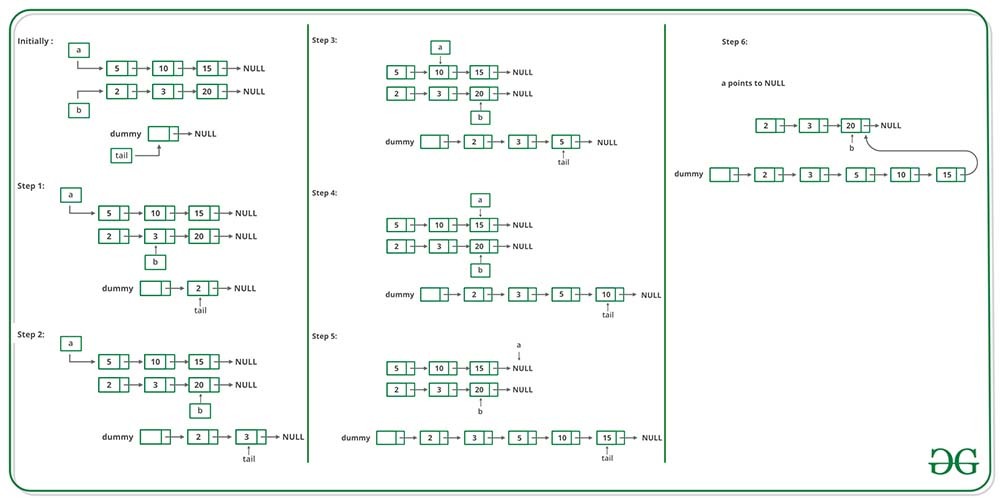
To see this logic explained and implemented in code, the following video is an excellent resource.
Merge Two Sorted Lists | Live Coding with Explanation | Leetcode #21
This video, 'Merge Two Sorted Lists' from Algorithms Made Easy, provides a concise walkthrough of the problem, the dummy node logic, the Java implementation, and a complexity analysis.
Please watch the entire video (around 4 minutes). It covers the entire process from theory to code.
4. Java Implementation and Analysis
The dummy node approach leads to very clean and concise code. Let's look at a textual reference that provides a clear implementation.
Merge two sorted lists (in-place)
The GeeksforGeeks article 'Merge two sorted lists (in-place)' presents a clear explanation and a well-structured Java implementation of this technique.
Read the 'Approach' section to reinforce the logic, then examine the Java code provided in the implementation section. Finally, review the time and space complexity analysis.
The core of the logic, which you'll find in the resources, looks like this:
// Assume a ListNode class is defined
class Solution {
    public ListNode mergeTwoLists(ListNode list1, ListNode list2) {
        // 1. Create a dummy node to act as the starting point.
        ListNode dummy = new ListNode(-1);

        // 2. Create a 'current' pointer to build the new list.
        ListNode current = dummy;

        // 3. Loop while both lists have nodes.
        while (list1 != null && list2 != null) {
            if (list1.val <= list2.val) {
                current.next = list1; // Append node from list1
                list1 = list1.next;   // Move list1's pointer
            } else {
                current.next = list2; // Append node from list2
                list2 = list2.next;   // Move list2's pointer
            }
            current = current.next;   // Move the current pointer forward
        }

        // 4. At least one list is now null. Append the remaining non-null list.
        if (list1 != null) {
            current.next = list1;
        } else {
            current.next = list2;
        }

        // 5. The merged list starts after the dummy node.
        return dummy.next;
    }
}
Complexity Analysis
- Time Complexity: , where and are the number of nodes in
list1andlist2, respectively. We must traverse every node in both lists once to construct the merged list. - Space Complexity: . This is a major advantage. We only use a few extra pointers (
dummy,current). We are not allocating new memory for the list's nodes; we are simply rearranging the pointers of the existing ones. This is exactly what interviewers look for in an optimal solution.
Test your understanding!
Given the following two lists:list1: 10 -> 20list2: 5 -> 15 -> 25
Trace the first two iterations of the while loop. What will the list pointed to by dummy look like, and what nodes will list1, list2, and current point to?
Show answer
Initial State:
dummy->[-1]current->[-1]list1->[10]list2->[5]
After Iteration 1:
- Compare
10and5.5is smaller. current.nextis set tolist2.list2advances to[15].currentadvances to the node it just attached.- State:
dummy->[-1]->[5]current->[5]list1->[10]list2->[15]
After Iteration 2:
- Compare
10and15.10is smaller. current.nextis set tolist1.list1advances to[20].currentadvances.- State:
dummy->[-1]->[5]->[10]current->[10]list1->[20]list2->[15]
Conclusion
Great job! You've now mastered another essential linked list algorithm. This problem is a perfect example of how a simple pattern can significantly simplify your code and help you avoid tricky edge cases.
Key Takeaways:
- Merging two sorted lists can be done efficiently with an iterative, two-pointer approach.
- The dummy node is a fundamental technique for linked list problems involving list construction. It provides a stable anchor point, simplifying the logic for handling the list's head.
- The optimal iterative solution achieves time complexity and, importantly, auxiliary space complexity.
Preview of the next lesson:
In this lesson, we saw how a dummy node tidied up our merging logic. This pattern is so useful that it deserves its own focus. In the next lesson, we will explore how to apply the dummy node technique as a general-purpose tool to simplify other linked list manipulation problems, such as removing nodes that meet specific criteria.