Welcome to our third lesson in this introductory module. In our previous sessions, we have constructed the architecture of the Jim Crow South, first by outlining its legal framework of segregation and disenfranchisement, and then by examining the economic system of sharecropping that trapped millions in debt and poverty. We now arrive at a crucial question: What held this unjust structure in place?
If laws were the skeleton and economics the muscle, the subject of today's lesson—extra-legal violence—was the nervous system, transmitting fear and enforcing compliance. In this lesson, we will explore the role of racial terror, particularly the phenomenon of lynching, in maintaining the South's rigid racial hierarchy. Understanding this brutal reality is not just a historical exercise; it is essential for comprehending the atmosphere of constant, ambient threat that permeates Richard Wright's childhood world in Black Boy.
A Reign of Terror
The period after the Civil War and Reconstruction did not bring peace. Instead, it saw a violent backlash from white society determined to "redeem" the South and re-establish total dominance. This wasn't the act of a lawless fringe; it was a widespread, often community-endorsed campaign of terror aimed at undoing the gains of emancipation. Paramilitary groups, most famously the Ku Klux Klan, rose to enforce a new racial order through brutality and intimidation.
The Equal Justice Initiative (EJI) has produced a landmark report on this era. We will begin by reading a section that details this post-war backlash and the re-imposition of white supremacy through violence.
Lynching in America: Confronting the Legacy of Racial Terror
This first reading from the EJI report provides the essential historical context for our topic. It explains how organized white supremacist groups emerged after the Civil War to suppress Black political and economic progress through a coordinated campaign of violence.
Please read the section titled WHITE BACKLASH. As you read, notice how political events, like elections, and economic competition were often the catalysts for mass violence. Pay attention to the description of the Ku Klux Klan, not as an extremist fringe group, but as an organization that drew members from every level of white society.
This campaign of violence was not a temporary phase. It evolved into a permanent feature of Southern life, a system of control that became known as lynching.
Lynching as a Tool of Racial Control
Between 1877 and 1950, nearly 4,000 African American men, women, and children were lynched in the United States, overwhelmingly in the South. The map below, produced in 1919, illustrates the terrifying geography of this violence.
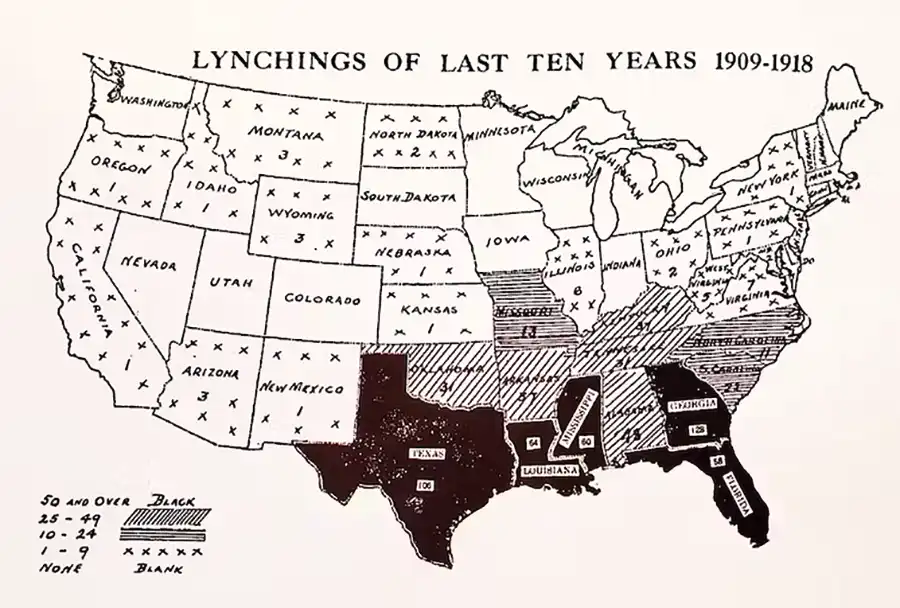
It is crucial to understand that these lynchings were not a form of "frontier justice" in places where law and order were absent. As the EJI report explains, they were acts of terror that took place in communities with fully functioning legal systems—systems that were simply not applied to protect Black citizens or punish their murderers.
We will now read another section from the EJI report which distinguishes Southern racial terror lynching from other forms of mob violence and explains its specific function.
Lynching in America: Confronting the Legacy of Racial Terror
This reading defines the central concept of our lesson: "terror lynchings." It explains how these acts differed from other forms of violence and were used specifically to maintain racial subordination.
First, read the introduction, which defines terror lynchings and outlines their lasting impact. Then, read the section LYNCHING IN AMERICA, which traces the evolution of lynching into a tool of racial control, highlighting its increasing brutality and exclusive focus on African Americans.
In the following video, Bryan Stevenson, the founder of the Equal Justice Initiative, eloquently explains how this system of terror was allowed to flourish and what its primary purpose was.
As Study Finds 4,000 Lynchings in Jim Crow South, Will U.S. Address Legacy of Racial Terrorism?
In this clip, Bryan Stevenson discusses the political and social dynamics that enabled the era of lynching. His explanation powerfully reinforces the key points from the EJI report.
Please watch the segment from this point. Listen for his explanation of how violence was essential to enforce white supremacy and how lynchings were aimed not at punishing crime, but at "keeping black people in their place."
The "Logic" of Terror: Pretexts and Spectacles
The effectiveness of lynching as a tool of social control lay in its terrifying arbitrariness. While accusations of serious crimes like murder or rape were common pretexts, many victims were killed for what were deemed "minor social transgressions." An African American could be lynched for arguing with a white man, bumping into a white woman on the sidewalk, or failing to show what a white person considered proper deference. This unpredictability ensured that all Black people lived with a pervasive sense of fear.
Many lynchings were not secret acts conducted under the cover of darkness. They were public spectacles, advertised in newspapers and attended by large crowds of white men, women, and children. These were ritualized murders designed to send a message of terror to the entire Black community.

The next reading from the EJI report details the various "reasons" given for lynchings and describes the horrific reality of these public spectacles. Please be aware that the content is graphic and disturbing.
Lynching in America: Confronting the Legacy of Racial Terror
This section categorizes the wide range of alleged offenses that triggered lynchings and describes in detail the phenomenon of spectacle lynching. It is a difficult but essential part of understanding the reality of racial terror.
Please read the following four short sections: FEAR OF INTERRACIAL SEX, MINOR SOCIAL TRANSGRESSIONS, PUBLIC SPECTACLE LYNCHINGS, and TARGETING THE ENTIRE COMMUNITY. These sections demonstrate the horrifying scope of the violence, from fabricated sexual assaults to accidental bumps on the sidewalk, and the ways in which mobs used these killings to intimidate and control entire populations.
The Shadow of the Gallows in Black Boy
This constant, looming threat of violence is the backdrop for every moment of Richard Wright's life in Black Boy. The terror was not just in the acts themselves, but in the psychological climate they created. It was in the stories whispered from one person to another, the casual way a white person could threaten a Black person's life, and the ever-present knowledge that any misstep could be fatal.
An academic paper on racial discrimination in Black Boy helps us connect this historical context directly to Wright's own words and experiences.
[PDF] Racial Discrimination Against the Black Community in Richard ...
This final reading explicitly connects the historical reality of lynching to its portrayal and psychological impact in Wright's autobiography.
First, read the paragraph in the "SYSTEMIC RACISM" section that begins here. Note Wright's powerful metaphor of fear flowing in "interminable waves." Then, read the section titled THE ROLE OF VIOLENCE. The quote from Wright about lynchings serving as a "continued warning" perfectly encapsulates the purpose of this form of terror.
As Wright so powerfully articulates, the violence did not have to be directly experienced to be effective. The stories, the rumors, and the visible powerlessness of his community in the face of this brutality were enough to enforce the racial hierarchy. The fear it generated was a constant companion, shaping his interactions, limiting his ambitions, and ultimately fueling his desire to escape.
Conclusion
In this lesson, we have confronted the most brutal enforcement mechanism of the Jim Crow system. We have learned that extra-legal violence, especially lynching, was far from random. It was a calculated and systematic tool of racial terror.
Here are the key takeaways:
- Extra-legal violence was a deliberate strategy used by white Southerners to "redeem" the South after Reconstruction and re-establish white supremacy.
- Lynching was not about crime control; it was a tool of racial control, often targeting individuals for minor social "transgressions" to terrorize the entire Black community.
- "Spectacle lynchings" were public, ritualized events that implicated the entire white community and served to dehumanize African Americans.
- For Richard Wright and millions of others, the constant threat of this violence created a psychological climate of fear that defined daily life and enforced the boundaries of the racial hierarchy.
We have now examined the legal, economic, and violent structures of the Jim Crow South. These oppressive forces, however, did not go unchallenged. They sparked a monumental demographic shift in American history. In our next lesson, we will explore the Great Migration, the mass movement of millions of African Americans—including, eventually, Richard Wright—from the rural South to the cities of the North, fleeing the very terror we have discussed today.