Hello! Welcome to your sixth lesson in our Object-Oriented Programming module.
In our last lesson, we dove into the world of polymorphism and Python's flexible "duck typing" approach. We saw that focusing on an object's behavior rather than its type allows for incredibly versatile code. However, this flexibility can sometimes be a double-edged sword. What if you need to guarantee that a set of classes all share a common structure?
This is where Abstract Base Classes (ABCs) come in. Today, you will learn to use abstract base classes to enforce interface contracts. We'll explore how ABCs provide a way to define a formal "blueprint" that subclasses are required to follow, blending Python's dynamic nature with the kind of structural rigor you might be familiar with from other programming paradigms.
This lesson will cover:
- The definition of abstract classes and abstract methods.
- Why and when to use ABCs to enforce a common interface.
- The syntax for creating and using ABCs with Python's
abcmodule. - Practical applications, including their use in Python's standard library and in designing machine learning systems.
From Informal Protocols to Formal Contracts
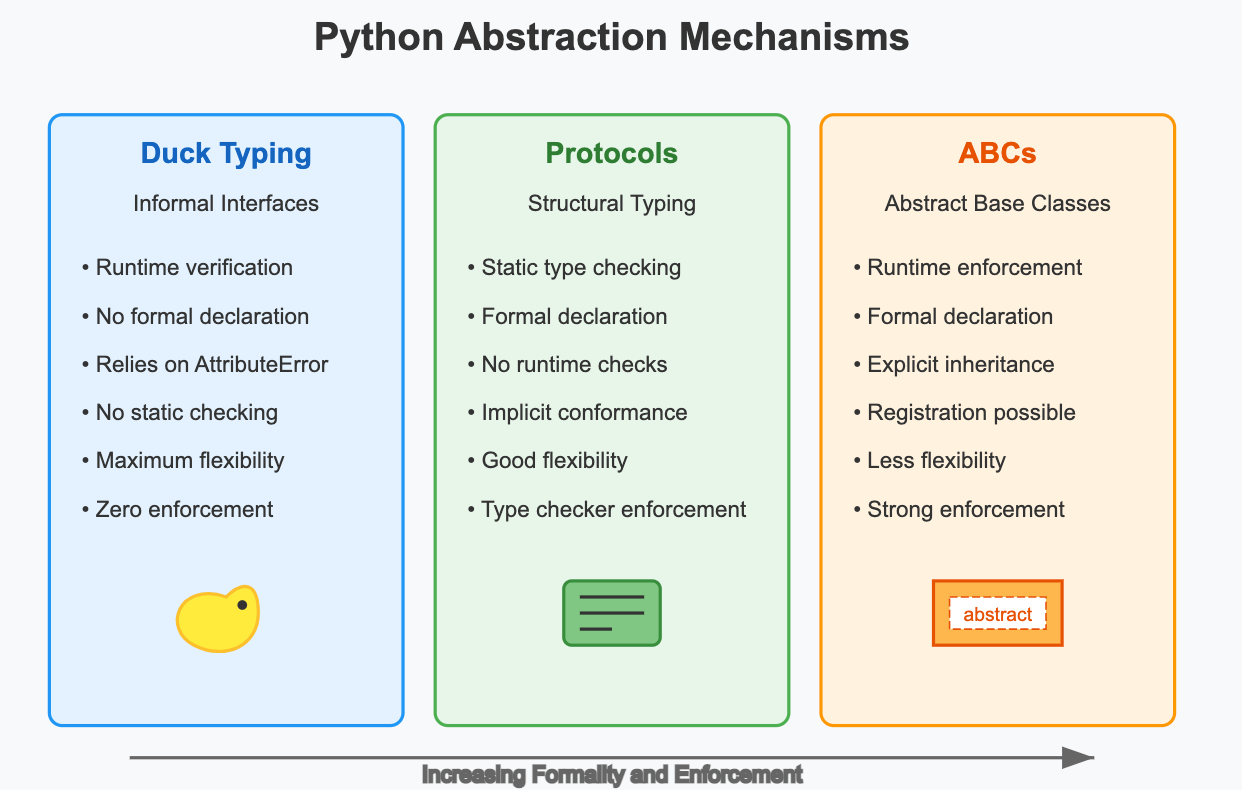
In the previous lesson, we saw how duck typing relies on informal "protocols," like implementing __len__ to work with len(). This is powerful, but it has a key limitation: there is no formal declaration of intent, and errors (like a missing method) are only caught when you try to use that method at runtime.
Abstract Base Classes provide a solution. They act as a formal contract. When a class inherits from an ABC, it agrees to fulfill that contract by implementing all the required methods.
Think of an ABC as an architectural blueprint for a house. You can't live in the blueprint itself (you can't instantiate an abstract class), but any builder who wants to construct a house from it must include certain essential features like walls and a roof (subclasses must implement the abstract methods).
Mastering Abstract Classes in Python
To start, let's get a clear definition of what an abstract class is and why it's a crucial tool for robust software design. This article provides a concise and excellent explanation.
Read the sections 'What is an Abstract Class?' and 'Why Do We Need Abstract Classes?'. Focus on the primary benefit: 'Enforcing a Consistent Interface'.
As the article highlights, the key benefit of ABCs is that they fail early. Instead of your program crashing at runtime because a method is missing, Python will raise a TypeError the moment you try to create an instance of an incomplete subclass. This makes your code more predictable and easier to debug.
Creating an Abstract Base Class
Python's built-in abc module provides the tools we need. To create an ABC, you:
- Import
ABCandabstractmethodfrom theabcmodule. - Make your class inherit from
ABC. - Use the
@abstractmethoddecorator on any method that you want to declare as part of the contract.
Let's see a practical example of creating a system for handling different file types.
Elegant Abstractions: Mastering ABCs in Advanced Python
This article, 'Elegant Abstractions', demonstrates how to refactor a simple class hierarchy into a more robust one using ABCs. It clearly shows the 'before' and 'after' and illustrates why the ABC approach is superior.
Read the sections 'Initial Version: Simple but Not Rigorous Enough' and 'Improved Version: Using Abstract Base Classes'. Pay close attention to the code example where LeapCellBrokenHandler fails to instantiate because it's missing the write method. This is the contract enforcement in action.
This enforcement is what we mean by an "interface contract." The LeapCellFileHandler ABC promises that any of its non-abstract subclasses will have a read and a write method.
Test your understanding!
You are designing a system to fetch data for a machine learning model. The data could come from a file on disk or from a web API. You want to ensure that any data-fetching class you create has a consistent interface.
Define an abstract base class called DataProvider with one abstract method, fetch_data(), that takes no arguments. Then, create a concrete class FileProvider that inherits from DataProvider and implements the method to return the string "Fetching data from file...".
What would happen if you then tried to execute api_provider = ApiProvider() with the following incomplete class definition?
class ApiProvider(DataProvider):
    def connect_to_api(self):
        print("Connecting...")
Show answer
First, here is the correct implementation of the ABC and the FileProvider class:
from abc import ABC, abstractmethod

# 1. Define the Abstract Base Class
class DataProvider(ABC):
    @abstractmethod
    def fetch_data(self):
        """Fetches data and returns it."""
        pass

# 2. Create a concrete implementation
class FileProvider(DataProvider):
    def fetch_data(self):
        return "Fetching data from file..."

# This works perfectly fine
file_provider = FileProvider()
print(file_provider.fetch_data())
If you tried to instantiate the incomplete ApiProvider class:
class ApiProvider(DataProvider):
    def connect_to_api(self):
        print("Connecting...")

# This line would raise an error
# api_provider = ApiProvider()
Python would raise a TypeError with a message like: TypeError: Can't instantiate abstract class ApiProvider with abstract method fetch_data. This happens because ApiProvider failed to fulfill the contract set by DataProvider by not implementing the fetch_data method.
ABCs in the Python Standard Library: collections.abc
One of the most powerful uses of ABCs is for creating custom container types, like your own list or dictionary. The collections.abc module provides a set of ABCs (Sequence, MutableMapping, Set, etc.) that serve as blueprints for Python's fundamental collections.
When you inherit from one of these, you get two major benefits:
- Flexible Type Hinting: You can write functions that accept any "dictionary-like" object by type-hinting a parameter as
collections.abc.Mappinginstead of the more restrictivedict. - Mixin Methods: The ABC provides default implementations for many common methods. For example, if you inherit from
MutableMappingand implement just 5 required abstract methods (__getitem__,__setitem__,__delitem__,__iter__, and__len__), you get methods likekeys(),values(),pop(), andclear()for free!
This video provides an excellent, in-depth look at how this works by building a custom InvertibleDict.
Python's collections.abc | InvertibleDict
This mCoding video is a fantastic practical dive into collections.abc. It demonstrates both the type-hinting use case and the power of mixin methods by building a complex and useful custom class.
Watch from 02:26 to 04:04 to understand how using MutableMapping for type hints improves code flexibility. Then, watch the detailed implementation of InvertibleDict from 05:37 to 11:45. Focus on how implementing just five core methods allows the class to behave like a full-featured dictionary.
Application to Machine Learning Pipelines
Your goal is to become proficient in machine learning, and ABCs are a common pattern in well-designed ML frameworks. They are used to ensure that different models, data preprocessors, or evaluation components can be swapped in and out seamlessly because they all adhere to the same interface.
For example, you could define a BaseModel ABC that requires all models to have a .train() and a .predict() method.
The following reading shows a practical example of using an ABC to define a base for an ML pipeline.
Mastering Abstract Classes in Python
Let's return to the 'Mastering Abstract Classes' article to see a direct application of ABCs in a machine learning context. This connects today's topic directly to your long-term goals.
Read the section 'Real-World Use Case: ML Pipeline with Mixins'. Notice how the BaseMLPipeline ABC enforces a run_pipeline method, ensuring any model built on this framework has a consistent entry point.
Conclusion
Today we've moved from the informal world of duck typing to the structured and explicit world of Abstract Base Classes. You've learned how to define and use them to enforce contracts that make your code more robust, predictable, and maintainable.
Key Takeaways:
- Abstract Base Classes (ABCs) are blueprints for other classes that cannot be instantiated themselves.
- They use the
@abstractmethoddecorator to define an interface contract, a set of methods that all concrete subclasses must implement. - ABCs enforce this contract at instantiation time, leading to a "fail-fast" design that catches errors earlier than duck typing.
- The
collections.abcmodule is a powerful example, providing blueprints for Python's built-in collections and allowing you to create your own custom containers with minimal effort. - This pattern is essential for building large, maintainable systems, including machine learning frameworks.
Preview of the Next Lesson:
In our exploration of collections.abc, we saw that to create a custom dictionary, you had to implement several "dunder" methods like __getitem__ and __len__. These are often called magic methods. In the next lesson, we will take a closer look at the most common magic methods, learning how they allow you to customize the fundamental behavior of your objects, such as how they are represented as strings and how they are compared to one another.