Recommended resources
The freely available resources this lesson will direct you to.
Introduction
In our last lesson, we drew a crucial distinction between negative rights (the right to be left alone) and positive rights (the right to be provided with something). We saw how the enforcement of positive rights, typically through government action, can lead to the violation of negative rights. This inherent conflict forces us to ask a fundamental question: if the primary purpose of rights is to protect individual freedom from interference, what then is the proper scope and authority of the government?
This lesson brings us to the very heart of libertarian thought. We will identify the single most important question that animates the entire libertarian project—the question it poses about the relationship between the individual and the state. Instead of taking the existence and powers of government for granted, libertarianism begins by placing them under a microscope. By the end of this lesson, you will understand this foundational skepticism and the principle that guides the libertarian analysis of any government action.
The Presumption of Liberty
Most political philosophies start by asking what the government should do to solve problems. Libertarianism starts from a different place. It begins with the individual and asks: "By what right does any person or group of people—including those who call themselves 'the state'—initiate force against another?"
The core idea here is the presumption of liberty. This principle holds that freedom is the natural, default condition of human beings. Therefore, it is not the exercise of freedom that requires a justification, but any restriction on freedom that does. An individual does not need to ask for permission to speak their mind, choose their career, or buy a product. However, any entity that wishes to stop them, tax them, or regulate their behavior carries a heavy burden of proof to justify that use of power.
Let's watch a short video where political scholar David Boaz explains this foundational concept.
Exploring Liberty: An Introduction to Libertarian Thought (with David Boaz) - Libertarianism.org
This video, "Exploring Liberty: An Introduction to Libertarian Thought," opens by explaining this exact idea.
Please watch the first minute or so, from the beginning. Focus on the key statement: "It's the exercise of power, not the exercise of freedom, that requires justification."
This perspective turns the usual way of thinking about government on its head. The state is not seen as a benevolent parent, but as a uniquely powerful institution that claims a special authority to use coercion. Libertarianism demands that this claim be rigorously justified.
This idea is further clarified in a short reading from Libertarianism.org.
This article directly addresses the libertarian view of state authority.
Read the first few paragraphs, starting from the initial definition. Then, pay close attention to the argument that claims of special authority require justification. Finally, read the following section which argues that most government claims are unjustifiable.
As the article notes, libertarians observe that we would never accept an ordinary person acting the way the state does—forcibly taking money from neighbors (taxation), telling them what they can or cannot consume (regulation), or forcing them into service (conscription). The central libertarian question, therefore, is: What gives the state a moral right to do things that would be considered criminal if done by any private citizen?
Scrutinizing the State's Authority
Libertarians are deeply skeptical of common justifications for state power, such as the "social contract." While we explored the social contract as a general theory in a previous lesson, libertarians point out that no one today has actually signed such a contract. They also highlight the historical origins of the state, not in voluntary agreement, but in conquest and domination.
From this skeptical standpoint, libertarians believe that the only powers a state could legitimately have are those that individuals could delegate to it. You have a right to defend yourself from an attacker, so you can delegate that power to a protective agency (the police). However, you do not have the right to force your neighbor to contribute to a charity of your choice. Therefore, you cannot delegate such a power to the state.
So, when analyzing any government program, a libertarian asks two fundamental questions:
- Is this action based on coercion or voluntary interaction?
- Does this use of state power protect individual rights or violate them?
Let's look at a practical example from the celebrated economist Milton Friedman, who represents a pragmatic, or "consequentialist," strand of libertarianism. He doesn't just argue from abstract principles; he asks whether government intervention actually works better than freedom.
TAKE IT TO THE LIMITS: Milton Friedman on Libertarianism
In this interview, "TAKE IT TO THE LIMITS: Milton Friedman on Libertarianism," Friedman discusses how a libertarian analyzes public policy.
First, watch the segment from the beginning of the discussion, where he defines his "consequentialist libertarianism" and distinguishes it from a more rigid, purely moral stance. His view centers on finding the system that leads to the best results, which he argues is maximum freedom. Next, see how he applies this thinking to a real-world agency, the Food and Drug Administration (FDA). Watch from his discussion of the FDA. Notice how he scrutinizes the agency's incentives. He argues that the pressure on bureaucrats to avoid approving a bad drug (a visible error) is far greater than the pressure to quickly approve a good one (where the lives lost from delay are invisible). His conclusion is that this government intervention, despite its good intentions, may cause more harm than good.
Friedman's analysis of the FDA is a classic example of the libertarian method in action. It does not take the agency's stated goals for granted. Instead, it asks whether this particular exercise of state power is truly necessary and effective compared to voluntary, market-based solutions like private certification and tort law (the ability to sue for damages).
The Minimal State: A Common Answer
While all libertarians are united by this deep skepticism of state power, they don't all agree on the answer. Their conclusions range from abolishing the state entirely (anarcho-capitalism) to limiting it to its most essential functions (minarchism). We will explore these different branches in great detail later in the course.
However, the most common answer to the libertarian question is the concept of a minimal state, often called a "night-watchman state."
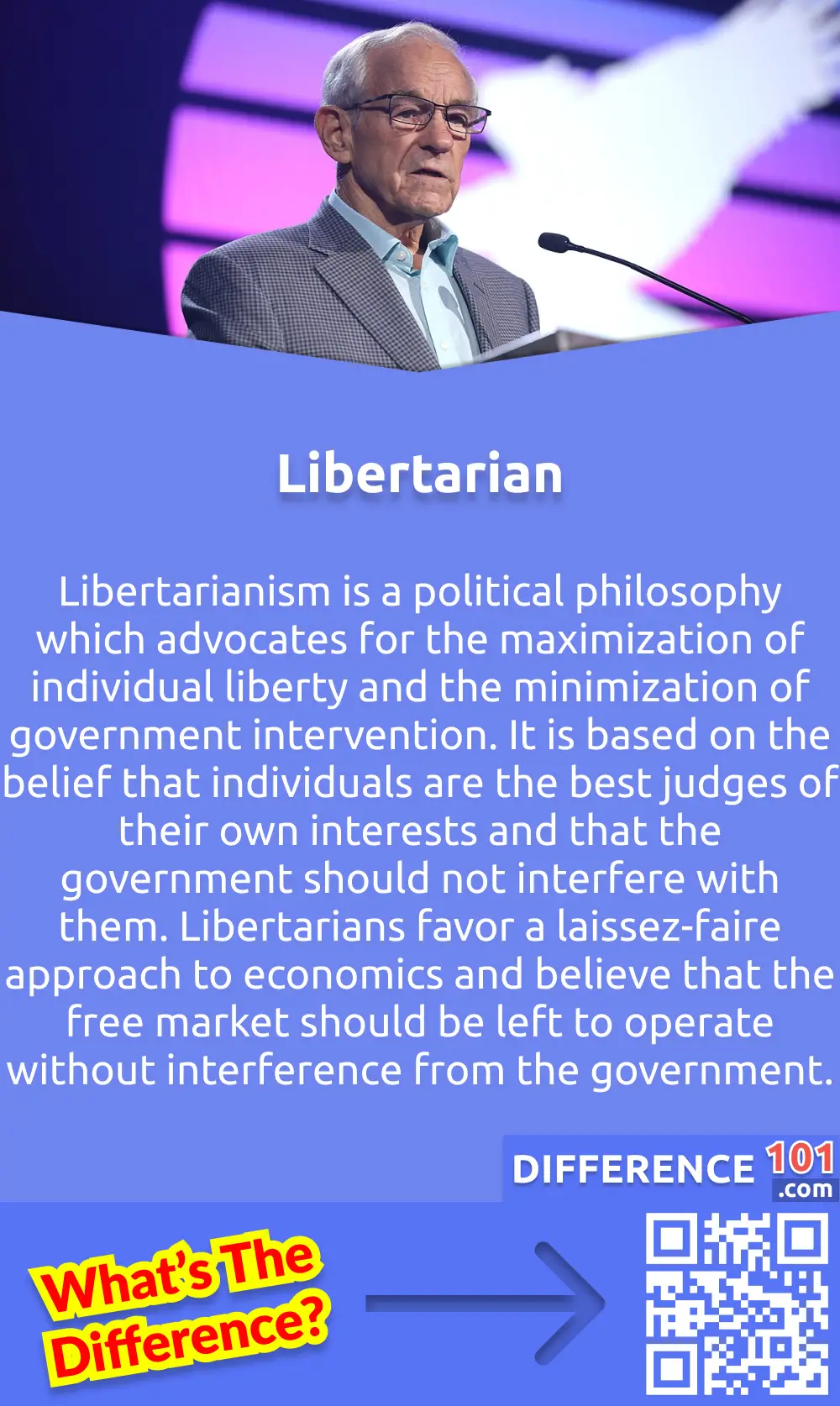
In this view, the state's only legitimate purpose is to protect negative rights. This means its functions should be strictly limited to:
- Police: To protect citizens from criminals within the country.
- Courts: To provide a forum for resolving disputes and administering justice.
- Military: To defend the nation from foreign aggressors.
Any government action beyond this sphere—such as managing the economy, providing welfare, regulating personal choices, or funding the arts—is seen as an illegitimate overreach that violates the rights of individuals. Milton Friedman summarizes this position concisely.
TAKE IT TO THE LIMITS: Milton Friedman on Libertarianism
Let's return to the Milton Friedman interview for his conclusion on the proper role of government.
Watch this very short clip from his summary where he lists what he sees as the "fundamental functions" of government.
This vision of a government strictly limited to protecting life, liberty, and property from force and fraud is the classical libertarian answer to the central question it poses.
Conclusion
In this lesson, we pinpointed the central question that defines libertarianism. It is not whether a government should exist, but what, if anything, justifies its existence and empowers it to act.
Here are the key takeaways:
- Libertarianism begins with a presumption of liberty: freedom is the default, and any limitation on it requires a powerful justification.
- The central question libertarianism asks is: By what moral authority does the state use force and coercion, and what are the proper limits of that authority?
- This leads to a deep skepticism of state power and a rigorous examination of its functions, comparing them against voluntary, market-based alternatives.
- The most common libertarian answer is the minimal state, a government limited to only the most essential functions of protecting negative rights: police, courts, and a national defense.
You now understand the fundamental starting point of all libertarian analysis. This critical lens, which questions the legitimacy of state action rather than assuming it, is the key that unlocks the entire philosophy.
Having established this foundational question, we are now ready to explore where these ideas came from. In our next module, we will travel back to the 17th-century Enlightenment to meet John Locke, the philosopher whose theories of natural rights and government by consent laid the intellectual groundwork for the entire libertarian tradition.